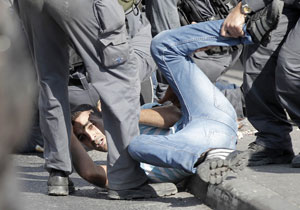
 JERUSALEM: Israeli security forces arrest a Palestinian during clashes between Palestinian protesters and Israeli police after authorities limited access for Muslim worshippers to the flashpoint al-Aqsa mosque compound Wednesday. — AFP
 JERUSALEM, Oct 15 (AFP): Palestinian protesters clashed with Israeli police in Jerusalem Wednesday after authorities limited access for Muslim worshippers to the flashpoint Al-Aqsa mosque compound, police said.
Four Palestinians were arrested and three police were injured in the confrontation, police spokeswoman Luba Samri said.
Police used stun grenades as a crowd of about 400 people gathered near the entrance to the mosque, according to an AFP photographer.
For the second time in a week, authorities restricted access to the esplanade on Wednesday, allowing only Palestinians aged over 50 to enter.
The violence was the latest in a series of face-offs between Palestinians and Israeli police in the old city of Jerusalem.
On Monday, demonstrators angered by Jews being granted access to the Al-Aqsa compound-Islam's third holiest site-clashed with security officers after morning prayers.
The site is the scene of frequent tensions and houses Islamic holy sites the Dome of the Rock and the Al-Aqsa mosque. It is revered by Jews as the location of the biblical Jewish temple, considered Judaism's holiest place.
Non-Muslim visits to the Al-Aqsa complex are permitted and regulated by police, but Jews are not allowed to pray at the site for fear it could trigger major disturbances.
Jews pray instead at the Western Wall below. Around 100 Israelis were given access on Wednesday to the square outside the mosque, accompanied by foreign tourists.
Knesset member Jamal Zahalka, from the Arab Balad party, told AFP he feared "tens of thousands" of Jewish pilgrims would be allowed inside the Al-Aqsa compound.
"This is no longer just a group of extremists, this is a demand made by the Israeli political class and even the (state) rabbinate," he told AFP.
© 2026 - All Rights with The Financial Express

