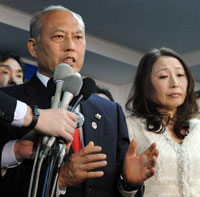
 JAPAN : Newly elected Tokyo Governor Yoichi Masuzoe (L) smiles beside his wife Masami at his campaign office in Tokyo Sunday.— AFP
 TOKYO, Feb 9 (AFP): The establishment candidate backed by pro-nuclear Prime Minister Shinzo Abe romped home in Sunday's election for governor of Tokyo against two anti-nuclear opponents.
The poll for chief executive of one of the world's biggest cities had been seen as a referendum on atomic power in the wake of the 2011 Fukushima disaster.
But livelihood issues appeared to play a bigger role in the election, which saw an emphatic victory by Yoichi Masuzoe-a former television personality and one-time cabinet minister.
Only around a third of eligible voters cast their ballots, media reported, down about 10 percentage points on the last election.
The city's 13 million inhabitants had been hit with the heaviest snowfall in nearly half a century on Saturday, and, despite a rapid thaw on polling day, many streets remained treacherous.
"I want to make Tokyo the number one city of the world, in areas including disaster prevention, welfare and the economy," Masuzoe told reporters as the scale of his victory became apparent.
"And above all, I will make the 2020 Olympic and Paralympic Games successful."
Koichi Nakano, professor of political science at Tokyo's Sophia University, said Masuzoe's win would provide a boost to Abe, and strengthen his hand on nuclear matters.
"The anti-nuclear agenda is a very difficult one to achieve," he said.
The vote had been triggered by the resignation of the previous governor, a policy wonk who admitted to political naivite after accepting an undeclared 50 million yen ($500,000) from a scandal-mired hospital magnate.
None of the major political parties had fielded a candidate, but all had swung behind one of the major players. Abe's conservative Liberal Democratic Party backed Masuzoe even though he left the party a few years ago.
Like Abe, he has said that Japan needs to switch its nuclear reactors back on. All of them are idled at present amid public nervousness in a country badly scarred by the disaster at Fukushima.
Opinion polls show a significant number of Japanese oppose nuclear power, but the two main anti-atomic candidates failed to gain enough traction to overturn Masuzoe's determined drive to talk about bread-and-butter issues like the economy and welfare.
Former prime minister Morihiro Hosokawa, 76, did not manage to connect with voters, despite having the high-profile backing of popular ex-premier Junichiro Koizumi.
Meanwhile: The heaviest snow in decades in Tokyo and other areas of Japan has left at least 11 dead and more than 1,200 injured across the country, reports said Sunday.
As much as 27 centimetres (10.6 inches) of snow was recorded in Tokyo by late Saturday, the heaviest fall in the capital for 45 years, according to meteorologists.
The storm hit Tokyo on the eve of its gubernatorial election.
Observers say the weather may affect voter turnout in the city of 13 million people. As of 6:00 pm (0900 GMT) turnout was down more than 10 percentage points from a previous poll during the last mayoral election.
As a depression moved along the Pacific coast Saturday, the northeastern city of Sendai saw 35 centimetres (13.8 inches) of snow, the heaviest in 78 years.
Local media said at least 11 people have been killed with one person also in critical condition in snow-linked accidents-mostly crashes after their cars skidded on icy roads.
In central Aichi prefecture, a 50-year-old man died after his car slipped on the icy road and rammed into an advertisement steel pole, a local rescuer said.
© 2026 - All Rights with The Financial Express

