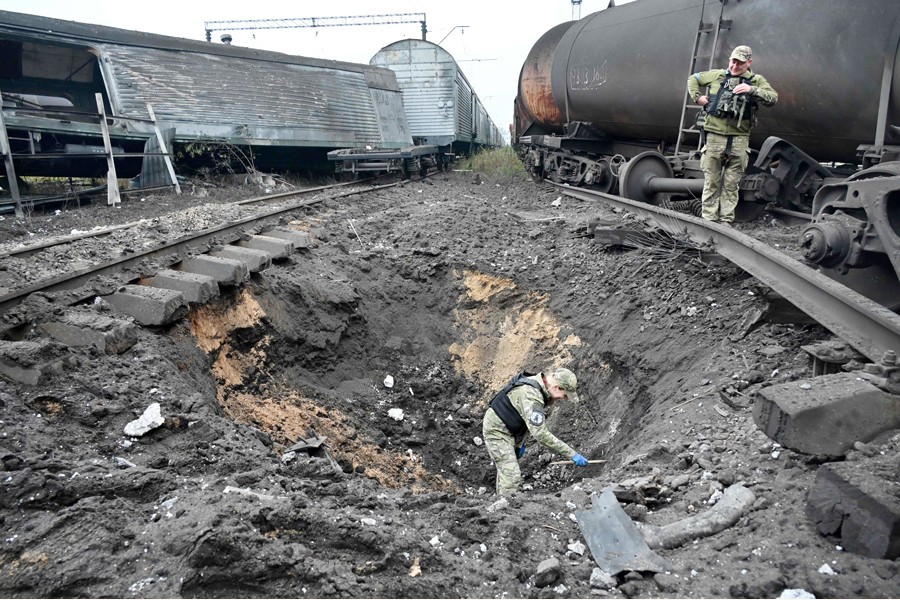
 A forensic explosives expert examines a crater from a missile explosion at a freight railway station in Kharkiv on Wednesday — AFP
 MOSCOW, Sept 21 (Reuters/AP): President Vladimir Putin on Wednesday ordered Russia's first mobilisation since World War Two, warning the West that if it continued what he called its "nuclear blackmail" that Moscow would respond with the might of all its vast arsenal.
"If the territorial integrity of our country is threatened, we will use all available means to protect our people - this is not a bluff," Putin said in a televised address to the nation, adding Russia had "lots of weapons to reply".
Russia's defence minister said the partial mobilisation will see 300,000 reserves called and up would apply to those with previous military experience.
Putin's partial mobilisation significantly escalates the conflict over Ukraine and comes as Russia battles a Ukrainian counter-offensive that has forced its troops to retreat and surrender some occupied territory.
Putin said the partial military mobilisation of its 2 million-strong military reserves was to defend Russia and its territories, claiming the West did not want peace in Ukraine.
Putin's speech was a worrying escalation and the threats he made in it must be taken seriously, British foreign office minister Gillian Keegan told Sky News.
"Clearly it's something that we should take very seriously because, you know, we're not in control - I'm not sure he's in control either, really. This is obviously an escalation," she said.
Russia's rouble fell and global oil prices surged after Putin's comments. The war has already caused a spike in fuel and food prices around the world.
Putin restated his aim was to "liberate" east Ukraine's Donbas industrial heartland region and that most people in the region did not want to return to what he called the "yoke" of Ukraine.
Russia already considers Luhansk and Donetsk, which together make up the Donbas region Moscow partially occupied in 2014, to be independent states. Ukraine and the West consider all parts of Ukraine held by Russian forces to be illegally occupied.
Russia now holds about 60% of Donetsk and had captured nearly all of Luhansk by July after slow advances during months of intense fighting.
Those gains are now under threat after Russian forces were driven from neighbouring Kharkiv province this month, losing control of their main supply lines for much of the Donetsk and Luhansk front lines.
Ahead of Putin's speech, in an apparently coordinated move on Tuesday, Moscow-installed leaders in occupied areas of four Ukrainian regions announced plans to hold referendums on joining Russia in coming days.
Russian war an affront
to UN charter: Biden
President Joe Biden is ready to make the case to world leaders at the U.N. General Assembly that Russia's "naked aggression" in Ukraine is an affront to the heart of what the international body stands for as he looks to rally allies to stand firm in backing the Ukrainian resistance.
Biden, during his time at the U.N. General Assembly, also planned to meet Wednesday with new British Prime Minister Liz Truss, announce a global food security initiative and press allies to meet an $18 billion target to replenish the Global Fund to Fight AIDS, tuberculosis and malaria.
But White House officials say the crux of the president's visit to the U.N. this year would be a full-throated condemnation of Russia as its brutal war nears the seven-month mark.
"He'll offer a firm rebuke of Russia's unjust war in Ukraine and make a call to the world to continue to stand against the naked aggression that we've seen these past several months," White House national security adviser Jake Sullivan said in previewing the president's address.
"He will underscore the importance of strengthening the United Nations and reaffirm core tenets of its charter at a time when a permanent member of the Security Council has struck at the very heart of the charter by challenging the principle of territorial integrity and sovereignty."
The address comes as Russian-controlled regions of eastern and southern Ukraine have announced plans to hold Kremllin-backed referendums in days ahead on becoming part of Russia and as Moscow is losing ground in the invasion.
Biden is confronting no shortage of difficult issues as leaders gather this year.
In addition to the Russian war in Ukraine, European fears that a recession could be just around the corner are heightened. Administration concerns grow by the day that time is running short to revive the Iran nuclear deal and over China's saber-rattling on Taiwan.
When he addressed last year's General Assembly, Biden focused on broad themes of global partnership, urging world leaders to act with haste against the coronavirus, climate change and human rights abuses. And he offered assurances that his presidency marked a return of American leadership to international institutions following Donald Trump's "America First" foreign policy.
© 2026 - All Rights with The Financial Express

