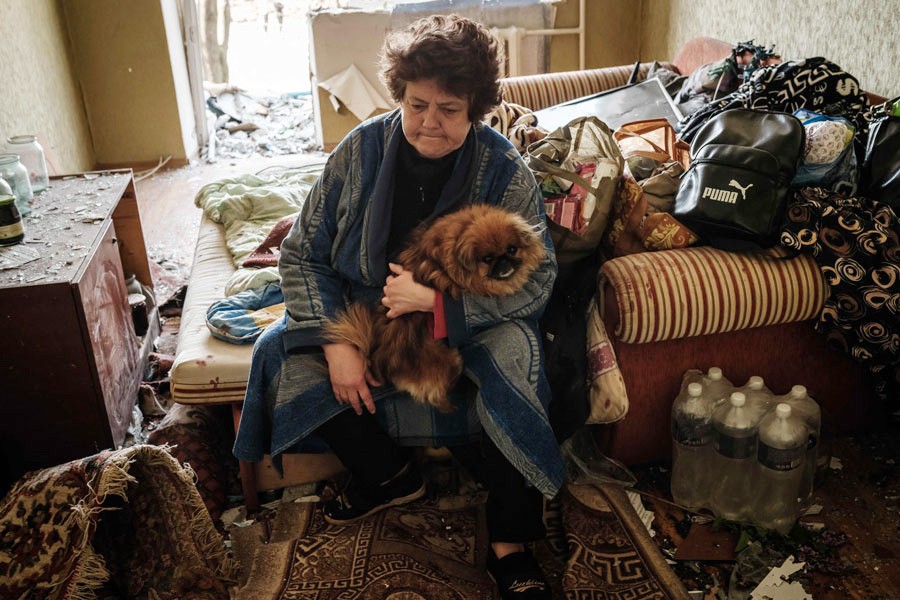
 A woman sits on her bed with her dog at an apartment damaged by a missile explosion in Kramatorsk on Thursday — AFP
 LVIV, May 05 (AP/AFP/ Reuters): Russian forces pounded targets across Ukraine, taking aim at supply lines for foreign weapons in the west and intensifying an offensive in the east, as the European Union moved Wednesday to further punish Moscow for the war with a proposed ban on oil imports.
The Russian military said Wednesday it used sea- and air-launched precision guided missiles to destroy electric power facilities at five railway stations across Ukraine, while artillery and aircraft also struck troop strongholds and fuel and ammunition depots.
The defense minister repeated that Russian forces have blocked off a steel mill in Mariupol from which scores of civilians were evacuated over the weekend. Another official denied they were storming the plant, as its defenders said a day earlier.
Ukrainian authorities, meanwhile, said attacks in the eastern Donbas region left 21 civilians dead.
The flurry of attacks over the past day comes as Russia prepares to celebrate Victory Day on May 9, marking the Soviet Union's defeat of Nazi Germany. This year the world is watching for whether Russian President Vladimir Putin will use the occasion to declare a limited victory - or expand what he calls a "special military operation" to a wider war.
A declaration of all-out war would allow Putin to introduce martial law and mobilize reservists to replace what Western officials say have been significant troop losses.
Kremlin spokesman Dmitry Peskov on Wednesday dismissed the speculation as "untrue" and "nonsense."
As areas across Ukraine came under renewed attack, Belarus, which Russia used as a staging ground for its invasion, announced military drills. The Defense Ministry in Minsk said the exercises that began Wednesday don't threaten any neighbors but a top Ukrainian official the country will be ready to act if Belarus joins the fighting.
While the Russian attacks were across a wide swath of Ukraine, some were concentrated in and around Lviv, the western city close to the Polish border that has been a gateway for NATO-supplied weapons.
US intel helped Ukraine
target Russian generals
Intelligence provided by the United States has helped the Ukrainian military target several Russian generals since Moscow's invasion, the New York Times reported Wednesday.
Citing multiple senior US officials, the newspaper said that of the approximately dozen Russian generals killed by Ukrainian forces, "many" had been targeted with the help of US intelligence.
The US National Security Council slammed the assertion that the United States was helping Ukraine kill Russian generals as "irresponsible."
"The United States provides battlefield intelligence to help the Ukrainians defend their country," NSC spokesperson Adrienne Watson told AFP in an email.
"We do not provide intelligence with the intent to kill Russian generals."
The heavy loss of high-ranking Russian military officers has stunned Western security officials, who last confirmed an official tally of seven generals in late March, though Ukraine has since announced more.
Ukraine war set to worsen
global hunger, says UN
Conflict, extreme weather and economic shocks increased the number of people facing a severe lack of food by a fifth to 193 million last year and the Ukraine war means the outlook will worsen without urgent action, a UN agency said on Tuesday.
The Global Network Against Food Crises, set up by the United Nations and the European Union, said in its annual report that the number of people facing acute food insecurity and requiring urgent, life-saving food assistance had nearly doubled in the six years since 2016 when it began tracking it.
"The outlook moving forward is not good. If more is not done to support rural communities, the scale of the devastation in terms of hunger and lost livelihoods will be appalling," the GNAFC report said.
Pope says he wants to
meet Putin in Moscow
Pope Francis said Tuesday he has requested a meeting in Moscow with Russian President Vladimir Putin over the Ukraine war but has heard nothing back.
The 85-year-old told Italy's Corriere Della Sera newspaper that he had sent a message to Putin around 20 days into the conflict saying "that I was willing to go to Moscow".
"We have not yet received a response and we are still insisting, though I fear that Putin cannot, and does not, want to have this meeting at this time," he said.
The pope has repeatedly called for peace in Ukraine and denounced a "cruel and senseless war" but without ever mentioning Putin or Moscow by name.
© 2026 - All Rights with The Financial Express

