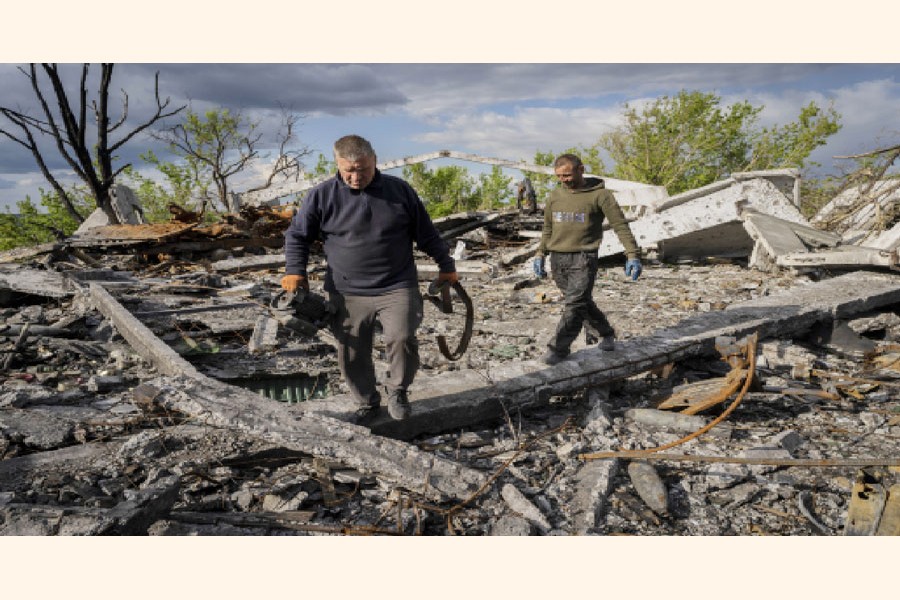
 Villagers walk past unexploded artillery shells as they collect scrap metal from a bombed warehouse in the village of Malaya Rohan, Kharkiv region on Wednesday — AP
 NEW YORK, May 19 (Reuters/AP): The United States does not have legal authority to seize Russian central bank assets frozen due to its invasion of Ukraine, Treasury Secretary Janet Yellen said on Wednesday, but talks with US partners over ways to make Russia foot the bill for Ukraine's post-war reconstruction are starting.
Yellen also said it is likely that the special license granted to allow Russia to make payments to its US bondholders would not be extended when it expires next week, leaving Russian officials a fast-narrowing window to avoid its first external debt default since the 1917 Russian revolution.
Central agenda item at this week's gathering of Group of Seven finance ministers, and Yellen is calling for increased financial support for the war-torn country, which the World Bank estimates is suffering $4 billion in weekly physical damage.
"I think it's very natural that given the enormous destruction in Ukraine, and huge rebuilding costs that they will face, that we will look to Russia to help pay at least a portion of the price that will be involved," Yellen told reporters here ahead of this week's meetings.
Some European officials have advocated that the EU, the United States and other allies seize some $300 billion in Russian central bank foreign currency assets frozen by sanctions. The assets are held abroad, but remain under Russian ownership.
"While we're beginning to look at this, it would not be legal now in the United States for the government to seize those" assets, Yellen said. "It's not something that is legally permissible in the United States."
US Treasury officials have also expressed concerns about setting precedents and eroding other countries' confidence in holding their central bank assets in the United States.
At the G7 meeting in the Bonn suburb of Koenigswinter, Yellen intends to focus on Ukraine's more immediate budget needs, estimated at $5 billion a month. On Tuesday she pressed US allies to step up their financial support, while a German government official said the ministers would pledge $15 billion of new budget aid.
Russia has some $40 billion of international bonds and has so far managed to keep current on its obligations and avoid default thanks to a temporary license from the Treasury granting an exception allowing banks to accept dollar-denominated payments from Russia's finance ministry despite crippling sanctions on Russia.
Battle for Mariupol draws
toward end after surrender
The battle that turned Mariupol into a worldwide symbol of defiance and suffering drew toward a close as Russia said nearly 1,000 last-ditch Ukrainian fighters who held out inside a pulverized steel plant had surrendered.
Meanwhile, the first captured Russian soldier to be put on trial by Ukraine on war-crimes charges pleaded guilty Wednesday to killing a civilian and could get life in prison. Finland and Sweden applied to join NATO, abandoning generations of neutrality for fear that Russian President Vladimir Putin will not stop with Ukraine.
The Ukrainian fighters who emerged from the ruined Azovstal steelworks after being ordered by their military to abandon the last stronghold of resistance in the now-flattened port city face an uncertain fate. Some were taken by the Russians to a former penal colony in territory controlled by Moscow-backed separatists.
While Ukraine said it hopes to get the soldiers back in a prisoner swap, Russia threatened to put some of them on trial for war crimes.
Amnesty International said the Red Cross should be given immediate access to the fighters. Denis Krivosheev, Amnesty's deputy director for the region, cited lawless executions allegedly carried out by Russian forces in Ukraine and said the Azovstal defenders "must not meet the same fate."
© 2026 - All Rights with The Financial Express

