 TAIWAN : Taiwan President Ma Ying-jeou cast his ballot at polling station in Taipei Saturday. — AFP
 TAIPEI, Nov 29 (agencies): Taiwan's premier resigned Saturday after the ruling Kuomintang (KMT) party suffered a landslide defeat at the island's biggest ever local elections.
Jiang Yi-huah announced that he had stepped down at a brief press conference, saying that he took "political responsibility" for the party's heavy losses-unofficial results showed the KMT had lost in five out of Taiwan's six municipalities.
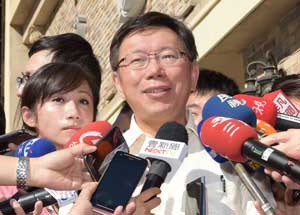
Meanwhile: An independent candidate backed by Taiwan's opposition, pro-independence party Saturday claimed victory in local elections as the next mayor of Taipei, breaking the ruling party's 16-year hold on the island's capital.
The win by Ko Wen-je, 55, a trauma surgeon, is a setback for the ruling Kuomintang (KMT) ahead of a presidential election in less than two years. Ko defeated KMT candidate Sean Lien, the son of a wealthy, politically-connected family.
The race for the mayor's job had been widely interpreted as a test of confidence in the China-friendly government of Taiwan President Ma Ying-Jeou.
"Professor Ko will deliver his acceptance speech," Liu Shi-chung, a media liaison for Ko's campaign, told Reuters. Ko will give his speech at 1130 GMT, Liu said.
Every Taiwan president has been a former mayor of Taipei after the island introduced direct presidential elections in 1996.
"We congratulate Mr Ko," Lien said in his concession speech. "I'm sorry I didn't win this election."
Taiwan citizens went to the polls to elect mayors and councillors for a record 11,130 seats across the island.
Another report adds: Taiwan's relations with historic foe China are playing a key role in local elections on the self-ruled island Saturday as the ruling Nationalist Party meets increased resistance to forging stronger ties with Beijing.
Voters on the island with a population of about 23 million will elect representatives to 11,130 local seats, including mayoral posts in major cities such as the capital, Taipei.
A poor showing for the Nationalists would make it easier for the rival Democratic Progressive Party to win the presidency in early 2016, an outcome expected to disrupt negotiations with China on trade and investment deals that have lifted Taiwan's half-trillion-dollar economy while raising Beijing's hopes for political reunification.
© 2026 - All Rights with The Financial Express

