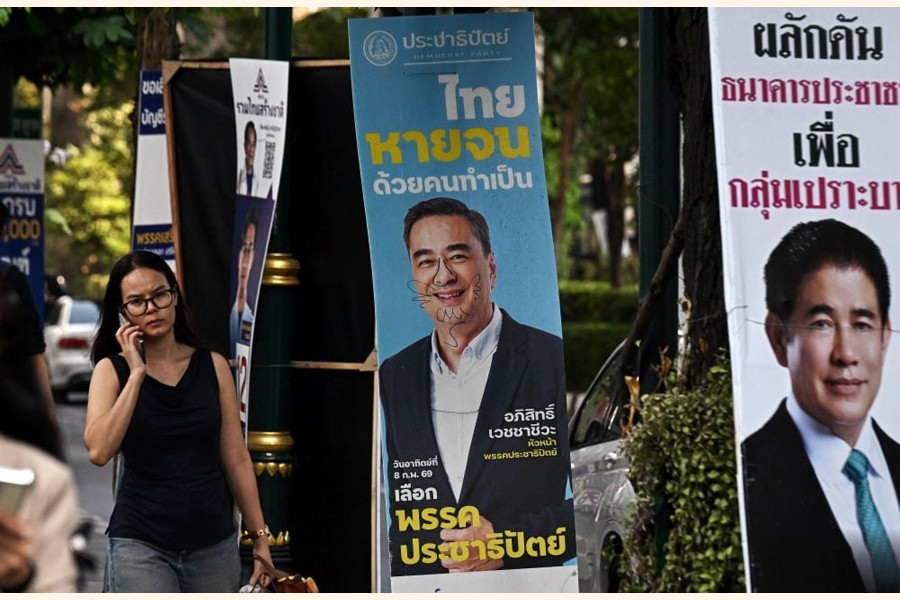
 BANGKOK: People walk past a defiled campaign poster of Democrat Party's prime ministerial candidate Abhisit Vejjajiva (centre) before the February 08 general election in Bangkok on Friday. — AFP
 BANGKOK, Feb 06 (AFP): Thais vote Sunday in an election pitting the popular reformists who won last time against the conservative who ended up as prime minister, with ex-leader Thaksin Shinawatra looming large from his prison cell.
The Southeast Asian nation's next government will need to reckon with a long-standing border dispute with Cambodia that twice erupted into deadly fighting last year, and the multibillion-dollar transnational cyberscam networks based in the region.
Economic growth is anaemic, with the tourism sector vital but arrivals yet to return to their pre-Covid highs, and fast-growing Vietnam is now attracting more foreign direct investment.
No party is expected to win an outright majority, and analysts say the election could be a repeat of the last poll less than three years ago.
Then, the previous version of the progressive People's Party recorded the largest vote share and the most parliament seats, but its candidate was blocked from the prime ministership and the party was later dissolved.
Instead Thaksin's Pheu Thai party, which came second, formed a coalition with the third-placed conservatives Bhumjaithai, only to have its prime minister removed by court order.
He was succeeded by Thaksin's daughter Paetongtarn Shinawatra, who was judicially ousted herself before parliament anointed her former coalition partner, Anutin Charnvirakul, in September-the country's third prime minister in two years.
"Thai elections have effectively become decoupled from government formation," political scientist Napon Jatusripitak said. "That's not necessarily a good thing for a country where democratic experience has been turbulent."
Thailand's political history is replete with military coups, bloody street protests and judicial bans on prime ministers and parties.
The most recent coup in 2014 was followed by five years of junta rule and a military-drafted constitution that gives institutions appointed by the senate-which is not directly elected-significant power.
© 2026 - All Rights with The Financial Express

