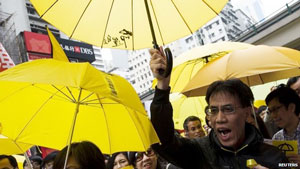
 A pro-democracy protester during the march to demand universal suffrage Sunday. — Reuters
 HONG KONG, Feb 1 (AFP): Thousands of pro-democracy activists have returned to the streets of Hong Kong for their first big rally since mass protests last year.
A large police presence was in force to deter demonstrators from taking over key areas of Hong Kong.
But protesters did not carry out a repeat of the occupations that shut down parts of the city.
Last year's Occupy demonstrations called for fully democratic elections for the territory's chief executive.
China has promised the semi-autonomous territory direct elections in 2017, but ruled that candidates had to be vetted by Beijing.
A sea of yellow umbrellas-the symbol of the campaign-moved slowly through central Hong Kong with crowds shouting for "true universal suffrage".
But numbers were well below expectations with 13,000 attending according to organisers-just over a quarter of the 50,000 they had hoped for.
"Today's protest wasn't a small one. It was smaller than we expected, but it's wrong to say Hong Kongers have given in to fake democracy," said organiser Daisy Chan.
Police said up to 8,800 people had joined the march, a fraction of the tens of thousands who gathered at the peak of the protests.
Authorities have made no concessions to activists' demands and tensions remain high in the semi-autonomous Chinese territory.
Police warned ahead of the rally that demonstrators were likely to once again try to occupy some of Hong Kong's main roads, which were cleared of tented camps in December.
But by late afternoon the march remained peaceful, with no sign that the crowds-including many people carrying yellow balloons-planned to take back the streets.
Chanting "No fake universal suffrage. I want genuine universal suffrage," the demonstrators on Sunday held yellow umbrellas, the symbol of the earlier protests.
The demonstrators oppose the Chinese government's decision that candidates in the 2017 election for Hong Kong chief executive will be vetted by a largely Beijing-controlled nominating committee.
The final election plan must be approved by a two-thirds majority in Hong Kong's Legislative Council before submitting to authorities in Beijing. But pro-democracy legislators, who hold 40 percent of the seats, have said they would veto the screening proposal.
© 2026 - All Rights with The Financial Express

