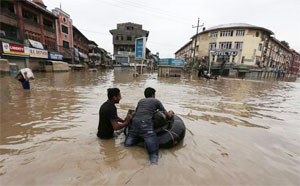
 Kashmiri youths use a tyre tube to cross a flooded street in Srinagar. — Reuters
 SRINAGAR, Sept 13 (agencies): Residents of revolt-torn Indian Kashmir turned their wrath on state administrators for failing to provide them with succour after the worst flooding in over a century, angrily dumping food parcels into gutters.
A week into the disaster, large parts of Srinagar, the capital of Jammu and Kashmir, lay under water with many people still trapped atop their homes, and others crowded in relief camps.
Their misery has added to problems of the administration in a Muslim-majority region where a revolt against Indian rule has simmered for nearly a quarter century.
Many complain that the government, which has maintained a heavy presence in the territory to keep a lid on the revolt, has left them to their fate.
Residents stranded for days by the floodwaters said that the army has selectively evacuated tourists and people according to a pre-set priority list, leaving locals to be rescued later by volunteers.
Rescuers struggled to reach more than 200,000 people still stranded Saturday in Indian Kashmir as deadly floodwaters receded, revealing horrific devastation in the Himalayan region including neighbouring Pakistan, officials said.
A smell of death hung in the air as animal carcasses lay in the roads of Indian Kashmir's normally scenic main city of Srinagar, a top tourist draw, that one top official said had been "drowned completely" by the worst floods in over a century.
"This in not a flood, this is a tsunami," Mehraj-Ud-Din Shah, Indian Kashmir State Disaster Response Force chief, told AFP by phone from Srinagar on Saturday.
"There's a stench everywhere as animals have died and their bodies are floating around," fuelling concern about the spread of water-borne disease, Shah said.
The floods and landslides from days of heavy monsoon rains have now claimed at least 480 lives in Pakistan and India.
But officials on both sides of the border said it was still too early to assess fully the extent of the disaster with many roads still impassable.
"There's no milk for children and they're crying day and night. The authorities supply us with rice but children need bread and milk," one survivor, Fizza Mai, 45, at a Pakistani relief camp, told AFP.
In both countries, security forces were using boats and helicopters to deliver food supplies and evacuate survivors. People waved from rooftops and upper-storey windows to attract attention.
In Indian Kashmir, there was anger over slow rescue efforts. Some rescuers had been attacked, although now such incidents had diminished, Indian Kashmir State disaster chief Shah said.
"My men have been beaten up, our boats have been attacked with stones. If people are depressed they can do anything. They blame the government for not doing anything," he said.
"We try to calm them down by saying 'We will help you, we will help your family, come with us'," he said.
In flood-hit areas in Pakistan, some people waded through knee-deep water to escape with many carrying children and household belongings on their backs while others led livestock.
Two dykes on a flooded river were blown up to save the historic southern Pakistani city of Multan, home to two milion and nerve centre of the country's textile industry, from the muddy, swirling floodwaters that have caused widespread crop damage.
Some 280 people have died from the heavy rains and flooding in the Punjab, Kashmir and Gilgit Baltistan regions, Ahmed Kamal, a spokesman for the National Disaster Management Authority (NDMA), told AFP, while over 214,000 people had been evacuated.
Pakistan, which has suffered a series of annual flood diasters, says as many as 2.29 million people have been affected.
In Indian Kashmir, as waters subsided, emergency officials were able to get to more afflicted areas.
"More than 200,000 people are still stranded," Shantmanu, Jammu region divisional commissioner, who uses one name, told AFP.
But rescue teams are now able to increasingly get "inside houses and get out those still trapped inside and account for dead bodies," he said.
In some areas, TV footage showed entire villages wiped out, their houses smashed by floodwaters that swept away their occupants. Strewn on the ground were household items like saucepans and cups and soggy clothing.
The government estimates at least 200 people died and 142,000 people have been rescued in the restive region Kashmir where militants have been fighting Indian rule since the late 1980s.
State chief minister Omar Abdullah promised houses would be rebuilt before "the immense cold" of winter strikes.
"There's no question of people living in tents in winter," he said in Srinagar.
Some 137 relief camps were operating in the Kashmir valley alone assisting over 100,000 people, officials said.
But "with only 65 days before snow is forecast in the (Kashmir) valley, the race against time has already begun for the rehabilitation process," warned Bipul Borah, a senior Oxfam charity official.
Abdullah said "clean-drinking water" was a problem and disinfectants like chlorine were being used to avert water-borne diseases.
© 2026 - All Rights with The Financial Express

