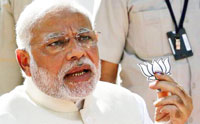
 Narendra Modi
 NEW DELHI, May 13 (agencies): President Barack Obama faces the prospect this week of having to offer his congratulations to a new Indian leader who was barred from the United States less than 10 years ago over massacres of Muslims in 2002.
US President pledged to work closely with the new Indian government as Hindu nationalist Narendra Modi was forecast Tuesday to have pulled off a crushing victory in the world's biggest election.
"Modi at Delhi Gate" said a headline in the Mail Today, while the Hindustan Times read simply "Exit Polls: Enter Modi" after a flurry of surveys released after voting ended Monday pointed to a decisive result.
All the polls showed Modi's right-wing opposition alliance trounced the left-leaning Congress party which has been in power for a decade, and most indicated that it had scraped enough votes to form a new coalition without having to seek fresh partners.
A Modi victory would be a blow for campaigners who have long maintained he is an autocratic Hindu supremacist responsible for an outbreak of religious riots in his home state of Gujarat in 2002 in which more than 1,000 people, mostly Muslims, died.
Modi was shunned by Western nations for years after the bloodshed in Gujarat, where he has been chief minister since 2001. He was denied a U.S. visa in 2005 under the terms of a 1998 US law which bars entry to foreigners who have committed "particularly severe violations of religious freedom."
Modi's rise on the national stage, however, and the importance of relations with India, which the United States sees as a key counterbalance to China in Asia, have forced a rethink.
Ambassadors of the European Union and the United States have met Modi to patch up relations.
Modi has denied any wrongdoing in 2002 and, in 2010, India's Supreme Court ruled that he had no case to answer.
The U.S. State Department has repeatedly declined to spell out whether it will issue a visa to Modi as prime minister, but analysts say it is all but certain he will be given one because of the "strategic" nature of the U.S.-India relationship, which Obama has called "one of the defining partnerships of the 21st century."
On Monday the State Department described the Indian elections, which were spread over five weeks, as "an inspiring example of the power of the democratic process in action" and stressed their peaceful nature - in spite of the killing of 41 Muslims in the state of Assam.
"We view our relationship with India as one that's vitally important for economic, strategic reasons," spokeswoman Jen Psaki said. "We look forward to working with the leaders chosen by the Indian people to advance this important partnership and to set an ambitious agenda."
Members of the US Congress campaigned against a visa for Modi in 2005 under the International Religious Freedom Act, but the strength of the anti-Modi lobby has since dwindled.
In March, a report to the U.S. Congress by a specialist in US immigration policy, Ruth Wasem, noted the 2010 Indian Supreme Court ruling and said that if Modi were to become prime minister he would be covered by diplomatic immunity and qualify for a visa. Wasem, a researcher for the Congressional Research Service, said Obama has authority under the US immigration act to deny entry to anyone who has committed "crimes against humanity or other serious human violations of human rights, or who attempted or conspired to do so."
Since no case has been proven against Modi, however, this is unlikely. One congressional aide said Modi could visit as early as September for the UN General Assembly in New York.
Ashley Tellis, a South Asia expert at the Carnegie Endowment for International Peace, said that if Modi were elected, Secretary of State John Kerry should visit India as soon as possible and Modi should be invited to the United States.
"I think the Obama administration will reach out to him if he is elected as prime minister as it would the leader of any other friendly state," Tellis said.
© 2026 - All Rights with The Financial Express

