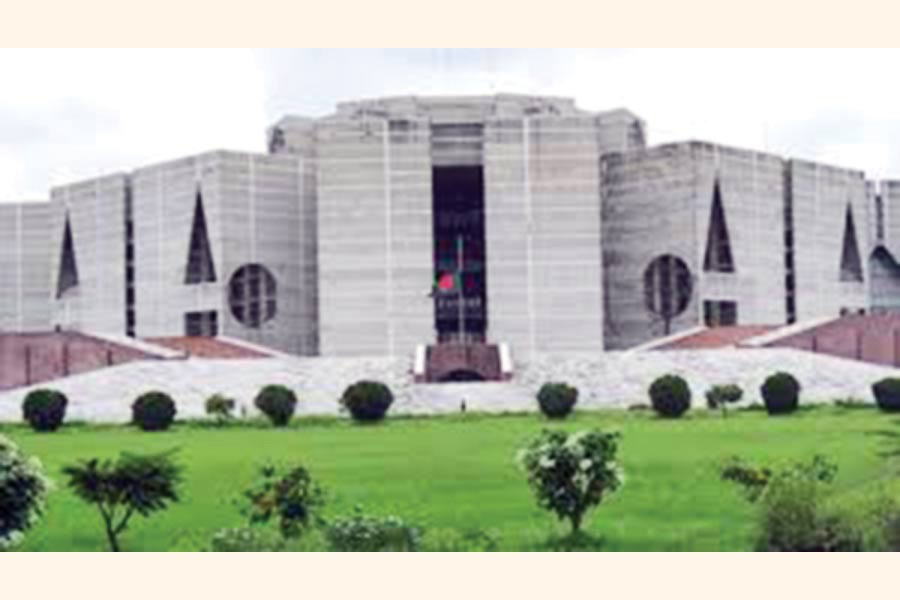
The House wasted Tk 1.64 billion for quorum crisis of 194 hours and 30 minutes during 23 sessions of 10th parliament, according to a Transparency International Bangladesh (TIB) report.
The report titled 'Parliament Watch: 10th Parliament' published on Wednesday said each working session was three hours and 26 minutes on an average and 28 minutes of quorum crisis daily.
Parliament members spent a very little portion of the total time in lawmaking.
Only 12 per cent of the total 1410.9 minutes time was spent for lawmaking, according to the report.
But they spent 16 per cent of general discussion period in non-parliamentary and indecent speeches, it said.
Globally, the time for lawmaking is higher than that of Bangladesh parliament.
In 2017-18, the House of Commons of the UK spent 48 per cent time for lawmaking while it was 32 per cent in Loksabha in India between 2014 and 2019.
The tenth parliament began its journey from January 2014 and continued till October 2018.
In tenth parliament, the TIB report said, a total of 193 bills were passed, including 51 amendments.
About 71 per cent of the laws were passed within one to 30 minutes which TIB finds as alarming.
In India, 16th Lok Sabha took 141 minutes time to pass a bill.
TIB presented the findings at a press briefing at its office in Dhaka city.
TIB executive director Iftekharuzzaman said 10th parliament could not meet people's expectations.
People could not be benefited from its fundamental role of accountability as the main opposition could not play its due role in last parliament.
The actual loss of parliament due to quorum crisis is far higher considering the time of the members and overall cost, he said.
Mr Zaman said the issue of law making was undermined in many ways.
There were 59 per cent businesses in 10th parliament which was only 17.5 per cent in first parliament.
The percentage of lawyers was 31 per cent in first parliament which reduced to 13 per cent in 10th parliament, he said.
"It's bad news that 71 per cent laws were passed within 30 minutes. It indicates whether parliament members at all read the laws and gave their opinions."
Responding to queries, Mr Zaman said 10th parliament could not be compared with previous parliaments as the fundamental parliamentary characteristics like accountability was not ensured.
Even the speaker could not play her due role, he added.
Only 45 per cent of the recommendations of the parliamentary standing committees were implemented, the report said.
TIB also found a conflict of interests among members in finance ministry, commerce ministry, industries ministry, post and telecommunication ministry, roads and bridges ministry, fisheries and livestock ministry, housing ministry and textile and jute ministry committees.
Although each of the total 50 standing committees was supposed to hold minimum one meeting totalling 3,000, only 48 committees held 1,566 meetings in 10th parliament.
About 105 books of 45 committees were published but those were not available for people, the report cited.
The activities of the parliamentary committees were also not open to the public, it mentioned.
Although rule is there to present international treaties for discussion through the President, it was not practised in 10th parliament.
msshova@gmail.com
© 2026 - All Rights with The Financial Express

