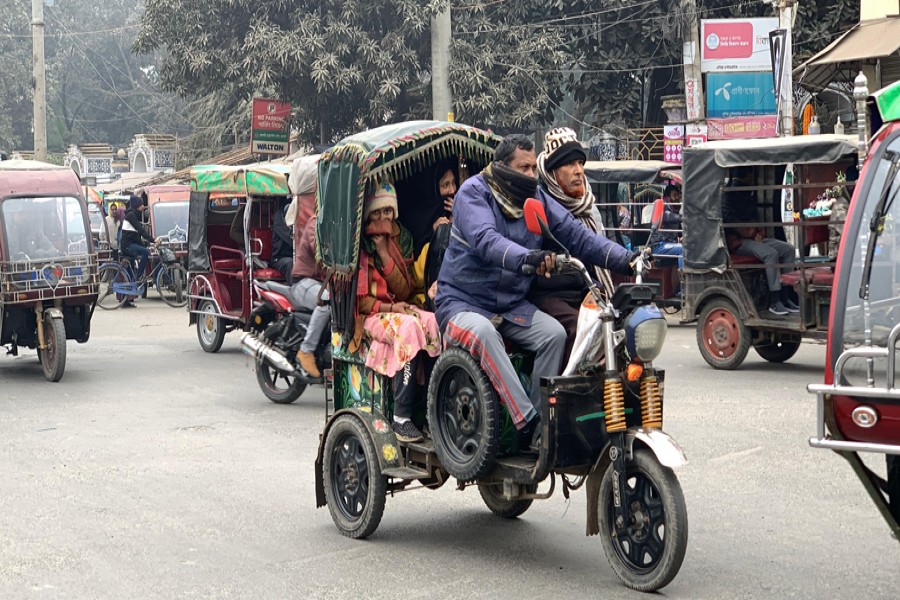
 Auto-rickshaw drivers, passengers seen on the road bundled in layers of warm clothing at Rajshahi city on Tuesday. — FE Photo
 RAJSHAHI, Jan 06: Day labourers and homeless people have been suffering the most as Rajshahi reeled under an intense cold spell with the temperature dropping to seven degrees Celsius on Tuesday morning.
The biting cold has caused widespread hardship, particularly for low- and middle-income groups. Despite the harsh weather, day labourers, construction workers, rickshaw-van pullers and auto-rickshaw drivers are compelled to head out early in the morning in search of work, risking their health to earn a living.
The situation is distressing for the city's homeless population. With little or no access to warm clothing, many are seen burning straw, firewood or discarded materials on the sidewalks, bus terminals and railway stations to keep warm. At night, they huddle together in groups, sharing body heat in an effort to survive the biting cold-yet the chill remains relentless.
Abdur Rahim Ali, a day labourer, said the cold has made it almost impossible to work. "Even if there is work, the body doesn't respond. Hands and feet go numb," he said, adding that winter means uncertainty for people like him-uncertainty over whether work will be available at all.
Saiful Islam, another labourer who travels daily from Charghat Upazila to Binodpur area of the city in search of work, echoed similar concerns. "I wear two or three layers of warm clothes, but still the cold pierces through. If I don't work, how will my family survive?" he asked.
Auto-rickshaw driver Sayem Ali said passenger numbers have dropped significantly due to the cold. "People are avoiding going out. Income has fallen, but driving in this freezing weather is extremely painful," he said.
Meanwhile, the sudden fall in temperature has triggered a moderate cold wave, severely disrupting normal life in the northwestern district.
Wrapped in a thick blanket of fog, Rajshahi has remained largely deprived of sunshine for several consecutive days. From early morning until noon, the cold shows little sign of easing, while icy winds and dense fog continue to paralyse daily activities. Visibility has dropped sharply, leaving the view from the roads hazy and life unusually sluggish.
According to the Rajshahi Meteorological Observatory, the minimum temperature was recorded at seven degrees Celcius at around 6:00 am on Tuesday, marking a fall of three degrees Celsius within just 24 hours. It was the lowest temperature the country recorded this winter. Meteorologists said the sudden dip has intensified the cold wave conditions across the region.
Children and elderly people have been among those bearing the brunt of the cold most severely.
A visit to different parts of the city revealed a starkly different Rajshahi compared to what it is in other seasons. Streets appeared unusually quiet, with fewer pedestrians than usual. Those who ventured out, did so hurriedly, bundled in layers of warm clothing, yet visibly shivering. Thick fog blurred vision, making even short-distance of travel uncomfortable and risky.
The cold wave has not only affected humans but also animals and birds. Early morning scenes show fewer cattle grazing in open fields, while birds cluster tightly on tree branches to protect themselves from the cold. Nature itself seems locked in a silent struggle against the winter chill.
Farmers, too, are worried. With sunshine absent for days, agricultural activities are being affected. Dense fog and excessive dew are raising concerns over potential damage to winter crops, including boro rice and seasonal vegetables. Farmers fear that prolonged foggy conditions may hamper normal crop growth.
Weather officials said humidity levels reached nearly 100 per cent, intensifying fog formation and reducing visibility to as low as 600 metres.
Rahidul Islam, acting officer of the Rajshahi Meteorological Department, said the moderate cold wave is the result of a sudden temperature drop and may persist for several more days. "There is no immediate indication of a significant rise in temperature," he added. Road transport has also been affected, with vehicles forced to use headlights even during daytime due to poor visibility. Drivers are moving at reduced speeds to avoid accidents, causing traffic congestion on key city roads during the morning hours.
Meanwhile, the district administration has initiated relief efforts to assist cold-stricken people. Rajshahi District Relief and Rehabilitation Officer Abdul Hai Sarkar said the district requires around 55,000 blankets.
"So far, we have received about 32,500 blankets. Procurement of additional blankets worth Tk 3.2 million is currently underway," he said.
anaetru@gmail.com
© 2026 - All Rights with The Financial Express