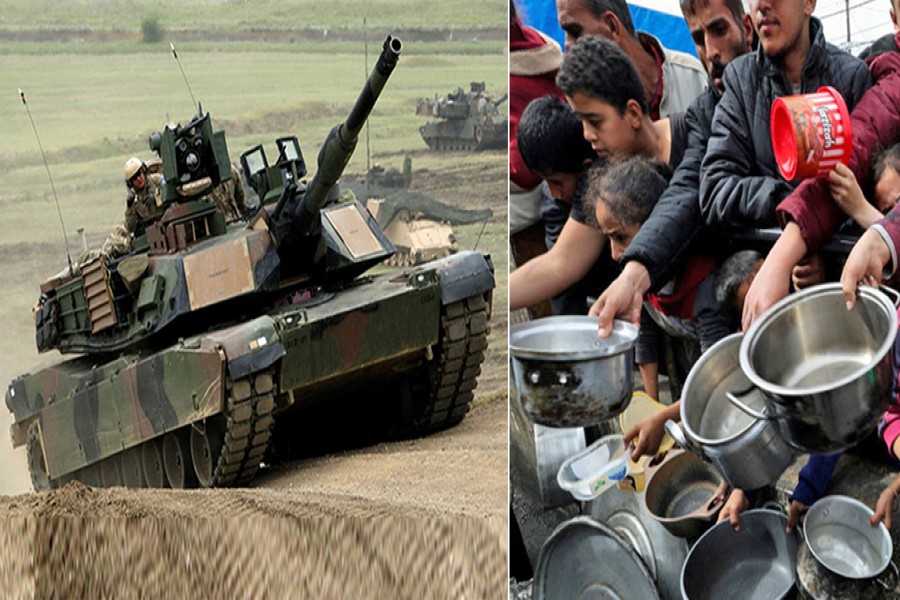
Record levels of global food insecurity in 2026, as projected by the World Food Programme (WFP) and an unprecedented high military expenditure sum up the current state of human civilisation. Expenditure on arms in 2024 was $2.7 trillion whereas there was a need for $300 billion then to eliminate world hunger, claimed UN Secretary-General Antonio Guterres. That record high military spending rose to $2.9 trillion in 2025, so has the global hunger during the period with roughly 266-295 million people across nearly 50 countries experiencing extreme food insecurity. For the first time, famines were reported from two separate hotspots in a single year this century. More importantly, Gaza and Sudan facing famines are both war zones. The year 2026 may be worse yet for global food security.
Clearly, Gaza has been a tinder box for long and it is followed by Sudan, Ukraine and now Iran or by extension more areas of the Middle East. Taiwan also has all the making of the next tinder box. So there is a direct link between and among armed conflicts, military expenditures and aid for the hungry, displaced people and refugees. Compared with the $2.9 trillion military spending, which is likely to rise in 2026, $300 billion is a moderate amount. Lately, geo-politics has gone through a sea-change with US president Donald Trump following a hawkish trade policy in the form of reciprocal tariff and imposition of an unfair war in collaboration with Israel on Iran. His 'America first' economic and commercial impetus has caused a rift in the military alliance, North Atlantic Treaty Organisation (NATO).
Apart from such policy shifts, America under Trump has withdrawn from 66 international organisations and treaties including the Paris Climate Agreement, effective January 27, 2026, the UN Framework Convention on Climate Change (UNFCCC) and Intergovernmental Panel on Climate Change (IPCC). It has also cut back the size of its humanitarian assistance for the refugees. The US was the largest donor in many of these initiatives and it still is with its 22 per cent share in the UN operational budget. A tight-fisted US has also encouraged its European alliance to follow suit. European NATO members have rather concentrated on raising their military capability. The rift between the US and European partners of the NATO widened when some members flatly refused to join the war against Iran.
Instead of humanitarian generosity, the war bogey has been the main driver of enhancing military capability. No wonder, military spending rose by 14 per cent in Europe with Germany increasing the defence budget by 24 per cent and Spain by 50 per cent. At the same time, their aid has shrunk drastically. So long the Western colonial powers were repaying under an unwritten obligation for the wealth they looted from their colonies in Asia, Africa and Latin America. If the leaders of the past generations initiated the aid and assistance for the people of the former colonies out of a feeling of compunction, the current generation of leadership suffers from no such guilty conscience. Also, their economies are no longer as robust as those were. So, they felt no qualms about slashing aid and assistance.
Of course, President Trump initiated the process. Now it has become the global trend. But the famines in Gaza and Sudan are also the creation of Western powers. Only 77 years ago the British withdrew from Palestine and a new state was carved out of the land for the Jews following the holocaust in Germany. It received UN recognition immediately but the truncated Palestine is yet to be recognised as a sovereign country. Backed by the US and its allies, Israel-Palestine conflict lingers on with the devastation of Palestine. Sudan and Syria are also the victims of vicious Western politics. So the hunger is primarily man-made, more than on account of unfavourable weather, for which innocent people have to pay for generations.
The leaders of the so-called free world should be ashamed of their aggression and conspiratorial role in creating social unrest, civil wars and crisis of food in lands far beyond in order to install a lackey in power, who would dance to their tunes. Trump has gone several steps ahead by abducting the president of a sovereign country and attacking another country rendering the UN role nothing more than one of a helpless onlooker. When democratic principles and values are so trampled, the international political and economic orders that have so long held intergovernmental relations together, maintaining some sort of equanimity, become a casualty. This is precisely what has happened since the launching of Trump's biased 'America first' doctrine.
Now the shockwaves unleashed by the Israel-US war on Iran have put at risk the economies on distant shores like that of Bangladesh. Energy crisis facing smaller nations has impacted industrial output and agriculture across wide swathes of the planet. Bangladesh has also become one of these victims. Unsurprisingly, this country has also found its place among the top 10 nations facing high levels of acute food insecurity. About 16 million people here faced severe food crisis in 2025, placing the country in a serious 'red-risk' category, according to the 2026 Global Report on Food Crises.
So the military showdown and perceived defence threat are at the root of current survival problems in the world. The leaderships of the developed world are mainly responsible for the crises. Foods are wasted in some parts while a lack of affordability and supply of foods deprive millions from the required intakes. There is no point raising the spectre of a Third World War at a time when the world is awaiting breakthroughs in artificial intelligence (AI). Food produced, despite crop failures in some regions due to climate change, in the world can feed more people than the total population in the world. If defence spending could be curtailed drastically and funds could be diverted or saved for feeding the hungry, the world would not come to such a pass. The option is between more spending on arms or on foods. If military confrontations were made a thing of the past in favour of peace and socio-political stability, food insecurity could as well be sent to the museum.
nilratanhalder2000@yahoo.com
© 2026 - All Rights with The Financial Express