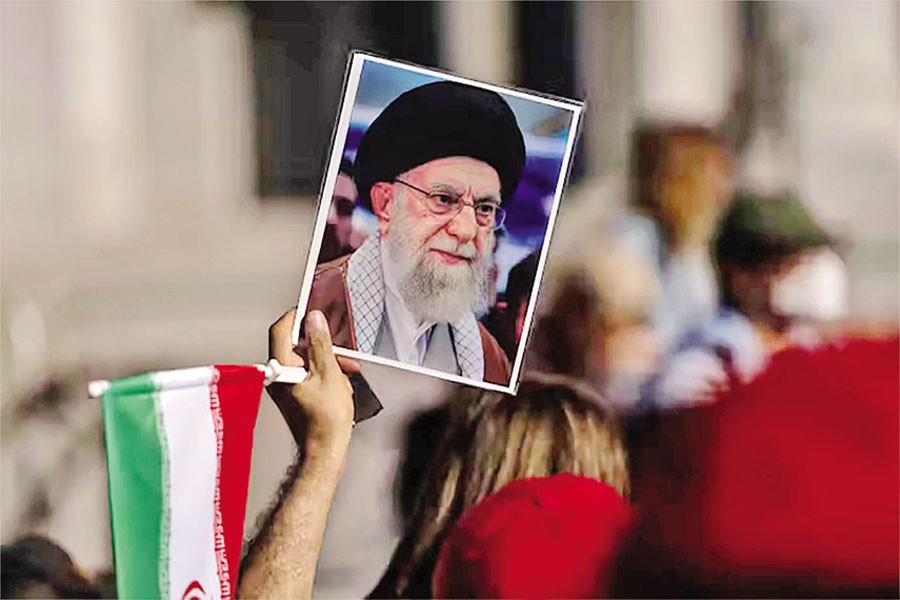
When American bombs fall in the Middle East, the world tends to interpret them through a familiar lens: nuclear brinkmanship, regional security, Israel's anxieties, Tehran's defiance. Yet geopolitics rarely unfolds in straight lines. In an era defined not by regional rivalries but by great-power competition, it is worth asking a harder question: is the attack on Iran truly about Iran - or is it, in part, about China?
The United States and China are now locked in what many analysts describe as a systemic rivalry. Trade wars, semiconductor controls, naval manoeuvres in the South China Sea, diplomatic competition across Africa and Latin America - the contest is global, structural and long-term. Washington sees Beijing as its primary challenger on the world stage. Any major geopolitical move must therefore be read against that background.
Energy sits at the heart of this rivalry.
China's meteoric economic rise has been powered by imported oil. Despite investments in renewables and domestic coal, the Chinese economy remains heavily dependent on crude imports to sustain industrial output, transportation networks and urban growth. Unlike the United States, which has leveraged shale production to transform itself into a leading energy producer, China relies overwhelmingly on external supply lines.
Two countries have played a particularly important role in that supply chain: Iran and Venezuela.
For years, Beijing has quietly purchased vast quantities of Iranian crude, often at discounted prices and frequently through opaque shipping arrangements designed to evade sanctions. Estimates suggest that the overwhelming majority of Iran's oil exports ultimately end up in Chinese refineries. This has not merely been a commercial relationship; it has been a strategic lifeline for Tehran and an economic cushion for Beijing.
Venezuela once represented another pillar of China's energy diversification strategy. But Washington's long campaign of sanctions, diplomatic isolation and pressure on Caracas fundamentally reshaped that landscape. A change in government - driven in significant part by sustained US intervention - altered Venezuela's geopolitical alignment and constrained the previous volume and flexibility of oil flows to China. What Beijing once counted as a reliable alternative has become far less predictable.
That leaves the Gulf.
At the centre of this equation lies the Strait of Hormuz, the narrow maritime artery through which roughly a fifth of global oil consumption passes each day. It is not simply a shipping route; it is the world's most critical energy chokepoint. Any serious disruption sends tremors through global markets. Insurance premiums spike. Freight costs surge. Inflationary pressures ripple outward.
If Iran were to close Hormuz - even partially - the consequences would be profound. Oil prices would climb sharply. Global supply chains would tighten. Energy-dependent economies would strain.
China, more than most major powers, would feel the pressure.
This is where the strategic logic begins to widen. An escalation that pressures Iran's ability to export oil - whether through direct military strikes, maritime insecurity, or intensified sanctions enforcement - indirectly squeezes China's energy security. Washington does not need to declare such an intention explicitly. Structural realities do the work.
Some argue that the current confrontation is about nuclear deterrence or regional proxy wars. Those factors matter. But they do not exhaust the explanation. In a world increasingly shaped by US-China rivalry, actions that weaken Beijing's supply resilience cannot be seen as incidental.
There is also the question of regime change - a phrase that has haunted American foreign policy for decades.
Donald Trump, often dismissed by critics as impulsive, has nevertheless shown a keen instinct for leverage politics. He understands - as do most seasoned strategists - that the architecture of the Iranian state makes traditional regime change a complicated proposition. The Islamic Revolutionary Guard Corps (IRGC) is not simply a military unit. It is an economic powerhouse, a political arbiter and a parallel state structure embedded deeply within Iran's governing system. Remove a president or even a supreme leader, and the institutional core remains intact.
Trump likely knows that decapitating leadership does not automatically transform Iranian policy. But weakening the state's coercive capacity, degrading its naval infrastructure, or fracturing its command hierarchy can limit its strategic reach - particularly its ability to threaten shipping routes or project power through proxies.
Yet there is another, even more consequential possibility.
If, at the end of sustained pressure, Washington were able to shape or support the emergence of a loyal, pro-Western regime in Tehran, the implications would extend far beyond internal Iranian politics. Iran possesses the world's fourth-largest proven oil reserves. Its export capacity, currently constrained by sanctions, could be rapidly expanded under a government reintegrated into Western financial systems.
Such a shift would not merely restore Iranian oil to global markets. It would place the direction and conditions of those exports under the influence - if not outright alignment - of Washington.
For China, that would be deeply unsettling.
At present, Beijing benefits from discounted Iranian crude, often purchased outside the dollar-denominated financial architecture dominated by the United States. A compliant Iranian government, eager to rebuild ties with Western economies, would have strong incentives to recalibrate its export patterns. Oil could flow preferentially to US allies. Contracts could be renegotiated. Pricing structures could shift. Sanctions relief might come with implicit geopolitical strings attached.
In that scenario, Washington would gain not only strategic breathing room in the Gulf but also leverage over a significant source of China's imported energy. It would not need to "close" the Strait of Hormuz to pressure Beijing; it could shape the flows that move through it.
For a country as energy-hungry as China, that would represent a structural vulnerability.
Of course, none of this guarantees that the United States can engineer such an outcome. Iran is not a blank slate. Nationalism runs deep. External intervention often produces backlash rather than compliance. The experience of Iraq stands as a cautionary tale.
But geopolitics is often about shaping probabilities rather than certainties.
China, for its part, has responded cautiously. It has called for restraint and de-escalation, mindful that an open confrontation in the Gulf threatens its own economic stability. Beijing does not want to be drawn directly into a military contest far from its shores. Nor does it want to see a critical energy supplier destabilised or politically transformed in ways that limit its access.
The dilemma for China is stark: it depends heavily on oil routes that the United States Navy ultimately has the power to secure - or disrupt. Its economic engine relies on flows that move through waters dominated by American alliances and military reach.
This is the quiet asymmetry at the heart of the rivalry.
So is the attack on Iran aimed at China?
Not exclusively. Regional dynamics, Israeli security concerns and long-standing hostilities with Tehran all play undeniable roles. But to treat the confrontation as purely local would be to ignore the defining geopolitical fact of our era: the United States sees China as its principal competitor, and every major strategic decision is filtered through that lens.
An Iran weakened, constrained or politically re-oriented is not just a Middle Eastern outcome. It is a variable in the balance of power between Washington and Beijing.
In the end, wars in one region often send their most consequential signals elsewhere. If this conflict reshapes energy flows, alters control over the Strait of Hormuz, or reconfigures Iran's political alignment, the effects will be felt far beyond the Gulf.
They will be felt in Beijing.
And that possibility - more than the missiles or the rhetoric - may explain why this confrontation carries the unmistakable shadow of a much larger contest.
mirmostafiz@yahoo.com
© 2026 - All Rights with The Financial Express