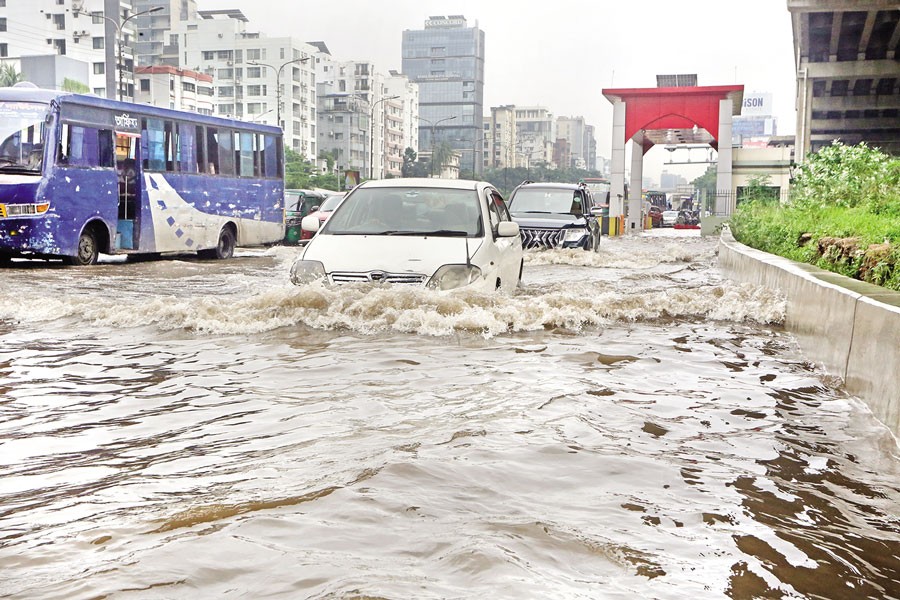
Every monsoon, Dhaka undergoes the same crisis. Roads disappear beneath murky water, vehicles stall in flooded streets, businesses shut their doors, schools suspend classes and millions of commuters spend hours stranded. The disruption has become so routine that many residents have come to regard it as an unavoidable feature of life in Bangladesh's capital. Yet there is nothing inevitable about a city grinding to a halt after a moderate to heavy rainfall.
The continuous downpour last week once again exposed the fragility of Dhaka's drainage system. Several parts of the city were submerged, disrupting transport and economic activity. Once again, citizens found themselves asking the same question they have asked for years: after spending hundreds of millions of taka annually on drainage and flood mitigation, why does the city continue to drown?
The two Dhaka city corporations reportedly spend crores of Taka every year in the name of addressing waterlogging. Yet inadequate waste management, poor maintenance and weak institutional accountability ensure that much of this expenditure fails to produce lasting results. Public money is spent, projects are announced and promises are repeated, but the experience of ordinary residents changes little.
This is not simply a story of unusually heavy rainfall. Climate change is undoubtedly making extreme weather events more frequent and intense, but attributing Dhaka's waterlogging solely to rainfall ignores the deeper structural failures that have accumulated over decades. Poor urban planning, encroachment on canals and wetlands, uncontrolled construction, inadequate drainage capacity, blocked drains and the absence of routine maintenance have together created a city that struggles to absorb even moderate rain.
One of Dhaka's greatest institutional weaknesses is fragmentation. Unlike every other city corporation in Bangladesh, where responsibility for drainage rests largely with the local authority, Dhaka's water management is divided among multiple agencies, including the two city corporations, Dhaka Water Supply and Sewerage Authority (WASA), the Bangladesh Water Development Board and several other government bodies.
This fragmented governance structure has become a textbook example of institutional dysfunction. Roads are excavated by one agency, pipelines installed by another and drainage systems built by a third. Too often, one project undermines another because agencies fail to coordinate planning or implementation. The result is duplicated expenditure, delayed work and infrastructure that functions far below its intended capacity.
No single institution ultimately accepts responsibility when flooding occurs. Instead, blame is passed from one agency to another while residents continue to suffer.
The consequences extend well beyond temporary inconvenience. Waterlogging carries significant economic costs. Traffic congestion worsens fuel consumption and productivity losses. Businesses lose customers, supply chains are disrupted and emergency services face delays. Floodwater often mixes with sewage, creating serious public health risks and increasing the spread of waterborne diseases.
The burden falls disproportionately on low-income residents. Informal settlements, often located in low-lying areas with poor drainage, experience prolonged flooding that damages homes and possessions while exposing families to contaminated water. For daily wage earners, every flooded day represents lost income that cannot easily be recovered.
Yet the financial cost of recurring waterlogging remains largely absent from public debate. Government agencies regularly announce budgets for drainage improvement but rarely publish comprehensive assessments measuring whether completed projects have achieved their intended objectives.
This reflects a broader weakness in public administration: success is often measured by project announcements rather than project outcomes.
Infrastructure should not be judged by how much money is allocated or how many contracts are awarded. It should be evaluated by whether citizens experience measurable improvements in their daily lives.
That requires independent post-project evaluation-something largely missing from Dhaka's urban management.
Every major drainage project should be subject to transparent performance audits. Authorities should disclose how funds were spent, whether projects met engineering standards, whether completion deadlines were respected and whether flooding has actually declined in targeted areas.
Such transparency would strengthen public trust while helping policymakers identify recurring design flaws.
Maintenance deserves equal attention.
Many drains already exist but remain clogged with plastic waste, construction debris and household garbage. In some areas drainage channels no longer connect effectively with nearby canals. Elsewhere, construction projects have obstructed natural water flows without providing adequate alternatives.
These are not engineering mysteries; they are governance failures.
Routine cleaning and maintenance rarely receive the same political attention as new infrastructure projects because they produce fewer ribbon-cutting ceremonies. Yet maintenance often delivers greater value than expensive new construction.
Bangladesh's new BNP-led government has rightly placed renewed emphasis on canal excavation and restoration. Reviving Dhaka's historic canal network could significantly improve stormwater management if implemented alongside broader urban planning reforms. However, excavation alone will not solve the problem.
Canals must remain free from illegal occupation. Wetlands that naturally retain stormwater require stronger legal protection. Future urban development must respect hydrological realities rather than treating waterways as obstacles to construction.
International experience offers valuable lessons.
Cities such as Singapore, Tokyo and Rotterdam also face heavy rainfall, yet comprehensive drainage planning, advanced stormwater management, regular maintenance and strong institutional coordination have dramatically reduced urban flooding.
No city can eliminate flood risk entirely, particularly under changing climatic conditions. But effective governance can substantially reduce both the frequency and severity of disruption.
Dhaka does not necessarily need more ambitious promises; it needs more competent execution.
Technology can also contribute. Real-time monitoring of drainage systems, digital mapping of flood-prone zones, predictive rainfall modelling and integrated emergency response platforms can improve preparedness. Equally important is enforcing regulations against illegal dumping of waste into drains and canals, supported by public awareness campaigns that encourage responsible waste disposal.
Still, technology cannot compensate for weak governance.
The central issue remains accountability.
Citizens deserve clear answers regarding how previous allocations have been used. Which drainage projects succeeded? Which failed? Why were they unsuccessful? Were contractors held accountable for poor workmanship? Did implementing agencies conduct independent evaluations? Were lessons incorporated into subsequent projects?
Without transparent answers, public confidence will continue to erode.
As Bangladesh continues its rapid urbanisation, Dhaka's resilience will increasingly determine the country's economic competitiveness. A capital city that repeatedly becomes paralysed by ordinary rainfall sends troubling signals to investors, businesses and development partners.
Urban infrastructure is not merely an engineering concern; it is an economic necessity.
The government therefore has an opportunity to move beyond reactive crisis management toward long-term resilience. This requires establishing a unified metropolitan drainage authority or, at minimum, creating a legally empowered coordination mechanism that clearly assigns responsibilities among agencies. Overlapping jurisdictions must give way to integrated planning, shared data systems and common performance targets.
Equally important is cultivating a culture of accountability where institutions are evaluated not by expenditures but by outcomes.
Citizens are not demanding miracles. They recognise that no densely populated megacity can become completely flood-free overnight. What they reasonably expect is that moderate rainfall should not bring one of South Asia's largest cities to a standstill.
That expectation is neither unrealistic nor unattainable.
Dhaka has reached a point where another cycle of expensive projects without measurable results is no longer acceptable. Before allocating additional funds, authorities should undertake independent reviews of existing drainage investments, identify systemic weaknesses and publish the findings for public scrutiny.
Only through comprehensive planning, transparent governance, rigorous maintenance and institutional accountability can the capital finally begin to break its annual cycle of flooding.
The people of Dhaka have waited long enough. What they now need is not another promise, but proof that every public penny spent in the name of solving water-logging genuinely contributes to a city that remains functional when the rains inevitably arrive.
mirmostafiz@yahoo.com
© 2026 - All Rights with The Financial Express