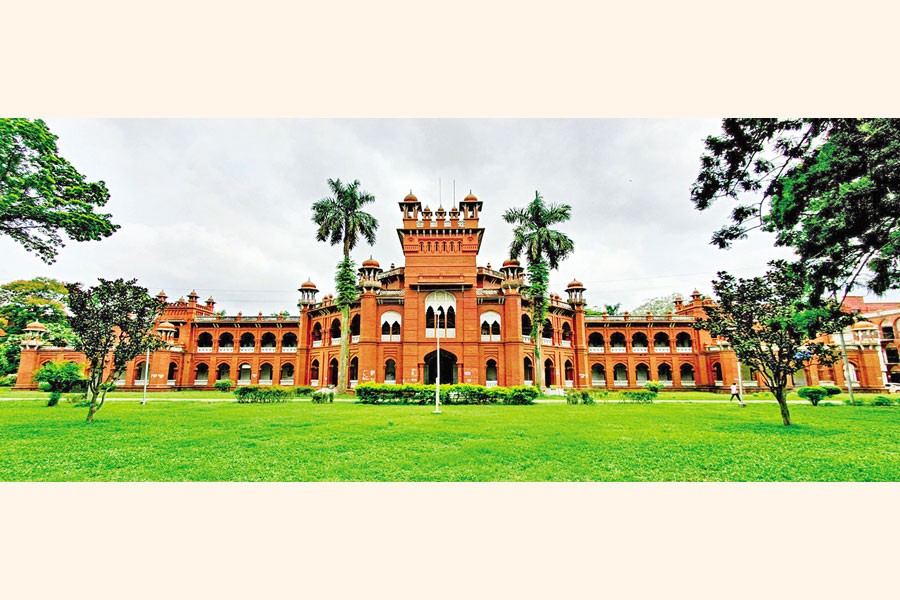
 A partial view of Dhaka University campus — collected from university website
 The role of Dhaka University often becomes a matter of critical discussion. Educationists, leaders and ordinary people often express their frustration. In this article, we want to seriously review the roles of, and realities about University of Dhaka. Established in 1921 under the Dacca University Act, it wasn't just some college. It became a crucible for national identity. The Language Movement in '52, the big uprising in '69, the Liberation War in '71, protests against authoritarian rule during the Ershad era, the democratic actions in the '90s, and the recent anti-fascist uprising in 2024 -- the university led them all. This background helps explain why critiques can get tangled up in national pride.
But a country can't rely on its founding memories forever. The university needs to focus on slowly transforming society, generation after generation.
When it comes to global standing, things aren't too sunny. According to the QS World University Rankings for 2026, Dhaka University ranks 584th globally and 132nd in Asia. Though this is the best showing for any Bangladeshi university, it's still pretty low-key compared to top universities around the world. EduRank's assessment that year shows roughly 21,932 academic papers and 325,073 citations. Those numbers might seem okay on their own, but next to leading institutions where research drives everything, it's on the smaller side.
Dhaka University's main issue isn't a lack of smart people; it's more about their environment. Public cash spent on higher education in Bangladesh is barely 0.3 per cent of GDP (gross domestic product), way less than the UNESCO suggestion of 6.0 per cent. A 2019 survey covering 25 public and private universities found that combined annual research expenditure amounted to only BDT 1.53 billion, roughly 1.0 per cent of total expenditure. Modern labs, research chances, and star teachers are all missing, which makes the brain drain worse.
Still, it wouldn't be fair to say the university's issues are only about funding. There's also the wild student politicking. A September 2024 survey by the Dhaka University Research Society of 2,237 students showed that 87.3 per cent felt general stress because of group politics, and 84.7 per cent pointed at the notorious guest room culture. In such conditions, being smart sometimes takes a backseat to pleasing party bosses. This environment systematically discourages independent intellectual activity and replaces the pursuit of knowledge with the pursuit of political patronage.
Faculty recruitment has increasingly become shaped by political loyalty rather than scholarly achievement. A university cannot possibly hope to be a world leading research institution unless faculty promotions and employment are based on academic criteria only.
Bangladesh's educational philosophy, inherited from colonial examination structures and never fundamentally reformed, produces systems that replicate existing knowledge but struggle to create new knowledge. This challenge runs through the entire educational culture, shaping the motivations of students, teachers, administrators and parents alike.
BCS (Bangladesh Civil Service) is given more importance than university research by both families and students. The civil service promises stability, status, and visibility. Researchers, by contrast, face low salaries, uncertain futures, and remain largely invisible despite contributing to international scholarship.
The weak relationship between academia and industry makes things worse. In other leading research systems, knowledge flows through collaboration and technology transfer. Bangladesh continues to face low funding, underdeveloped partnerships, and ineffective bureaucracy, pushing qualified graduates to migrate abroad.The consequences are visible. In the ready-made garment industry, 24 per cent of top leadership positions are held by foreign nationals despite a large pool of university-educated Bangladeshis. The Asian Development Bank estimates brain drain costs Bangladesh 0.5 per cent of GDP annually.
Moving forward requires sustained state investment. Raising education spending to 4.0 per cent of GDP would radically change the resources available to public universities. Faculty hiring must be based on research output and peer evaluation rather than political connections. International collaborations, joint PhD programmes, and visiting professor arrangements can help raise academic standards and expose Bangladeshi scholars to global practices.
Student politics must be reformed rather than eliminated. The tradition of student activism is a legitimate expression of democracy. Re-establishing democratic student union elections and removing formal linkages between student organisations and national party patronage systems is the right place to start. At the most basic level, Bangladesh needs to redefine success. Research must become a financially viable career with competitive salaries, reliable infrastructure, and social recognition. The ambition to understand the world and contribute new knowledge should be celebrated just as much as topping a competitive examination or landing a government post.
Eventually, the issue facing Dhaka University is indicative of a society that has not yet defined itself as a knowledge-based economy. The university's historical role isn't enough for Bangladesh's future. It must build knowledge now.
imifan563@gmail.com
© 2026 - All Rights with The Financial Express