Bangladesh Bank (BB) Governor Dr Ahsan H Mansur on Monday said commercial banks would have little choice but to actively seek borrowers as surplus liquidity continues to build up in the banking system, driven by strong deposit growth and relatively lower government borrowing.
With deposits expanding faster than public-sector credit absorption, banks are expected to redirect excess funds towards private-sector lending, a shift that could support investment and economic activity in the coming months, the governor observed.
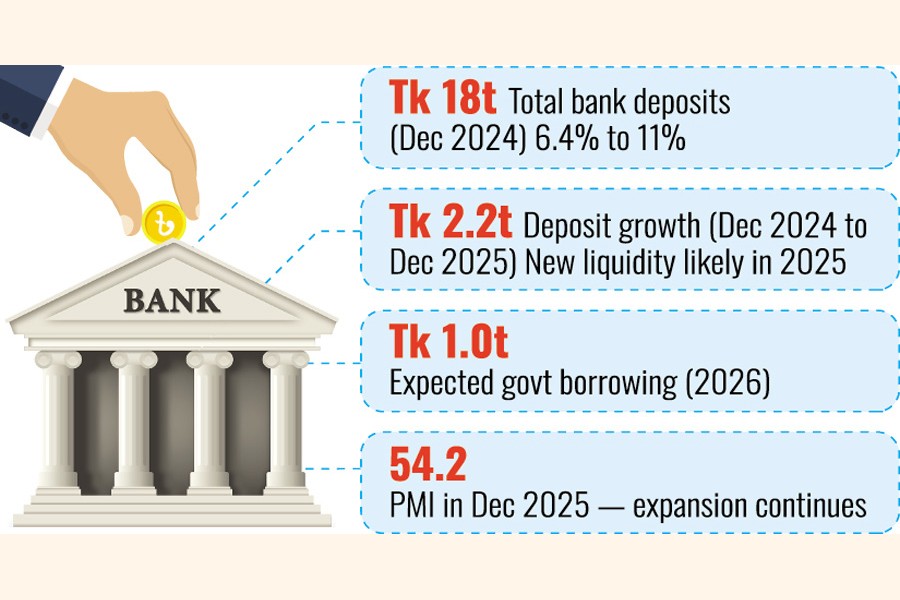
Sharing the latest liquidity situation, he said deposit growth stood at 6.40 per cent in December 2024, when the total deposit base amounted to Tk 18 trillion.
This implies that additional liquidity of around Tk 1.20 trillion was injected into the money market in 2024.
However, government borrowing during the year exceeded Tk 1.20 trillion, absorbing a large part of that liquidity.
The BB governor noted that deposit growth is likely to reach around 11 per cent by the end of December last year, translating into an estimated Tk 2.20 trillion of additional liquidity entering the market.
In contrast, government borrowing this year is expected to be slightly over Tk 1.0 trillion.
"As a result, banks will have enough liquidity to invest in the private sector. I think banks will now start actively looking for borrowers," he said.
Dr Mansur made the remarks while speaking as the chief guest at a seminar titled "Systematic Efforts to Understand Economic Pulse: Importance of Purchasing Managers' Index (PMI).
He said the central bank has extended policy support to all stakeholders seeking regulatory interventions to overcome various anti-business constraints.
The BB governor also said the central bank is moving towards liberalisation of the foreign exchange market.
"We want to see our corporate flags all over the world. That is why we continue to build our foreign exchange reserves," he added.
The seminar was jointly organised by the Metropolitan Chamber of Commerce and Industry, Dhaka (MCCI), and Policy Exchange Bangladesh (PEB) at the MCCI office in Gulshan, Dhaka.
James Goldman, Deputy High Commissioner and Development Director of the British High Commission to Bangladesh, attended the event as the special guest.
MCCI President Kamran T Rahman said the PMI is globally recognised as a key forward-looking economic indicator, providing accurate and timely insights into the overall health of the economy and capturing early trends.
"We need to unlock the full potential of the PMI," he said.
Chairman of Policy Exchange Bangladesh Dr Masrur Reaz said Bangladesh suffers from a persistent shortage of timely and frequent official data, which limits rigorous economic analysis and evidence-based policymaking.
He said the PMI, a monthly dataset released regularly for nearly two years on a fixed date, helps identify turning points in the business cycle and closely track key economic variables.
According to the PMI methodology, a reading above 50 indicates economic expansion, below 50 signals contraction, while a reading close to 50 suggests no significant change.
By the end of December 2025, the country's PMI rose by 0.2 points from November to 54.20, indicating a slightly faster pace of economic expansion.
President of the International Chamber of Commerce (ICC), Bangladesh, Mahbubur Rahman, Chairman of the Policy Research Initiative (PRI) Dr Zaidi Sattar, and Bangladesh Bank Deputy Governors Nurun Nahar and Dr Md Habibur Rahman, among others, were present at the seminar.
jubairfe1980@gmail.com
© 2026 - All Rights with The Financial Express