FE REPORT
Bangladesh's vast deep-sea ecosystem holding potential caches of resources faces mounting pressure from overfishing, aggressive industrial practices and plastic pollution, shows a multinational survey.
With the new findings presented to the country's chief executive Tuesday, a conclusion was drawn that another territory lies, equivalent to the size of Bangladesh, undersea unexplored.
The alarm and beacon are carried in the report submitted by the high-level committee on the findings of a comprehensive marine fisheries and ecosystem survey conducted by the research vessel R.V. Dr Fridtjof Nansen. The report was placed before the head of interim government, Prof Muhammad Yunus, at a meeting held at the state guesthouse Jamuna.
The month-long survey, carried out between 21 August and 21 September last year, involved 25 scientists from eight countries, including 13 host Bangladesh's researchers.
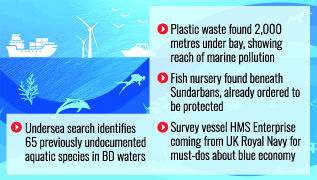
Presenting the findings, Prof Sayedur Rahman Chowdhury of Chittagong University's Institute of Marine Sciences said the study identified 65 previously undocumented aquatic species in Bangladesh's waters.
But the discoveries were overshadowed by troubling trends. "The excessive proliferation of jellyfish in deep waters is a clear sign of ecological imbalance," Chowdhury said, attributing the phenomenon to overfishing.
Researchers also detected plastic waste at depths of up to 2,000 metres, underlining the reach of marine pollution.
A comparison with a 2018 study shows a sharp decline in large-fish species in deep waters, while fish stocks in shallow coastal areas are falling at an "alarming" rate. Officials note that between 270 and 280 large trawlers currently operate in deep-sea fishing, with around 70 using sonar-based targeted fishing - a highly aggressive method.
While such practices increase profits for deep-sea operators, they are devastating for small-scale fishers who depend on shallow waters. "If targeted sonar fishing continues unchecked, the Bay of Bengal could be stripped of fish," warns fisheries adviser Farida Akhter, adding that the government would soon take a decision on regulating sonar fishing.
The survey also highlights significant tuna potential in Bangladesh's deep-sea waters and identifies a critical fish nursery beneath the Sundarbans mangrove forest which authorities have already ordered to be protected.
Addressing the meeting, chief adviser Prof Muhammad Yunus stressed that Bangladesh failed to fully understand or utilise its vast maritime resources.
"Our maritime area is comparable in size to our landmass, yet we lack even basic data on what resources it holds," he said. "To unlock this potential, we need sustained research and strong policy support."
Officials also revealed that a multi-role hydrographic and oceanographic survey vessel, HMS Enterprise, is in the process of being transferred from the UK's Royal Navy to the Bangladesh Navy, which is expected to strengthen the country's marine-research capacity.
The head of the post-uprising government, Prof Yunus, urges coordinated research with littoral countries such as Japan, Indonesia and the Maldives. "We must identify the problems scientifically and work with experts. Only then can new economic horizons emerge from the sea."
mirmostafiz@yahoo.com
© 2026 - All Rights with The Financial Express