Bangladesh's merchandise-export earnings remained under pressure in February 2026, extending a prolonged period of decline amid weakening global demand and mounting external headwinds.
The latest data show that the country's external-trade sector has yet to regain momentum, with readymade garment (RMG) shipments, the mainstay of exports, continuing to contract.
While several smaller sectors posted modest growth, exporters warn that geopolitical tensions, US tariff measures and intensifying competition from regional rivals are compounding the challenges facing the country's export engine.
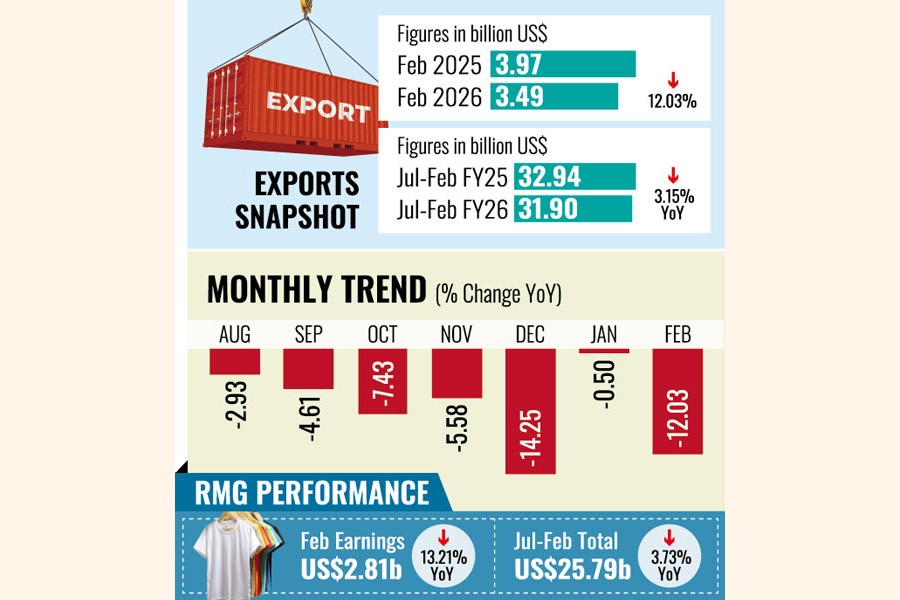
The single-month merchandise export earnings in February 2026 registered a 12.03 per cent year-on-year negative growth for the seventh consecutive month compared to the same month in 2025.
In February 2026, Bangladesh earned US$3.49 billion, down from US$3.97 billion in February 2025, according to data released on Monday by the Export Promotion Bureau (EPB).
Meanwhile, overall export earnings during the first eight months of the current fiscal year also remained on a negative growth trajectory as shipments of the main export earner to major destinations declined.
Bangladesh earned US$31.90 billion during the July-February period of fiscal year 2025-26, reflecting a 3.15 per cent year-on-year negative growth against US$32.94 billion in the corresponding period of the previous fiscal year.
Exports slipped into year-on-year negative territory in August 2025, when the country recorded a 2.93 per cent fall.
The decline was followed by further contractions of 4.61 per cent in September, 7.43 per cent in October, 5.58 per cent in November, 14.25 per cent in December and 0.50 per cent in January.
Of the total February earnings, RMG brought in US$2.81 billion, marking a 13.21 per cent year-on-year decline compared to the same month in 2025, EPB data showed.
As usual, RMG maintained its dominant position, contributing US$25.79 billion, despite a 3.73 per cent negative growth, to total export earnings during the first eight months of the current fiscal year.
Within the clothing segment, knitwear exports fell by 4.56 per cent to US$13.68 billion, while woven garment exports declined by 2.79 per cent to US$12.10 billion.
Sources said that while the relatively strong performance in July reflected some resilience, the slowdown since August underscores mounting challenges for Bangladesh's export sector amid fluctuating global demand and shifting market dynamics.
Exporters attributed the negative export growth to weakening global demand, the imposition of reciprocal tariffs by the United States, and China's increased focus on markets where Bangladesh is competitive.
They also pointed to intense global competition, rising production costs, and ongoing geopolitical and trade uncertainties as significant external pressures weighing on export performance.
The EPB, however, attributed the overall decline, including that of the RMG sector, to temporary factors such as port disruptions, the national election and subdued demand in key markets.
Several key sectors, including leather and leather goods, jute and jute goods, home textiles, light engineering and frozen fish, registered positive year-on-year growth, reflecting gradual diversification of the country's export basket, it added.
Talking to The Financial Express, Mohammad Hatem, president of the Bangladesh Knitwear Manufacturers and Exporters Association (BKMEA), attributed the declining trend to buyers holding back work orders during the election period, a general slowdown in orders due to sluggish global demand, and trade tensions stemming from US tariff measures.
He said that while the Russia-Ukraine war has yet to end, the world is witnessing fresh tensions between Iran and the United States, which could further dampen global demand.
The BKMEA leader apprehended a further deterioration in export performance in the coming months up to June, adding that the continued negative trend in export earnings reflects the harsh reality faced by the industry.
He urged the government to release cash incentive payments in a timely manner ahead of Eid and to provide soft loans to exporters who are not entitled to cash incentives so that they can pay workers' wages and festival allowances before the holiday.
Exporters said buyers typically hold back work orders two to three months before a national election and monitor the situation for at least a month afterwards.
They added that US tariff measures have altered overall market dynamics, leading to weaker sales in that market and fewer new orders.
Moreover, China and India, in an effort to offset the impact of US tariffs, are "snatching away" orders by offering aggressively low prices.
The July-February breakdown shows that home textile exports rose by 2.67 per cent year on year to US$593.43 million.
Leather and leather products earned US$790.90 million, up 4.41 per cent.
The agricultural sector recorded a 10.01 per cent negative growth, earning US$668.17 million.
Jute and jute goods exports reached US$550.30 million, up slightly from US$547.88 million during the period under review.
Frozen and live fish exports grew by 3.62 per cent to US$327.64 million during the first eight months of fiscal 2025-26.
Pharmaceutical exports rose by 6.32 per cent to US$154.66 million.
In FY25, Bangladesh earned US$48.28 billion from exports, driven by US$39.34 billion in RMG earnings.
Munni_fe@yahoo.com
© 2026 - All Rights with The Financial Express