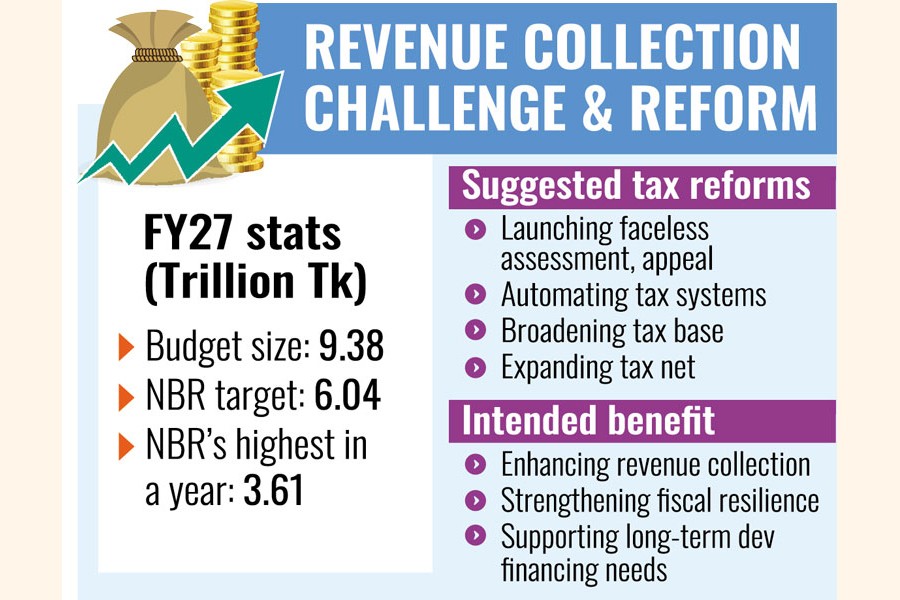
The Finance Division has suggested a gradual introduction of faceless assessments and appeal systems for tax files to lower human discretion in order to enhance revenue collection.
It would also help improve taxpayers' trust and strengthen voluntary compliance with the tax payment system, finance officials said in the Medium-Term Macroeconomic Policy Statement (MTMPS) released on Thursday.
"If implemented with consistency and institutional discipline, these reforms can significantly enhance revenue collection, strengthen fiscal resilience, and support Bangladesh's long-term development financing needs," the MTMPS on "Revenue Outlook and Mobilisation Strategy" mentioned.
To finance the Tk 9.38 trillion budget for the fiscal year 2026-27, the government has entrusted the National Board of Revenue (NBR) with collecting Tk 6.04 trillion, a daunting task for the revenue authority, which so far collected Tk 3.61 trillion at best in a fiscal year.
Economists and analysts say financing the large budget will be a big challenge for the Tarique Rahman-led government.
Finance Division officials are also highly concerned about the collection of such a large amount of revenue in a year.
The MTMPS mentions that Bangladesh faces a consistent 13-15 per cent gap between targets and actual collection of revenue, with the revenue-to-GDP ratio dropping to 7.9 per cent in FY25.
It says revenue growth significantly lags behind GDP expansion, indicating vast untapped potential within the informal economy.
The Finance Division says Bangladesh continues to face persistent underperformance in revenue collection relative to its budgetary targets.
In FY24, total revenue mobilisation reached Tk 4.116 trillion, reflecting a moderate growth of 12.2 per cent.
However, it remained significantly below the target of Tk 4.78 trillion.
In FY25, revenue collection grew by 6.2 per cent compared to that of FY24, amounting to Tk 4.369 trillion against the target of Tk 5.180 trillion, which was 15.6 per cent lower than the target.
This consistent shortfall has led to a concerning decline in the revenue-to-GDP ratio, which dropped from 8.2 per cent in FY24 to 7.9 per cent in FY25.
Over the last five fiscal years, the gap between targeted and actual mobilisation averaged between 13 and 15 per cent.
"This widening discrepancy emphasises the urgent need for a comprehensive reform of taxation policy and administration," the MTMPS says, adding that while various initiatives have been launched to modernise tax administration and enhance collection, the country continues to struggle to realise its full fiscal potential.
However, the country's total revenue earnings are likely to reach Tk 9.25 trillion by FY29, targeting a 15 per cent tax-to-GDP ratio by 2035 to support a trillion-dollar economy, says the MTMPS.
To achieve this target, the government's strategy will focus on automating tax systems, broadening the tax base, and expanding the tax net to activate the "Investment-Production-Employment-Consumption-Tax" cycle, driving growth without increasing the tax burden, it adds.
The MTMPS also mentions that to support the vision of a trillion-dollar economy, the government aims to achieve a 15 per cent tax-to-GDP ratio by 2035.
"The centre-piece of this strategy is to broaden the tax base by fostering investment through business simplification and optimising the business environment in the domestic market. This approach ensures that expanded production and employment serve as the primary drivers of sustainable revenue."
"Key priorities include transitioning to an efficient tax administration that optimises tax expenditure by linking incentives directly to job creation and technological advancement. By ensuring fiscal discipline and eliminating wasteful expenditures, this strategy seeks to transform revenue into an instrument for economic democratisation and sustainable development," it adds.
syful-islam@outlook.com
© 2026 - All Rights with The Financial Express