Mobile phone and internet access in Bangladesh continued to expand during the July-September quarter of 2025, reflecting steady progress in digital connectivity, although gaps persist in personal device ownership, internet use, gender parity, computer access and the urban-rural divide, according to the latest survey by the Bangladesh Bureau of Statistics (BBS).
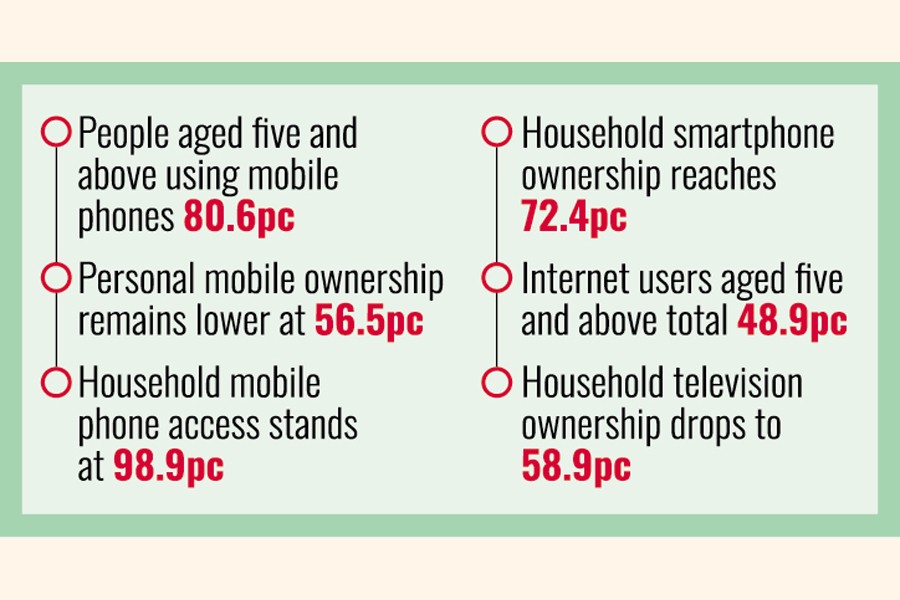
The quarterly Information and Communication Technology (ICT) Access and Use Survey 2025-26 shows that 80.6 per cent of the population aged five years and above currently use mobile phones. However, personal ownership remains lower, with 56.5 per cent of individuals owning at least one mobile handset.
At the household level, access to mobile phones is nearly universal. About 98.9 per cent of households reported having at least one mobile phone during the first quarter of FY26, up from 97.9 per cent in 2023, indicating continued growth in household-level access to digital communication.
Smartphone ownership has expanded markedly over the past two years. The survey found that 72.4 per cent of households now own at least one smartphone, rising from 63.3 per cent in 2023 and 72.8 per cent in FY25, although the pace of growth eased slightly in the latest quarter. A clear urban-rural divide persists, with 81 per cent of urban households owning a smartphone compared with 69 per cent in rural areas.
Internet use also continued its upward trend. The BBS survey shows that 48.9 per cent of individuals aged five years and above were direct internet users by the end of September 2025, up from 38.9 per cent in 2022. At the household level, 56.2 per cent had at least one internet user during the July-September period, compared with 55.1 per cent at the end of FY25.
While mobile phone use among men and women is almost equal -- 81 per cent for men and 79 per cent for women -- the survey highlights persistent gender gaps in personal ownership and internet access. About 63 per cent of men own at least one mobile phone, compared with 53 per cent of women. Internet use follows a similar pattern, with 51.2 per cent of men using the internet, against just over 46.3 per cent of women.
Trends over time indicate diverging patterns in connectivity and ownership. Personal mobile phone ownership has declined slightly, falling from 61.8 per cent in 2022 to around 57 per cent by September 2025, while internet use has risen steadily over the same period.
The survey also provides insight into access to other household technologies. Television ownership continued to decline, with 58.9 per cent of households owning a TV in the first quarter of FY26, down from 62.2 per cent in 2023 and 59.6 per cent in FY25. Radio use fell further to 15 per cent of households, reflecting changing media consumption habits.
Computer ownership remains limited and largely stagnant. Only 9.1 per cent of households reported owning a computer, up marginally from 8.9 per cent in 2023, indicating slow growth in access to advanced digital devices.
Electricity coverage, however, is nearly universal, reaching about 99 per cent of households nationwide, providing a strong foundation for further digital expansion.
The ICT Access and Use Survey was conducted among 61,632 households across the country, collecting data from individuals aged five years and above. The findings are used to inform national ICT policy and development planning, as well as international reporting to platforms such as the International Telecommunication Union and the Sustainable Development Goals tracker.
Overall, the latest data point to steady gains in mobile and internet access at both individual and household levels, alongside structural challenges related to personal device ownership, gender disparities and unequal access to higher-end digital technologies.
bdsmile@gmail.com
© 2026 - All Rights with The Financial Express