A higher inflow of remittances prompts the central bank to scale up intervention in the foreign-exchange market to forestall any imbalance in dollar-taka exchange rates and avoid its economic domino effect.
Officials say amid a steady rise inflow of remittances in recent days the Bangladesh Bank (BB) ramped up its US dollar purchase from commercial banks.
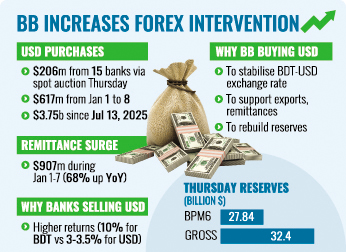
As part of the mopping-up move, the central bank purchased an additional US$206 million from 15 banks through an interbank spot- market auction on Thursday.
According to latest central bank's data, the BB bought a total of $617 million from scheduled banks during the first eight days of January 2026, compared to $1.01-billion purchase in the entire month of December 2025.
The central bank of Bangladesh has so far bought $3.75 billion from banks directly since July 13 last under the prevailing free-float exchange arrangement.
"We've recently strengthened our ongoing intervention in the forex market to offset the higher inflow of remittances ahead of the upcoming national elections and the Holy Ramadan," a senior central banker told The Financial Express (FE) Thursday while explaining the latest market situation.
The inflow of remittances grew by nearly 68 per cent to $907 million during January 01-07 this calendar year, up from $541 million in the same period of last year.
The central banker expects the current upward trend in remittances to continue until March as Eid-ul-Fitr is scheduled to be celebrated in the third week of that month.
"We're purchasing US dollars from scheduled banks to maintain exchange-rate stability, a move that helps preserve export competitiveness and support sustained remittance inflows," the central banker explains.
He also says such interventions are also helping gradual buildup of the country's foreign-exchange reserves.
Bangladesh's gross forex reserves still over $32-billion mark despite spending $1.53 billion on settling import-payment obligations to the Asian Clearing Union (ACU) member-countries.
After the payments for November-December period of 2025, the country's gross forex reserves stood at $32.40 billion Thursday in a decrease from $33.78 billion of previous working day, according of the official figures.
Under the International Monetary Fund (IMF)'s Balance of Payments International Investment Poisson Manual-six edition, encoded as BMP6, the forex reserves came to $27.84 billion on the day from $29.19 billion.
The central bank has already remitted the funds to the ACU headquarters in Tehran in line with the existing provisions of the union.
As per the existing provisions, outstanding import bills and interest thereof are to be paid by member-countries every two months.
On the other hand, commercial banks have recently seen a higher supply of the greenback on back of lower import-payment obligations and an upward trend in inward remittance.
"We prefer to sell our excess US dollars to the central bank for taking higher returns than holding the currency in own portfolios," a senior executive of a leading private commercial bank told the FE while replying to a query over the swaps.
Banks can earn around 10 per cent by investing in the form of BDT, while returns on dollar holdings declined to rates in-between 3.0 per cent and 3.50 per cent, the private banker explains.
siddique.islam@gmail.com
© 2026 - All Rights with The Financial Express