Bangladesh's liquefied natural gas (LNG) supply chain has come under fresh uncertainty after its leading supplier, QatarEnergy, warned of a potential force majeure following military strikes on its facilities.
The development has raised concerns over the security of long-term contracted supplies at a time when the country is heavily reliant on imported LNG to meet domestic demand.
While several scheduled cargoes have already cleared the Strait of Hormuz, officials fear that a prolonged disruption could strain the country's energy balance and complicate supply planning in the months ahead.
Bangladesh's leading LNG supplier, QatarEnergy, sent a letter to state-run Petrobangla on Monday night informing it of a "potential event of force majeure", market insiders said.
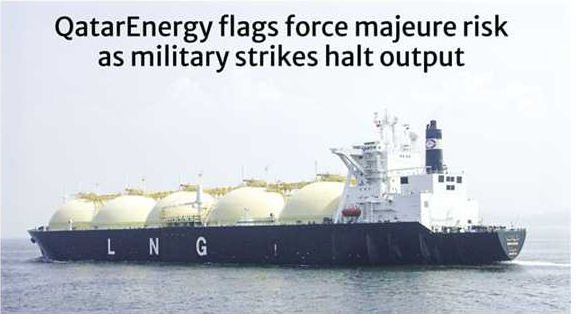
The notice came hours after QatarEnergy announced that it had ceased LNG production.
The move indicates that QatarEnergy may not be able to supply LNG to Bangladesh under its contractual obligations.
"The supplier informed us about the potential force majeure through an email, and we saw the letter this morning when offices reopened today (Tuesday)," a senior Petrobangla official told The Financial Express.
"If the force majeure remains in effect for a prolonged period, Bangladesh's LNG supply chain could be endangered," he warned.
In a press statement issued on Monday, QatarEnergy said: "Due to military attacks on QatarEnergy's operating facilities in Ras Laffan Industrial City and Mesaieed Industrial City in the State of Qatar, QatarEnergy has ceased production of liquefied natural gas (LNG) and associated products."
The company added that it values its relationships with stakeholders and would continue to communicate updates as more information becomes available.
Qatar accounts for around 20 per cent of global LNG exports, most of which are shipped through the Strait of Hormuz.
"We have a pre-fixed schedule of six incoming LNG cargoes from Qatar, of which four have already passed through the Hormuz," a senior official of state-run Rupantarita Prakritik Gas Company Ltd (RPGCL) said.
Two additional LNG cargoes are scheduled to transit the Strait of Hormuz on March 15 and March 18 respectively, the RPGCL official added.
If the Strait of Hormuz remains closed for an extended period, Bangladesh's LNG supply chain could be severely affected.
The Strait of Hormuz is one of the world's most strategically important waterways, linking the Persian Gulf with the Gulf of Oman and the Arabian Sea. Roughly 20 per cent of global crude oil and a significant share of LNG shipments pass through it each day.
QatarEnergy began supplying LNG to Bangladesh under its second long-term sales and purchase agreement (SPA) in late February.
The first cargo under the second SPA, carrying around 138,000 cubic metres of LNG, arrived at the Moheshkhali floating storage and regasification unit (FSRU), operated by a US-based company, and delivered the gas successfully last week.
However, QatarEnergy's media department did not comment when approached on February 27.
The commencement of LNG supplies under the second SPA followed a similar start of deliveries from US-based Excelerate Energy under a separate agreement.
With the addition of the two new SPAs signed with QatarEnergy and Excelerate Energy, Bangladesh is now importing LNG under four separate long-term agreements, a Petrobangla official said.
Previously, QatarEnergy and Oman's OQ Trading International had been supplying LNG under two separate SPAs, with Qatari supplies beginning in April 2018 and Omani deliveries starting in January 2019.
Bangladesh has reduced spot market purchases following the commencement of LNG imports under the new contracts, mainly due to limited regasification capacity, officials said.
Azizjst@yahoo.com
© 2026 - All Rights with The Financial Express