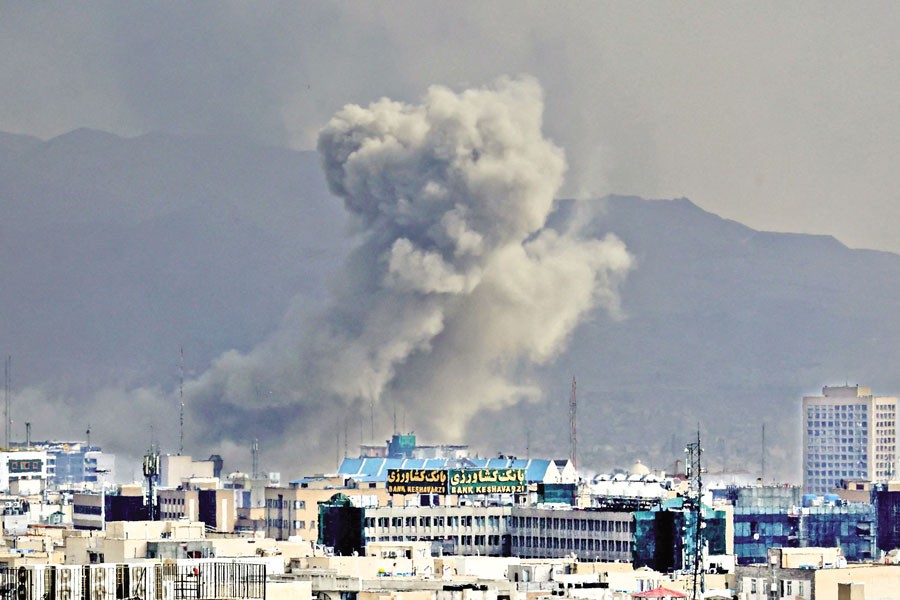
 A plume of smoke acends after a military strike in the capital of Iran on Monday. — AFP
 The US-Israeli air war against Iran expanded on Monday with no end in sight, with Israel attacking Lebanon in response to strikes by Hezbollah, and Tehran firing missiles and drones at Gulf states and a British air base as far away as Cyprus, report agencies.
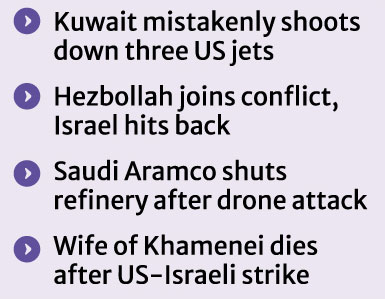
Kuwait mistakenly shot down three American F-15E fighter jets during an Iranian attack. All six crew members ejected and were safely recovered. Video, filmed at a location verified by Reuters, showed one of the planes spiralling out of the sky, an engine lit up in flames.
 A weekend of bombing that killed Iran's supreme leader dragged its neighbours into war and shut shipping traffic in the Gulf. Markets opened on Monday with energy prices rising sharply, putting the global economic recovery at risk.
Iran and Iranian-backed militias fired missiles at Israel and Arab states, apparently hitting the US Embassy compound in Kuwait, while Israel and the United States pounded targets in Iran.
At least 555 people have been killed in Iran so far by the US-Israeli campaign, the Iranian Red Crescent Society said, and more than 130 cities across the country having come under attack. Eleven people have been killed in Israel and 31 in Lebanon, according to authorities there.
The wife of Iran's slain Supreme Leader Ayatollah Ali Khamenei died on Monday, according to local media, after she sustained wounds from US and Israeli bombing on Tehran that killed her husband days earlier.
Mansoureh Khojasteh Bagherzadeh had been in a coma after she and her husband were targeted in the attack late Saturday, Iran's ISNA News Agency reported.
Iranian state television claimed Iran had targeted US aircraft, without elaborating. The US military did not immediately respond to a request for comment.
Meanwhile, in the first formal Pentagon briefing since the campaign began, Defense Secretary Pete Hegseth declined to set out a time frame to end the campaign, saying it was up to President Donald Trump.
The military's aim was to destroy Iran's ability to project force beyond its borders, which it had been using to provide cover to develop a nuclear weapon, Hegseth said.
"We're hitting them surgically, overwhelmingly and unapologetically," he said.
The Chairman of the US Joint Chiefs of Staff, General Dan Caine, described a campaign of overwhelming force that included hitting more than 1,000 targets in the first 24 hours, and said more forces were still on their way to the region.
Iran denies seeking a nuclear weapon and says it was offering to curb its nuclear programme at talks when the United States launched an unprovoked assault.
In the biggest US foreign policy gamble in decades, Trump launched the campaign alongside Israel against a foe that had tormented the US and its allies for generations.
Iran targets regional oil infrastructure
World markets were rattled by the fighting and oil prices soared.
Saudi Arabia's Ras Tanura oil refinery, one of the kingdom's largest, temporarily halted operations on Monday following an attack by drones, the country's defence ministry confirmed.
Authorities said the incoming aircraft were intercepted before reaching critical infrastructure.
Online videos from the site appeared to show thick black smoke rising after the attack. Even successfully intercepted drones cause debris that can spark fires and injure those on the ground.
Saudi Aramco's Ras Tanura refinery, with a capacity of 550,000 barrels per day, is part of a larger energy complex on the kingdom's Gulf coast and also functions as a key export terminal for Saudi crude oil.
Iran's decision to expands its attacks to major regional oil infrastructure adds a new element to the war gripping the Middle East, directly targeting the lifeblood of the area's economy.
Iran has also threatened ships in the Strait of Hormuz, the narrow mouth of the Persian Gulf through which a fifth of all oil traded passes. Several ships have been attacked as well there.
War spreads to Lebanon
In a sign Iran's rulers are still reaching out to the outside world, a senior Iranian security official contacted Reuters to say Iran was defending itself against aggressors and would continue to do so.
A new front in the war opened on Monday when Hezbollah, one of Tehran's principal allies in the Middle East, launched missiles and drones towards Israel.
Israel responded with sweeping airstrikes, which it said targeted the Hezbollah-controlled southern suburbs of Beirut and struck senior militants. Lebanese state news agency NNA said an initial tally showed 31 people had been killed and 149 injured.
Israel declared Hezbollah leader Naim Qassem a "target for elimination". Officials said they were not for now considering a ground invasion of Lebanon, whose government on Monday banned military activities by Hezbollah.
As Washington's allies in the Gulf came under renewed attack from Iranian missiles and drones, black smoke rose above the area around the US embassy in Kuwait. There were loud blasts in Dubai and Samha in the UAE, and in Doha, capital of Qatar.
In the first strike to reach US allies in Europe, a drone hit Britain's Akrotiri air base in Cyprus overnight. Britain and Cyprus said the damage was limited and there were no casualties.
In an X post on Monday, Ali Larijani, a powerful adviser to Khamenei, said Iran would not negotiate with Trump, who had "delusional ambitions" and was now worried about US casualties.
First US casualties
US Central Command said a fourth US service member had died, without giving details of the circumstances. The deaths of the first three American service personnel were confirmed on Sunday. Two US officials told Reuters they were killed on a base in Kuwait.
An extended military campaign could pose a major political risk for Trump's Republican Party ahead of US midterm elections. Only around one in four Americans approve of the operation, according to a Reuters/Ipsos poll on Sunday.
© 2026 - All Rights with The Financial Express