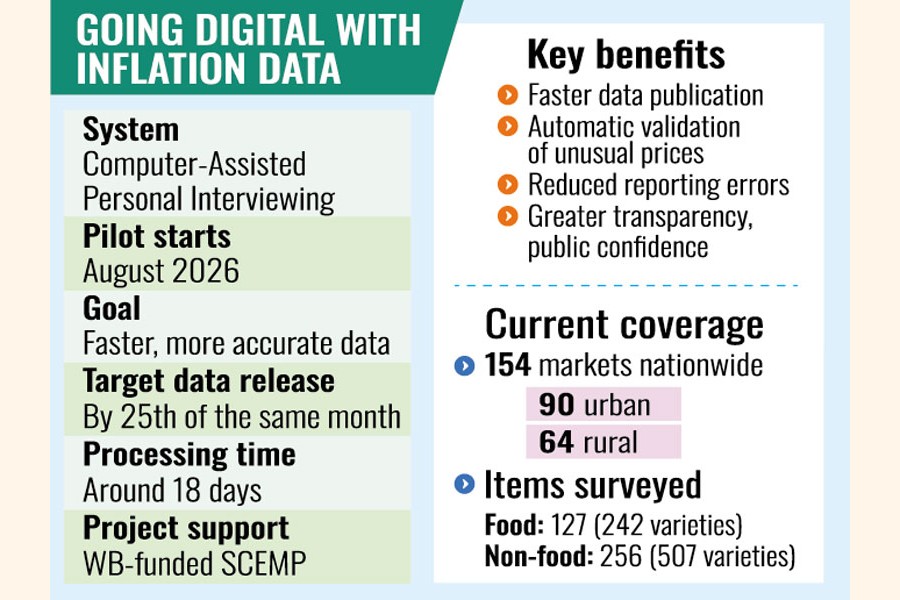
Bangladesh's statistics agency is set to prepare to digitise the inflation data collection, a move officials say will speed up the release of consumer price figures and strengthen confidence among the people in one of the most closely watched economic indicators.
The plan is to replace the paper-based price survey system with Computer-Assisted Personal Interviewing (CAPI), according to officials familiar with the initiative.
The shift is intended to address long-standing concerns over the reliability of manually collected price data while allowing the agency to publish monthly inflation figures days earlier than at present.
The Bangladesh Bureau of Statistics (BBS) expects to begin piloting the digital system in August and aims to roll it out later this year if the trial proves successful.
"We expect to publish inflation data within the same month. We may even be able to release the figures by the 25th," a senior BBS official told The Financial Express on Wednesday requesting anonymity because the matter is yet to be formally announced.
The inflation data is vital because it measures how fast prices rise and purchasing power drops, used mainly in wage adjustments in many organisations. It should be guided by the interest rate regime.
The Bangladesh Bank uses it to decide whether to raise the policy rate or not, while companies use it to plan future costs and set product prices.
The BBS currently releases inflation data during the first week of the next month after completing field surveys and data processing.
Officials say the digital platform will automatically detect unusual price movements and require verification before they are incorporated into the Consumer Price Index (CPI), reducing the scope for reporting errors and improving oversight.
The reform also seeks to counter persistent allegations that some enumerators have failed to visit markets and instead completed survey forms from their offices.
Officials say the new system would rely on automated validation tools, making such practices significantly more difficult.
Under the CAPI system, the agency expects to complete price collection, validation, and processing in around 18 days, substantially reducing the time needed to compile the monthly CPI.
The project is being financed under the Statistical Capacity Enhancement and Modernisation Project (SCEMP), which is supported by the World Bank.
The BBS gathers price information from 154 markets nationwide, including 90 urban and 64 rural ones.
Urban coverage includes 12 markets in Dhaka, four in Chattogram, 18 in other divisional cities, and 56 in district towns. Enumerators collect three price quotations for each product and its varieties.
The survey covers 127 food items with 242 varieties and 256 non-food items with 507 varieties.
Prices in Dhaka and Chattogram city corporations are collected weekly, while surveys in other urban centres and rural areas are conducted monthly.
Data is obtained from selected retail outlets and service providers, with average prices used to calculate the indices.
The index is based on the 2021-22 prices, while expenditure weights are drawn from the Household Income and Expenditure Survey 2016-17.
The national CPI combines the urban and rural indices using weights based on the Classification of Individual Consumption by Purpose (COICOP).
The BBS publishes separate inflation measures for the national, urban, and rural populations, with food and non-food indices reported individually.
Elementary indices are calculated using the Jevons formula and chained Jevons methodology.
jasimharoon@yahoo.com
© 2026 - All Rights with The Financial Express