Bangladesh's foreign-exchange reserves remain comfortably above the $34-billion mark even after the country cleared a major round of regional import payments.
Officials say steady inflows of remittances and export earnings have helped keep the reserve position stable despite the routine outflow.
 The latest payment of $1.37 billion to the Asian Clearing Union (ACU), which settles trade transactions among several regional economies every two months, slightly reduced the reserve level but did not significantly affect the country's overall external position.
After the payment for the January-February period of 2026, the country's gross forex reserves fell to $34.10 billion on Sunday from $35.49 billion on the previous working day.
Under the International Monetary Fund's Balance of Payments and International Investment Position Manual (sixth edition), commonly known as BPM6, the reserves declined to $29.38 billion during the period under review from $30.76 billion, according to the latest data from Bangladesh Bank.
"Our forex reserves now stand at a satisfactory level, even after making the routine payment to the ACU," a senior official of Bangladesh Bank told The Financial Express in response to a query.
He also said Bangladesh is currently able to meet more than five months of import payment obligations with the existing reserves.
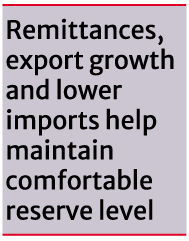
"Higher inflows of remittances along with steady growth in export earnings have helped boost the country's forex reserves," the central banker explained.
He also said lower import payment obligations have contributed to improving the country's forex reserve situation.
Purchases of the US dollar from commercial banks by the central bank have also helped increase the forex reserves recently, according to the official.
The central bank has so far bought $5.49 billion from banks directly since July 13 last year under the prevailing free-floating exchange rate arrangement, Bangladesh Bank data showed.
Meanwhile, the amount of ACU payment declined to $1.37 billion during the period under review from $1.53 billion earlier, mainly due to lower imports from ACU member countries.
Under existing provisions, outstanding import bills and related interest are settled by member countries at the end of every two months.
Bangladesh currently imports various consumer goods, cotton, raw materials and capital machinery from ACU member countries, particularly from neighbouring India, according to central bank officials.
The ACU is a regional arrangement involving Bangladesh, Bhutan, India, Iran, Myanmar, Nepal, Pakistan, Sri Lanka and Maldives, through which intraregional transactions among participating central banks are settled on a multilateral basis.
siddique.islam@gmail.com
© 2026 - All Rights with The Financial Express