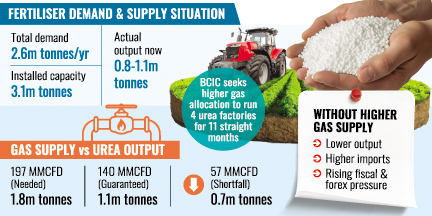
The state-run BCIC has sought an uninterrupted supply of at least 197 million cubic feet of gas per day (MMCFD) to keep four urea fertiliser factories operational for 11 consecutive months.
The Bangladesh Chemical Industries Corporation (BCIC) recently made a proposal to the Ministry of Industries (MoI) for taking its necessary steps to this effect in line with the recommendations of a committee formed by the Energy and Mineral Resources Division.
The corporation has also requested the authorities to amend Clause 10.3 of BERC (Bangladesh Energy Regulatory Commission) Order No. 2023/20 in order to raise the guaranteed daily gas supply to 197 MMCFD from 140 MMCFD for the sake of uninterrupted fertiliser production.
The BCIC, operating under the industries ministry, runs seven fertiliser factories.
Urea fertiliser alone accounts for nearly 80 per cent of BCIC's overall output, sources said, adding that the corporation currently runs five urea fertiliser plants, all of them heavily dependent on natural gas as their primary raw material.
Due to a severe gas crisis in the country, an uninterrupted gas supply to most urea factories remained largely unavailable since 2007-08.
Gas supply remains suspended between April and November each year, forcing the BCIC fertiliser plants to shut their production for extended periods routinely, it was learnt.
As a result, the BCIC fertiliser factories are unable to utilise their full installed production capacity of 3.1 million tonnes per year although the country's demand for the agriculture inputs is estimated at 2.6 million metric tonnes annually.
According to the BCIC data, prolonged factory shutdowns have not only increased the production costs of fertiliser, but also caused corrosion-related damage to machinery, thus reducing the annual production to approximately 2.0 million tonnes.
In recent years, the volume of fertiliser production has dropped further to 0.8-1.1 million tonnes. As a result, the country is to import the remaining amount of fertiliser to meet the demand for the same.
Usually, urea prices are fixed by the government at significantly lower rates than its production costs, causing sustained losses to the BCIC factories.
While trade-gap subsidies are provided to imported urea, locally-produced urea has not received such support for years.
The situation worsened in June 2022 when gas prices rose sharply to Tk 16 per cubic meter from Tk 4.45.
As a result, the BCIC was unable to pay gas the bills accordingly, sources said, adding that the outstanding dues on account gas bills have reached nearly Tk 20 billion.
To address the problems, the Finance Division issued a circular on August 20 2024, allowing the Agriculture ministry to purchase BCIC-produced urea at Tk 38,000 per tonne and provide Tk 13,000 per tonne as trade gap, with effect from June 2022.
To overcome the prevailing gas scarcity, the government also formed a high-powered panel to review the feasibility of operating domestic fertiliser plants through importing LNG.
In its report, the committee recommended running four out of five urea factories continuously for 330 days to produce at least 1.8 million tonnes annually, with an average gas supply of 180.81 MMCFD.
The report also suggested fixation of gas price for the fertiliser sector at a minimum Tk 30 per cubic meter to help offset LNG import costs.
It noted that the increased domestic production could save the country's foreign currency, generate employment, and support skill development.
However, the BCIC data shows that the four factories require a minimum safe load of 197 MMCFD to operate simultaneously.
At 140 MMCFD, only two factories can maintain their operation.
If gas supply remains capped at 140 MMCFD, the BCIC estimates that its annual production will be as low as 1.1 million tonnes, falling short of the 1.8-million-tonne target by 0.7 million metric tons.
Such a shortfall would also lead to increase in the fertiliser imports, government subsidy payment and foreign exchange expenditure.
The situation is different for the newly commissioned Ghorashal Palash Fertilizer PLC, which has an annual production capacity of 0.924 million tons, due to its foreign-loan repayment obligations.
When contacted, Director (production and Research) of BCIC Md. Moniruzzaman said: "We have requested the MoI to take necessary action for the resolving problems with regard to the four BCIC closed factories."
He was also hopeful about getting a good response from the ministry concerned to this effect.
rezamumu@gmail.com
© 2026 - All Rights with The Financial Express