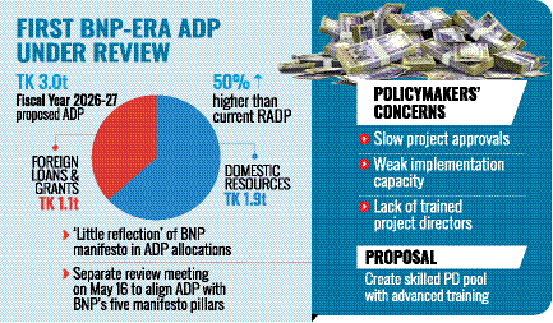
Top policymakers of the government have found little reflection of the ruling BNP's election pledges in the proposed Tk 3.0-trillion Annual Development Programme (ADP) for FY2026-27 -- the first ADP under the new government, which is 50 per cent higher than the revised allocation for the current fiscal year.
Against this backdrop, the extended meeting of the Planning Commission decided to hold a separate meeting on May 16 to align the proposed ministry- and sector-wise allocations under the next ADP with the five pillars of the BNP's election manifesto, sources said.
The meeting to finalise the draft of the new ADP was held on Saturday at the NEC auditorium in the capital, with Finance and Planning Minister Amir Khosru Mahmud Chowdhury in the chair.
Prime Minister's Adviser on Finance and Planning Dr Rashed Al Mahmud Titumir, State Minister for Planning Zonayed Abdur Rahim Saki, and senior government officials were present.
According to several officials who attended the meeting, the decision to convene another meeting came following a proposal from Dr Titumir.
"The PM's finance and planning adviser said at the meeting that although allocations in the new ADP have been increased, the process of formulating the programme has largely remained unchanged from previous years. The meeting documents also contained no indication of how the ADP aligns with the BNP's election manifesto," an official said.
The adviser also urged officials to finalise the entire ADP in line with the five pillars of the BNP's election manifesto, the official added.
According to documents placed at the meeting, the ADP for the next fiscal year has been proposed at Tk 3.0 trillion, of which Tk 1.9 trillion is expected to come from the government's own resources and Tk 1.1 trillion from external sources in the form of loans and grants.
The government is currently implementing a revised ADP (RADP) of Tk 2.0 trillion in the ongoing fiscal year, comprising Tk 1.28 trillion from domestic sources and Tk 720 billion from external financing.
The size of the proposed ADP would increase by 50 per cent, with a 48.44-per cent rise in domestic resource allocation and a 52.77-per cent increase in external financing.
An additional Tk 89.25 billion would be allocated from the own sources of autonomous government corporations for the implementation of their projects, according to the documents.
With the inclusion of funds from these autonomous bodies, the size of the proposed ADP would stand at Tk 3.09 trillion.
The transport sector is set to receive the highest allocation of Tk 500.93 billion in the next fiscal year, accounting for 16.70 per cent of the total ADP.
The education sector is proposed to receive the second-highest allocation of Tk 475.91 billion, or 15.86 per cent of the total outlay.
The health sector is expected to receive Tk 355.36 billion, while the energy and power sector is likely to rank fourth with an allocation of Tk 326.92 billion.
According to the proposal, the Local Government Division, the Road Transport and Highways Division, and the Health Services Division are set to receive the highest allocations, respectively.
The new ADP will include a total of 1,121 development projects, significantly lower than the 1,333 projects under the current Revised ADP (RADP).
Of these, 892 are investment projects, 18 are feasibility study projects, and 98 are technical assistance projects. In addition, 36 projects will be implemented by autonomous agencies using their own resources.
A total of 26 projects identified for completion in the current fiscal year will be carried over to the next fiscal year.
A total of 223 projects are expected to be completed in the next fiscal year, including 171 investment projects.
Sources present at the meeting said the PM's finance and planning adviser also expressed dissatisfaction
over the slow pace of project approval.
He stressed the need for faster approval of projects to accelerate development activities. However, he observed that there is a lack of capacity and willingness within the Planning Commission in this regard.
Meanwhile, expressing displeasure over the sluggish implementation of projects, the finance and planning minister also voiced concern at the meeting, sources said.
He suggested forming a pool of project directors (PDs) comprising skilled officers and providing them with advanced training to enhance their efficiency.
jahid.rn@gmail.com
© 2026 - All Rights with The Financial Express