Bangladesh has demonstrated notable resilience in navigating recent economic headwinds, with growth expected to strengthen gradually over the next few years, according to Frederic Neumann, chief Asia economist and co-head of Global Research Asia at HSBC Global Research.
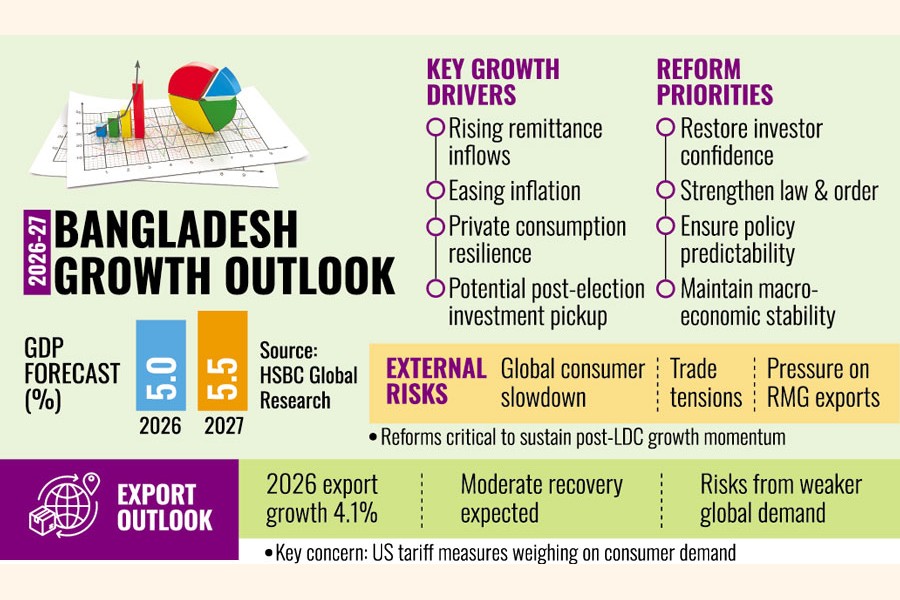
Speaking at an event organised by the Hongkong and Shanghai Banking Corporation Limited (HSBC) in Bangladesh on Monday, Neumann said the bank projects Bangladesh's gross domestic product (GDP) growth at 5.0 per cent in 2026, rising to 5.5 per cent in 2027.
Export value growth is forecast at 4.1 per cent for the 2026 calendar year, reflecting a moderate recovery amid a challenging global environment, he said.
The event, titled "Bangladesh and the World: Economic Prospects for 2026 and Beyond", brought together senior finance professionals, corporate leaders and policymakers to discuss global and regional economic trends and their implications for Bangladesh.
In his keynote address, delivered via Zoom, Neumann observed that Bangladesh has emerged with resilience from the shocks of recent years, including global inflationary pressures, tighter financial conditions and volatility in external demand.
He noted that remittance inflows continue to increase year on year, reflecting growing trust in formal transfer channels. Combined with easing inflation, these trends are expected to support private consumption, which remains a key driver of economic activity.
However, he cautioned that while domestic and foreign investment could pick up modestly following the recent general election, any meaningful acceleration would depend heavily on the new government's ability to restore and sustain investor confidence.
Strengthening law and order, ensuring policy predictability and maintaining macroeconomic stability would be critical in this regard, he said.
Looking ahead, Neumann highlighted Bangladesh's impending graduation from least developed country (LDC) status in November 2026 as a major milestone that also brings fresh challenges.
He stressed that the transition would require renewed efforts to enhance export competitiveness through expanded market access, improved governance and stronger infrastructure.
"LDC graduation underscores the urgency of reforms," he said, adding that Bangladesh would need to move swiftly to secure favourable trade arrangements and diversify its export base beyond traditional products.
He identified a slowdown in global consumer demand as the principal external risk facing the economy, noting that this has been partly driven by tariff measures imposed by the United States.
Such developments, he warned, could weigh on export-oriented sectors, particularly readymade garments.
Against this backdrop, Neumann emphasised the need for Bangladesh to accelerate trade negotiations with the European Union, its largest garment export market.
Ensuring continued preferential or near-preferential market access after LDC graduation would be crucial to sustaining export growth and employment, he said.
With the formation of a new government following what he described as a largely peaceful election, Neumann said the administration now holds a clear political mandate to pursue reforms and deliver the stability sought by citizens and investors alike.
"Facing an extensive reform agenda, the government must demonstrate its commitment to promises made and address the aspirations of the country's young generation," he remarked.
The keynote session was followed by an interactive question-and-answer segment, during which participants raised issues ranging from exchange rate management to investment climate reforms and global financial market trends.
At the event, Jignesh Ruparel, chief financial officer of HSBC Bangladesh, delivered a presentation outlining the HSBC Group's latest global financial results and its international capabilities.
He noted that the group's 161-year history is rooted in its founding mission to facilitate local and international trade.
With a presence in 56 countries and territories, including Bangladesh, HSBC continues to connect customers to opportunities worldwide, Ruparel said.
Kausar Alam, president of the Institute of Cost and Management Accountants of Bangladesh, described the CFO connect event as a timely initiative that offered valuable insights into Bangladesh's evolving macroeconomic landscape within a global context.
He said the economy holds significant latent potential, supported by favourable demographic trends and a resilient private sector.
He added that the private sector remains a key driver in Bangladesh's ambition to become a trillion-dollar economy by 2040, provided that structural bottlenecks are addressed and reforms are implemented effectively.
Speaking at the gathering, Md Mahbub ur Rahman, chief executive officer of HSBC Bangladesh, said the bank's strong performance in 2025 reflects the strength of its global network and the trust placed in it by clients.
As Bangladesh enters a pivotal phase of reform and growth, he said, HSBC's role is to connect local ambition with global opportunity.
Through initiatives such as CFO connect, Rahman added, the bank aims to provide a platform for senior finance professionals in Bangladesh to exchange insights, deepen engagement with global trends and strengthen their preparedness for an increasingly dynamic and uncertain economic environment.
The event was attended by chief financial officers, senior executives and stakeholders from both local and multinational companies operating in Bangladesh.
bdsmile@gmail.com
© 2026 - All Rights with The Financial Express