Energy Adviser Muhammad Fouzul Kabir Khan on Tuesday blamed retailers and wholesalers for the ongoing liquefied petroleum gas (LPG) crisis and the sharp rise in prices, saying the shortage was largely artificial.
He said the government has intensified enforcement measures against businesses accused of hoarding LPG and charging consumers more than the regulated price.
Mr Khan said coordinated drives involving district administrations, law enforcement agencies and consumer rights officials were already under way to stabilise the market and rein in price manipulation. Dishonest traders were being fined for overcharging in violation of the law, he added.
The adviser was speaking to reporters after a meeting of the Advisers' Council Committee on Government Purchase at the Bangladesh Secretariat in the capital.
The meeting, chaired by Finance Adviser Dr Salehuddin Ahmed, approved a number of proposals, including the procurement of fuel oil and crude oil.
"We will deploy officials everywhere. The government will take every possible measure to stabilise LPG prices," the adviser said.
When asked about allegations that advance leakage of information from the Bangladesh Energy Regulatory Commission (BERC) regarding a possible LPG price hike had triggered hoarding, Mr Khan said the matter would be looked into.
He said that after holding several meetings on the LPG issue over the past few days, he found that LPG imports had increased over the month, leaving no justification for a supply shortage.
A team of officials was sent to Chattogram on Tuesday to investigate the situation, while similar inspections are under way in Dhaka. "We are hopeful that the supply shortage is temporary and will gradually ease," he said.
However, the adviser acknowledged that international sanctions on some LPG carriers have disrupted gas shipments.
Meanwhile, Finance Adviser Dr Salehuddin Ahmed, speaking after the same meeting, ruled out any possible economic impact from strained bilateral relations between Bangladesh and India, referring to the recent incident involving the exclusion of cricketer Mustafizur Rahman from the Indian Premier League (IPL).
Responding to a question on delays in the bifurcation of the National Board of Revenue (NBR), Dr Ahmed said all formalities were nearly complete. "It will be completed during the tenure of the interim government," he said.
At the meeting, the committee approved the procurement of 40,000 tonnes of bulk granular fertiliser from Saudi Arabia for the current fiscal year. The fertiliser will be imported from SABIC Agri-Nutrients Company at a cost of Tk 1.91 billion, with each tonne priced at US$390.
Under another approval, the government will import refined fuel oil from seven suppliers -- PetroChina, ENOC, IOCL, OQT, PTLCL, BSP and UNIPEC -- at a total cost of Tk 108.26 billion during the January-June period.
The committee also approved the import of 700,000 tonnes of Murban-grade crude oil from Abu Dhabi National Oil Company at a cost of Tk 55.42 billion, and 800,000 tonnes of Arabian Light crude oil from Saudi Aramco at a cost of Tk 63.20 billion.
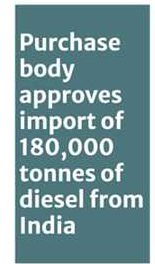
In addition, the meeting approved the import of 180,000 tonnes of diesel from Numaligarh Refinery Limited through the India-Bangladesh Friendship Pipeline at a total cost of Tk 14.61 billion.
The committee also approved proposals to procure lentils and edible oil for the Trading Corporation of Bangladesh (TCB) for sale at subsidised prices ahead of and during the holy month of Ramadan.
Under the plan, 10,000 tonnes of lentils and 13.57 million litres of refined soybean oil will be procured.
syful-islam@outlook.com
© 2026 - All Rights with The Financial Express