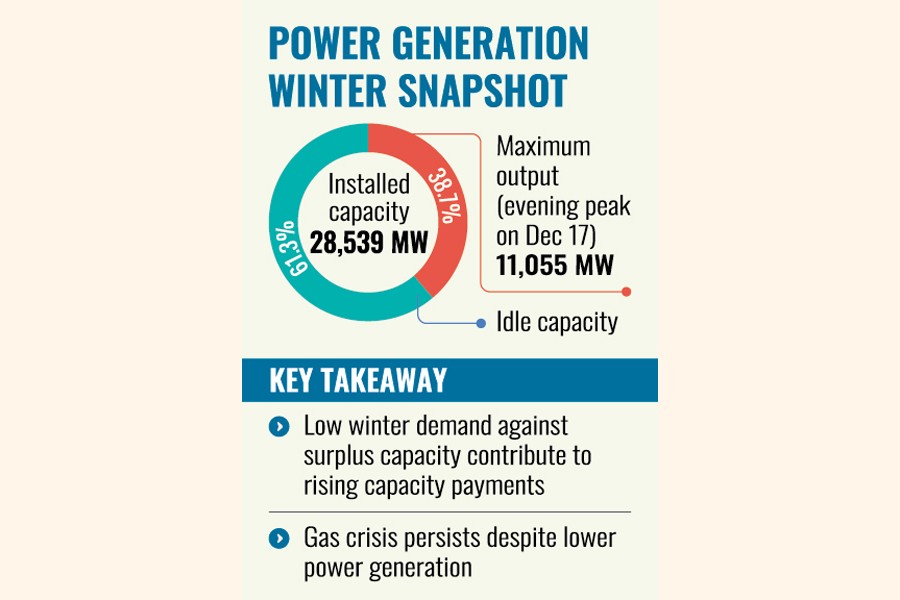
Electricity generation across Bangladesh has fallen to nearly one-third of installed capacity as winter sets in and demand drops sharply.
While the seasonal slump has eased the chronic supply pressures typically seen during summer, it has also exposed the financial burden of maintaining surplus generation capacity.
With a large number of power plants lying idle, the government remains liable for substantial capacity payments under existing contracts.
The situation highlights a structural imbalance between installed capacity and actual demand, raising questions about planning efficiency in the power sector, sector insiders said.
Data from the Bangladesh Power Development Board (BPDB) show that the decline in generation has not led to load-shedding so far, indicating that industrial and agricultural activity has yet to rebound strongly enough to absorb the excess capacity.
Electricity generation during day peak hours on December 17 stood at 9,810 megawatts, only 34.37 per cent of the total installed capacity of 28,539 MW.
During the evening peak, generation rose to 11,055 MW, equivalent to 38.73 per cent of capacity, BPDB data showed.
Over the past year since last winter, overall generation capacity has increased by 973 MW, from 27,566 MW to 28,539 MW.
Market insiders say that despite the surplus capacity, BPDB will have to bear "skyrocketing capacity payments" to the owners of idle power plants under existing agreements.
Although power generation typically declines during winter, the country did not experience load-shedding as of December 17, according to BPDB data.
This suggests that productive activities in industry and agriculture have not expanded enough to outpace available power supply.
Data also show that gas-fired power plants accounted for the largest share of electricity generation on the day, producing 91.83 million kilowatt-hours (mkWh).
Coal-fired plants generated 72.53 mkWh, followed by oil-based plants at 4.58 mkWh, solar plants at 3.70 mkWh, and hydro and wind plants at around 1.0 mkWh. Imported electricity from India and Nepal together contributed 46.49 mkWh.
The decline in power generation has had a knock-on effect on natural gas demand, a fuel the country struggles to supply due to years of limited exploration of domestic reserves and heavy reliance on costly liquefied natural gas (LNG) imports.
On Sunday last, 41 gas-fired power plants remained shut as Petrobangla supplied around 753 million cubic feet per day (mmcfd) of gas, meeting only about 30.28 per cent of the combined demand of gas-based plants, estimated at around 2,486 mmcfd.
Sources said domestic gas supply continues to decline amid the depletion of existing fields and slow progress in boosting extraction, resulting in lower-than-expected fuel availability for power generation.
Bangladesh's total natural gas production currently stands at around 2,564 mmcfd, including 872 mmcfd of regasified LNG, according to Petrobangla data as of December 17.
Output from local gas fields, including those operated by international oil companies, accounts for about 1,692 mmcfd.
Industry insiders said the ongoing gas crisis is affecting all categories of consumers, leading to cuts in industrial output and causing widespread hardship for ordinary people.
© 2026 - All Rights with The Financial Express