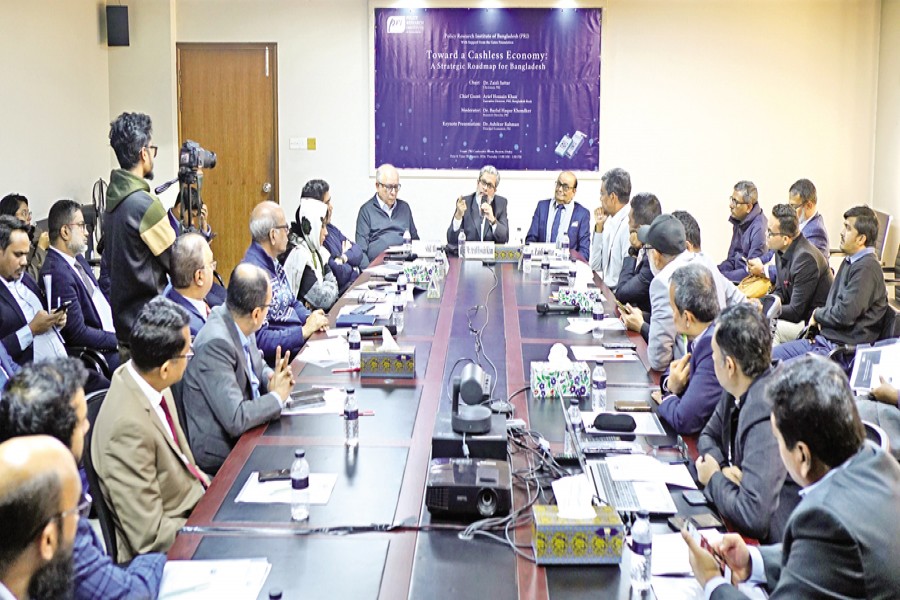
 The PRI-organised workshop in progress in the capital on Thursday. — FE Photo
 FE REPORT
Bangladesh had made steady progress in digital transactions since the early 1990s, with nearly half of all transactions now conducted digitally, but the country still lagged behind several neighbouring economies in establishing a cashless payment ecosystem, speakers said on Thursday.
They stressed the need for phased reforms, stronger consumer protection, and better regulatory coordination to ensure an inclusive transition toward a cashless economy.
The observations came from a stakeholder consultation workshop titled "Toward a Cashless Economy: A Strategic Roadmap for Bangladesh" and organised by the Policy Research Institute (PRI) of Bangladesh in PRI's Dhaka conference room with support from the Gates Foundation.
Arief Hossain Khan, executive director of the Bangladesh Bank, attended the event as the chief guest, while the session was chaired by Dr Zaidi Sattar, chairman of PRI.
Policymakers, regulators, economists, and financial sector representatives took part in the discussion following a keynote presentation by Dr Ashikur Rahman, principal economist at PRI.
The presentation highlighted challenges and policy priorities for expanding digital and cashless transactions.
It noted that digital transactions accounted for 48.73 per cent of the total transactions by volume in Bangladesh, but only 34.59 per cent by value, with banks dominating such transactions in terms of value, while mobile financial services (MFS) led by volume.
Bangladesh had made notable progress in digital payments -- driven mainly by MFS, QR-based payments and online banking -- but remained largely cash-dependent, it added.
The chief guest, Arief, said the central bank was actively promoting digital payments and financial inclusion to build a secure payment ecosystem.
However, he stressed that success in moving toward a cashless economy would depend on close coordination among regulators, financial institutions, and technology providers to ensure inclusiveness.
In his opening remarks, Dr Zaidi emphasised the need to properly capture the value generated by digital transactions in national accounts, noting that the adoption of the UN System of National Accounts (SNA) 2025 by the Bangladesh Bureau of Statistics would be critical to reflect digital advances in the gross domestic product (GDP).
"A country does not need to be rich or have high per capita income to transition to a cashless system," Dr Ashikur said citing India's Unified Payments Interface (UPI), which now accounted for about 85 per cent of the digital payments and nearly half of the global real-time transactions, processing over 640 million transactions daily.
China's Alipay ecosystem now served more than one billion users, with cash usage projected to fall to 3 per cent by 2027, he added.
According to the Global Findex Database 2025, Bangladesh's readiness for digital transactions still lagged behind India and China, despite the proven role of cashless systems in promoting financial inclusion, better economic governance, and lower transaction costs, he said.
The consultation highlighted financial inclusion, lower transaction costs, and improved economic governance as major benefits of a cashless transition, drawing lessons from global and regional experiences.
Dr Khurshid Alam, executive director of PRI, and Dr Bazlul H Khondker, research director of the institute, also spoke at the event.
jahid.rn@gmail.com
© 2026 - All Rights with The Financial Express