For decades, Bangladeshi migrant workers have been known for their resilience and hard work in foreign lands. But in an increasingly competitive global labour market, physical endurance alone is no longer enough. Communication is fast becoming the decisive factor, reports UNB.
Foreign language proficiency is emerging as a key determinant of job access and upward mobility for Bangladeshis, particularly those seeking employment abroad.
 Although Bangladesh sends a substantial number of workers overseas every year, majority of them lack functional proficiency in foreign languages beyond basic English or Arabic. As a result, many remain confined to low-paid and less secure positions with limited scope for career advancement.
From the Middle-East to Europe and East Asia, expatriate Bangladeshis often struggle to negotiate wages, understand contracts, or assert workplace rights due to language barriers.
In a study published by the Ministry of Expatriates' Welfare and Overseas Employment, 52 per cent of migrant workers identified language barriers as a major challenge.
The study, conducted among 479 migrant workers, mostly in the Gulf countries, was published in April 2023.
As per the Bureau of Manpower, Employment, and Training (BMET), a mandatory language test is now required for labour migration to South Korea, Japan, and Hong Kong, leading to a smoother experience for Bangladeshi workers in those regions.
Against this backdrop, the government has begun implementing commitments made in its election manifesto. The Ministry of Education has taken steps to introduce third-language education from the secondary level.
Speaking at a programme at the International Mother Language Institute on February 21, State Minister for Education and Primary and Mass Education Bobby Hajjaj said the government is considering making a foreign language compulsory alongside Bangla and English.
"The government is taking into account the demands of the international labour market and higher education. Languages such as Arabic, Chinese, Japanese and French will be introduced gradually to help students develop multilingual skills and expand employment opportunities."
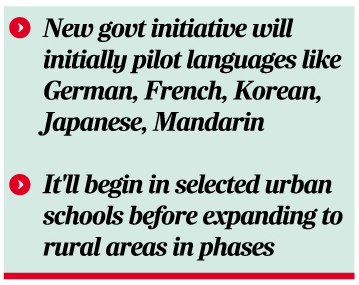
According to the ministry officials, the initiative will initially pilot globally in-demand languages including German, French, Korean, Japanese and Mandarin. The programme is expected to begin in selected urban schools before expanding to rural areas in phases.
Demand is particularly strong in destinations such as Japan, South Korea and Germany, where language proficiency is often mandatory for skilled or semi-skilled positions.
Even in the Middle-East countries, where Bangladeshi workers have long been present, employers increasingly value communication skills for supervisory and technical roles.
Professor Mohammad Absar Kamal, Acting Director at the Dhaka University Institute of Modern Languages (IML), said foreign languages have long been neglected in Bangladesh's education system, which has slowed the development of a multilingual academic and professional culture.
"These language skills equip students from diverse professional backgrounds with opportunities to gain valuable experiences abroad," he added.
Chinese Ambassador to Bangladesh Yao Wen has said a target has been set to bring around 10,000 students of Bangladesh under Chinese language education programmes.
Speaking at a meeting at the Secretariat on February 24, the Chinese envoy said the initiative is aimed at creating employment opportunities in nearly 1,000 Chinese companies currently operating in Bangladesh and developing a skilled workforce for the international job market.
© 2026 - All Rights with The Financial Express