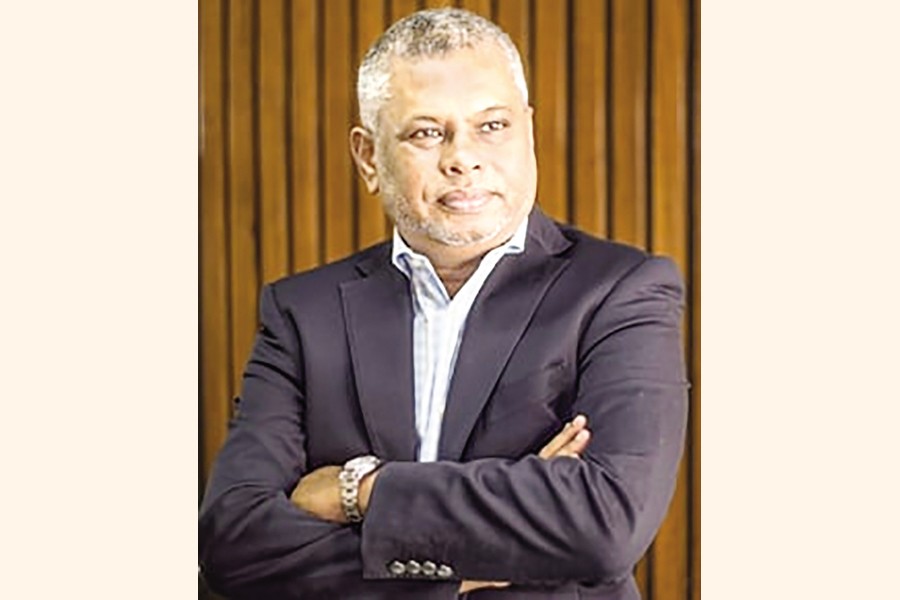
 Mohammed Amirul Haque, President of Bangladesh Cement Manufacturers Association
 Cement manufacturers in Bangladesh fear existential crisis in recent times due mainly to an irrational tax burden and lack of policy support, says the top representative of the sector to narrate how the industry's robust growth steers a reverse course.
Mohammed Amirul Haque, President of Bangladesh Cement Manufacturers Association (BCMA), also says amid many odds in the backdrop of overall economic sluggishness, cement companies have been incurring a loss nowadays.
"Cement manufacturers are now overburdened with taxes. Different types of taxes have been levied on us without proper justification, causing us to suffer seriously," he told The Financial Express (FE) during an exclusive interview.
Some 2.0-percent Advance Income Tax (AIT) is imposed on clinker import, he says. And taxmen over-estimate the raw material, causing uneven pressure on them.
"Say, for example, per-tonne clinker is purchased at $45 or $47 per tonne, tax officials made assessment of the AIT assuming the price is $52.5 per tonne." Another 3.0-percent AIT is imposed on slag. And the assessment is made on $30 per tonne whereas the actual value is $19.
In addition to these, there are 5.0-percent AIT on limestone imports, 3.0 per cent on fly ash, and 5.0 per cent on gypsum. There are also burdens of "irrational" supplementary and customs duties at different stages of procurement.
"The discrepancy forces companies to pay higher advance taxes than they should, severely affecting their cash flow," laments Mr Haque, who is the founder-Managing Director and CEO of Premier Cement Mills Limited.
"If we (cement makers) siphoned off the money through under-invoicing, then legal action should be taken against us."
After paying advance taxes, a miller sells the finished goods after ninety days when a miller has to pay interest on the money invested. "Even a matter of grief is that the refund is not adjusted with due diligence when a cement maker pays income tax."
Though there are advance taxes at import level, there is AIT at the sales stage, too, the association chief points out and calls it double taxation.
"All mechanisms are there to make a company a losing concern. No one in the cement industry is making a profit," claims the industrialist, who has also been involved with various other businesses such as trading and shipping, agriculture, fishing, and real estate, among others, for the last three decades.
"Regarding the issues we have been telling the government, the National Board of Revenue (NBR), and ministers concerned." Lately they have also approached the advisers of the interim government after a new chapter of 'discrimination-free' Bangladesh emerged.
"But no one in the tax administration has paid any attention--nobody has listened to us."
Focussing on the backdrop of the cement sector, Mr Haque recounts that Bangladesh turned a cement- manufacturing nation from an importing one within two-three decades thanks to the country's private sector.
"Jubilant entrepreneurs of the country have nourished the country's cement sector to the present situation," he says, adding that since 2000, Bangladesh is no more a cement- importing country.
Private -sector operators like Shah Cement, Premier, Bashundhara, Crown, Seven Rings, Meghna, Akij have been running the business in this sector with relentless effort.
"The country must acknowledge their credit as they turned an import- oriented sector to an export-oriented one."
There has been an estimated investment worth Tk 600 billion (60,000 crore) in the country's cement sector, he mentions, adding that the cement industry is capital-intensive.
In addition to tax issues, they also face setbacks due to energy crunch and inadequate logistics ecosystems in the country.
Many companies, he explains, continue running their factories not because of profitability but because shutting down would be costlier given outstanding loans, employee commitments, and contractual obligations.
This means, after managing such a large industry, if no one can make a profit, no one will want to enter this industry again.
"We are discouraging the next generation. Please, do not enter this industry," he says in a huff, adding that the current generation of business leaders is somehow managing to navigate these difficulties.
"But what worries me most is a lack of incentive for the next generation. If young entrepreneurs see only harassment, arbitrary taxation, and little respect for their contribution, why would they step into this sector?"
He has a word on the overall business environment in the country: "If you compare with competing nations, our cost of doing business is far higher. When the local market is highly competitive, passing these costs on to the consumer is nearly impossible. That leaves companies trapped between rising expenses and capped selling prices."
However, the BCMA president acknowledges that some quarters within the government-such as the finance and commerce advisers, the central bank governor and the BIDA Chairman-have been supportive and willing to listen.
But he makes it clear that piecemeal goodwill is not enough. What is needed is a consolidated government-industry mechanism where issues are heard regularly and acted upon swiftly.
saif.febd@gmail.com
© 2026 - All Rights with The Financial Express