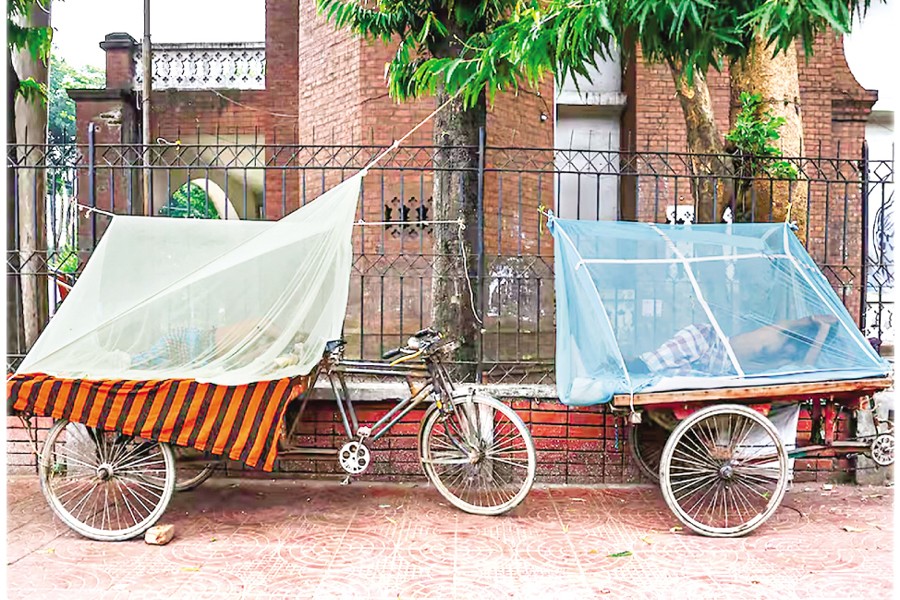
 People sleep on three-wheeler carts using mosquito nets, following a surge in the number of dengue-infected patients, in Dhaka, on June 25, 2025. — Reuters file photo
  Mosquito-borne diseases kill more than one million people and infect up to 700 million each year - almost one in ten people. 128 years ago, mosquito-borne disease was first discovered by a British doctor on August 20, 1897. Sir Ronald Ross found the malaria parasite in the stomach of a female Anopheles mosquito, providing the first evidence that mosquitoes transmit malaria between humans.
To commemorate this moment in history, World Mosquito Day (WMD) was founded. Each year, World Mosquito Day presents us with an opportunity to raise awareness of the dangers posed by mosquito-borne diseases and the ongoing efforts to combat the world's deadliest creature.
According to the World Mosquito Program, 2024 was the worst year on record for dengue. More than 14 million cases were reported worldwide, with close to 12,000 dengue-related deaths. The year before, the WHO reported over 6.5 million cases with more than 7,300 deaths. This year, the world has so far seen 3.6 million dengue cases and over 1,900 deaths reported from 94 countries and territories. The fastest spreading mosquito-borne disease in the world shows no signs of relenting, and there has been a notable surge in the Pacific in 2025, with Samoa, Fiji, Tonga, and the Cook Islands all declaring outbreaks.
Senior Director of Field Entomology at WMP (World Mosquito Program), Dr Greg Devine said, "The general trend in dengue cases globally is relentless upwards. Sustainable ways to combat dengue, such as the Wolbachia method, are desperately needed."
In the last couple of years, Bangladesh has also been hitting record numbers of Dengue cases. According to a National Institute of Medicine research article, 2023 was the deadliest year with 321,179 cases and 1,705 deaths. 2024 had more relief than 2023, but still recorded 101,211 cases and 575 deaths across the country, according to the Dengue Dashboard for Bangladesh by the Health Emergency Control Room. Even this year, as of mid-August, Bangladesh recorded over 100 deaths due to this disease.
Malaria is another deadly mosquito-borne disease that claims hundreds of thousands of lives worldwide each year. In 2023, over 263 million cases were reported worldwide with 597,000 deaths, according to the WHO. Bangladesh reported 16,567 cases with 6 deaths that year, and then 13,099 cases in 2024 with 6 deaths. The World Health Organization (WHO) reports that Bangladesh is home to 36 Anopheles species, of which four are considered the primary vectors of malaria.
In recent weeks, the WHO has raised an urgent call to prevent a repeat of an epidemic of chikungunya that swept the globe two decades ago, as new outbreaks linked to the Indian Ocean region spread to Europe and other continents. An estimated 5.6 billion people live in areas across 119 countries at risk from the virus. Back in 2017, Bangladesh saw an outbreak of the Chikungunya virus that caused over 13,800 people in Dhaka to seek treatment within just four and a half months. After 7 years of the virus's absence in Bangladesh, 2024 saw at least 67 Chikungunya cases. Moreover, 2024 saw a global rise in Chikungunya virus infection reports, with more than 620,000 reports and 213 deaths worldwide.
Zika virus, a lesser-known virus to people, which is also transmitted through infected Aedes Mosquitoes, has also been identified in Bangladesh. The first-ever Zika case in Bangladesh was confirmed in 2016, which the IEDCR detected in retrospective surveillance. The WHO declared a public health emergency of international concern regarding microcephaly, other neurological disorders, and the Zika virus from February to November 2016. According to the WHO, to date, a total of 89 countries and territories have reported evidence of mosquito-transmitted Zika virus infection. Cases of Zika virus disease declined from 2017 onwards globally; however, the icddr,b researchers confirmed a cluster of cases in Dhaka, Bangladesh, in May 2025. The five cases were discovered in patient samples collected in 2023. All five patients lived within a kilometre of each other, were sampled within a month of each other, and had no travel history outside the country for two years before they presented with symptoms.
VACCINES FOR MALARIA: After 128 years of discovering mosquito-borne diseases, we still do not have proper prevention methods for many of these diseases, and we depend more on cures. However, some vaccines have been licensed and also recommended by the WHO. Two malaria vaccines (RTS,S/AS01 (Mosquirix) and R21/Matrix-M) are currently recommended by WHO for use in children living in moderate to high malaria transmission areas. Current malaria vaccines reduce uncomplicated malaria by around 40 per cent, severe malaria by around 30 per cent, and all-cause mortality by 13 per cent. While malaria exists in Bangladesh, a widespread malaria vaccination program is not yet in place. A large-scale community trial of the R21/Matrix-M vaccine is reportedly underway in the Chittagong Hill Tracts, testing its efficacy and feasibility.
As for Dengue, currently, only one vaccine is available for dengue prevention. WHO recommends the use of Q-denga® (TAK-003) in children aged 6-16 years in settings with high intensity of dengue transmission. This is also not available widely in Bangladesh. For Chikungunya, a live-attenuated vaccine called IXCHIQ is approved in the US for individuals 18 years and older, but it is not widely available in other countries. For the Zika virus, unfortunately, no licensed vaccine exists for public use as of yet.
WOLBACHIA: Various global and local organisations are working to find solutions to these mosquito-borne diseases. World Mosquito Program (WMP) is a not-for-profit initiative focused on protecting communities from mosquito-borne diseases. It often partners with governments and funders, working for the betterment of the situation. On the other hand, Oxitec is a British biotechnology company that develops genetically modified insects in order to improve public health and food security through insect control. It engineered Aedes aegypti ("Friendly™") for population suppression; also launched Sparks™, a platform to scale Wolbachia (a common type of bacteria found in insects that can be used to control the population of Aedes aegypti mosquitoes) replacement at the commercial level. US-based MosquitoMate is a Wolbachia-based incompatible insect technique (IIT) company and is frequently cited alongside Oxitec in policy/field literature.
In Bangladesh, new scientific research offers fresh hope for controlling dengue, as researchers develop a strain of Wolbachia-infected Aedes aegypti mosquitoes adapted to local conditions in Dhaka. icddr,b said in a press release in May 2025 that the development brings Bangladesh closer to deploying a safe, biological tool to combat arboviral diseases. Local startup THiNK Group (still in its early period) - "Moshar Machine" is a locally built mosquito-trap/IoT concept aiming to create "mosquito-free" zones and positioned for deployments with civic partners. Moreover, Start Network (Start Fund Bangladesh) is an NGO network that is using anticipatory alerts/forecasting for dengue surges; it aims to fill an innovation gap in outbreak prediction. Local steps also include using odomos during the monsoon season.
In addition to DSCC and DNCC collaborating with icddr,b, the government is also collaborating with international organisations like the World Bank and UNICEF to secure funding and technical support. In July 2023, the government planned to initiate a substantial Tk1,288 crore project to control the mosquito population. Apart from these, every year the city corporations launch operations to clean surrounding areas in order to reduce mosquitoes, especially during the monsoon season when cases of dengue, malaria, and chikungunya are high in Bangladesh. As a part of the government's awareness program, DNCC engaged 5,500 volunteers to raise public awareness and installed modern mosquito traps in public areas this year.
To control mosquito-borne diseases, Bangladesh government can try deploying robotics or Al systems (like the "Dragonfly" robot) to scan and map mosquito hotspots quickly, releasing male Aedes mosquitoes infected with Wolbachia to suppress wild populations ( a proven method in countries like Thailand), and even using traditional "jatra" plays, mobile AV vans, and loudspeaker (miking) announcements in remote villages to engage and educate.
Even with the existing steps, Bangladesh is endangered with mosquito-borne diseases as well as the world; this is why, on World Mosquito Day, we can raise awareness, and we can hope that the international and national parties, the government and its partner organizations, and the NGOs and the startups will work together to bring the country, as well as the world, closer to a safer environment.
khalidsaifullahkhanjuel@gmail.com
© 2026 - All Rights with The Financial Express