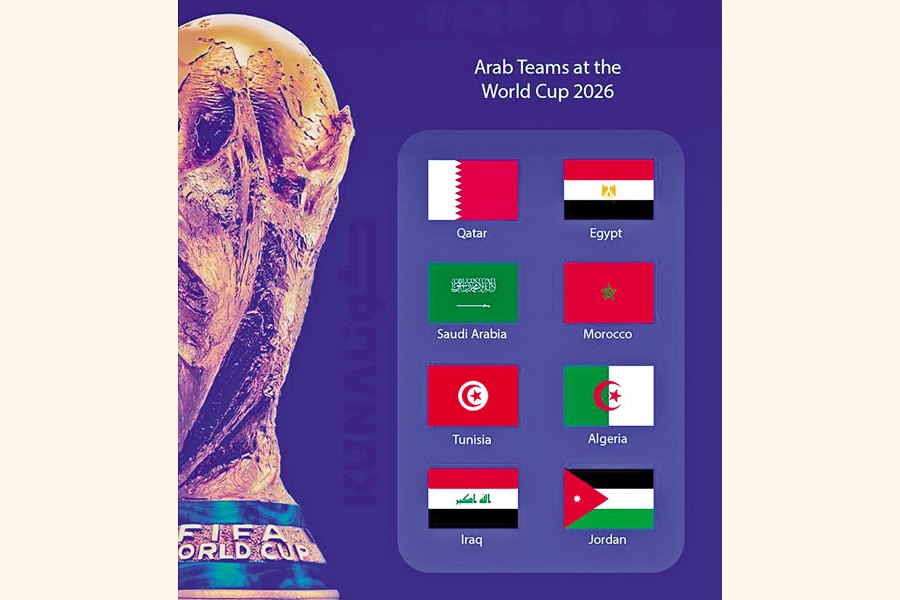
DUBAI, June 17 (Agencies): The 2026 FIFA World Cup is set to give the Arab world its biggest stage yet, with a record eight teams from the region qualifying for the tournament across the US, Canada and Mexico.
A record eight Arab nations are taking part in the 2026 FIFA World Cup, giving the Arab world its largest-ever representation on football's biggest stage across the United States, Canada and Mexico.
Saudi Arabia, Qatar, Jordan, Morocco, Tunisia, Egypt, Algeria and Iraq are on the team sheet this year, doubling the previous Arab record set in 2018. Jordan will make its first World Cup appearance, while Iraq returns after a 40-year absence.
The expanded tournament, which brings together 48 teams for the first time, is expected to draw 6.5 million attendees and add up to $40.9 billion to global GDP, according to organiser estimates based on an Oxford Economics study. The final impact, however, may prove more modest once ticket costs, travel expenses, hotel pricing and host-city pressures are taken into account.
Josh Gilbert, Lead Analyst, Middle East at eToro, said the bigger story for Arab economies is the exposure that comes with football's largest global event.
"For the countries involved, the prize isn't necessarily the tournament itself, but the attention it brings. A strong run in the tournament puts a country in front of a global audience, generating exposure that no tourism budget can replicate," Gilbert said.
Tourism gains could outlast the tournament
Morocco's 2022 campaign remains the clearest regional case study. The country reached the semi-finals in Qatar and then welcomed 14.5 million visitors in 2023, up 34 per cent from the previous year. Football was not the only reason for that jump, but Gilbert said the tournament helped keep Morocco in the global conversation and supported tourism demand well after the final whistle.
The same effect could now work across a much wider Arab line-up, especially if one or more teams manages a deep run in the tournament. Tourism boards, airlines, hotels, restaurants, retailers and consumer brands stand to gain from the visibility that comes with World Cup momentum.
"World Cup fever is hard to ignore, and it extends well beyond the host cities," Gilbert said.
That is relevant for the UAE and the wider Gulf, where tourism and hospitality have already been expanding. The GCC attracted 72.2 million inbound tourists in 2024, up 51.5 per cent from 2019 levels, while UAE hotel establishments welcomed a record 32.34 million guests in 2025.
The UAE is not hosting matches, but the World Cup economy is expected to flow through local spending channels.
Fans are likely to spend on flights, hotel stays, watch parties, sports bars, restaurants, food delivery, merchandise, advertising, payments and streaming subscriptions. Broadcasters, digital platforms, payment providers and consumer brands are also expected to benefit from higher engagement during the tournament.
Saudi Arabia has led regional football investment in recent years, while Qatar, the UAE and Morocco have used sport as part of wider diversification plans built around tourism, global visibility and consumer-sector growth.
"The World Cup will not transform regional economies on its own, but it is a tailwind for sectors that were already moving in the right direction and with more Arab teams involved than ever before, MENA has a bigger stage," Gilbert said.
A general view of the inside of the stadium ahead of the FIFA World Cup 2026 Group D match between USA and Paraguay at Los Angeles Stadium on June 11, 2026 in Los Angeles, California.
© 2026 - All Rights with The Financial Express