RACE Management has issued a legal notice against the securities regulator, accusing it of contempt of court for proceeding with the liquidation or conversion process of close-ended funds.
The country's largest private asset management company, which currently controls more than 47 per cent of the listed mutual fund sector, however, has not obtained any court order against the liquidation or conversion of listed funds.
By contempt of court, RACE means that several petitions filed by the asset manager over regulatory actions against it are yet to be disposed of. RACE argues that until its legal battle with the Bangladesh Securities and Exchange Commission (BSEC) is resolved, the fate of listed pooled funds should remain pending.
The Financial Express has seen a copy of the legal notice signed by barrister Md Mustafizur Rahman, who is representing RACE Management in court.
The conversion or liquidation of funds is due to happen under the revised mutual fund rules that came into effect in November last year.
According to the rules, if units of any fund trade at more than a 25 per cent discount to their net asset value (NAV) on the bourses, the fund should be liquidated or converted into open-ended funds, subject to majority votes from investors.
RACE manages 10 large funds with assets worth nearly Tk 21.34 billion. The five-year compound annual growth rate of all the funds is negative, reflecting the asset manager's poor performance.
Despite persistent investor losses, RACE has managed to pocket a staggering Tk 6 billion in management fees, according to the BSEC.
The lack of return on investments is why investors have turned away from the funds managed by RACE, causing the units to trade at heavy discounts in the secondary market.
The legal notice followed a BSEC order issued on May 7 targeting the conversion or winding-up of closed-end mutual funds managed by RACE.
Law Valley, representing RACE, served the notice demanding that the regulatory order be suspended. Otherwise, the BSEC would face severe judicial backlash, according to the notice.
RACE has framed itself as a victim of "regulatory targeting".
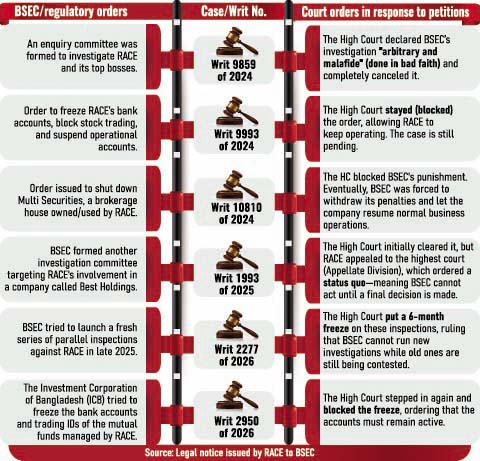
Earlier, the market watchdog suspended BO accounts opened by RACE, restricted transactions through them and instructed trustees and custodians to take control of the funds over alleged misconduct against the interests of unitholders.
RACE allegedly opened and operated multiple BO (Beneficiary Owner) accounts with separate brokerage houses for handling the underlying securities of assets under its management, instead of keeping the securities under approved custodians in line with the Mutual Fund Rules, 2001.
This arrangement, the BSEC said, created risks for unitholders because fund assets could potentially be traded or moved outside normal custodian oversight.
The regulator also investigated allegations of irregular block transactions, trading between RACE-managed funds, and possible diversion or mismanagement of assets.
The BSEC has slapped RACE with fines for blatant irregularities in 11 of its 12 managed funds, including two open-ended funds.
RACE vigorously disputes these penalties and the subsequent May 7 fund restructuring order. In its legal defence, the asset manager claims that its hands had been tied by the BSEC itself.
RACE, in the legal document, said, "The alleged non-compliance arises solely from regulatory actions, and not from any negligence or failure on the part of RACE or the mutual funds."
The fund manager further argued that the restrictions imposed by the regulator - such as the suspension of BO accounts - created a state of legal "impossibility of performance", rendering it physically unable to buy bonds or rebalance portfolios.
The legal notice, however, also cited court orders that reversed some of the regulatory actions. For example, a High Court order led to the unfreezing of frozen bank accounts, allowing RACE to continue operating.
RACE is currently using an intricate web of High Court and Appellate Division stay orders to block the BSEC from taking disciplinary action or removing it from management.
Market reform task forces argue that the regulator's failure to decisively remove failing asset managers years ago is what crippled the mutual fund sector in the first place.
As the legal battle drags on, ordinary retail investors remain the ultimate victims, with their capital locked away in deeply discounted funds.
The roots of the current standoff trace back to an unprecedented regulatory intervention that fundamentally altered the mechanics of the country's capital market.
Under the original BSEC (Mutual Fund) Rules, 2001, all closed-end mutual funds were strictly bound to a 10-year lifespan. Upon maturity, asset managers were legally obligated either to wind up the funds - liquidating the assets and returning cash to retail investors - or convert them into open-ended structures.
In 2018, when several of RACE's funds were about to mature, the BSEC made 3a controversial policy shift by ordering an extension of closed-end mutual funds for an additional 10 years.
This decade-long extension effectively trapped billions of taka in public capital and fractured investor trust.
In healthy global markets, closed-end funds trading at a discount naturally correct as they approach maturity because savvy investors buy units to claim the full NAV upon liquidation. By pushing redemption deadlines into the late 2020s and 2030s, the BSEC eliminated any immediate arbitrage incentive.
With no exit path in sight, market confidence evaporated. RACE-managed funds began trading at chronic and severe discounts - often 30-50 per cent below their actual net asset values - leaving trapped retail investors with no choice but to absorb catastrophic losses if they exited early through the secondary market.
farhan.fardaus@gmail.com
© 2026 - All Rights with The Financial Express