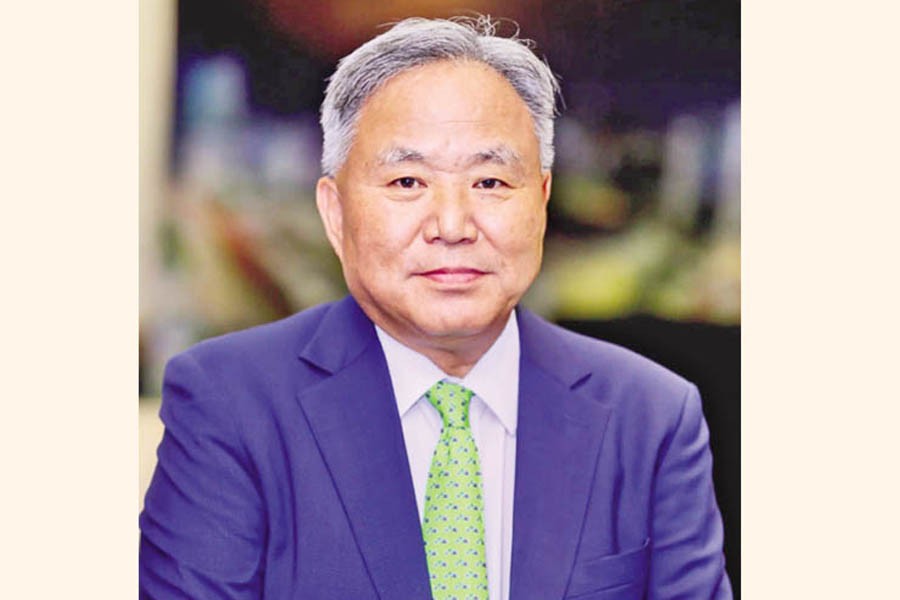
 South Korean Ambassador Park Young-sik
 Bangladesh remains a "promising destination" for South Korean investment, but further business-environment upgrade is crucial to attracting sustained foreign capital and managing a smooth transition beyond least-developed country (LDC) status.
This is how South Korean Ambassador in Dhaka Park Young-sik wraps up his experiences and strikes a note of cautious optimism, as his country seeks early conclusion of a comprehensive partnership deal.
In an exclusive interview with The Financial Express, the outgoing ambassador of the Republic of Korea outlines Seoul's growing economic engagement with the country, underscoring expanding investment in manufacturing, ongoing infrastructure cooperation and the strategic importance of the proposed Comprehensive Economic Partnership Agreement (CEPA) between the two Asian nations.
Park, a career diplomat with extensive experience in trade and development cooperation, took up his posting in Dhaka amid a renewed push to expand the newly industrialized country's economic presence in South Asia.
Known for his stance on private-sector-led development and institutional reform, he has made diversification beyond garments and support for Bangladesh's LDC transition central to his diplomatic agenda.
South Korea is currently the fifth-largest source of foreign direct investment (FDI) in Bangladesh. In recent years, Korean companies have diversified beyond garments into sectors such as automobiles, mobile phones and consumer electronics, often through joint ventures with local firms.
Samsung Electronics produces consumer goods, including mobile phones, in Bangladesh, while Hyundai and Kia vehicles are assembled locally. These investments, Park says, are creating higher-quality jobs and helping build domestic manufacturing capacity.
"Bangladesh continues to be a promising destination for South Korean investors, with its rapidly growing economy, strategic location and abundant labour force," he tells the reputed business daily in Bangladesh.
Notwithstanding such optimism, Park points to persistent structural challenges that could deter future investment unless addressed. These include delays in visa issuance and renewal, bottlenecks in customs clearance, high tariffs on raw materials and intermediate goods, and difficulties in accessing foreign currency.
"Prompt payment in US dollars after project completion and the ability to repatriate profits with ease are essential for foreign investors," he suggests, adding that progress in these areas would "certainly encourage more Korean FDI".
Such concerns echo those raised by other foreign investors, as Bangladesh grapples with foreign-exchange inadequacies and a tightening of capital controls amid broader macroeconomic pressures.
He notes that Korean companies have played a pivotal role in Bangladesh's economic story, particularly in the rise of the ready-made garment (RMG) sector, which has driven export growth for decades.
Park describes the garment industry as the historical backbone of bilateral ties, but argues that the relationship is now entering a new phase.
"In recent years, we have seen remarkable developments in diversifying areas of cooperation beyond RMG, particularly in manufacturing and infrastructure."
South Korea, he stresses, does not pursue strategic interests in Bangladesh beyond economic cooperation. Instead, the focus remains on long-term development partnerships that support industrial growth and job creation.
The proposed CEPA, now under negotiation, could become next major milestone in bilateral relations. Talks began in November 2025, with a second round scheduled for January next year in Dhaka.
Bilateral trade between the two countries peaked at around US$3.0bn in 2023 but has since stagnated, largely due to Bangladesh's limited range of export products for the Korean market.
"A CEPA could reduce trade barriers, expand market access and remove obstacles to foreign investment," Park hopes, arguing that it would create new opportunities for businesses on both sides.
The agreement could also help Bangladesh strengthen its position in South Korea's garment market. At present, Bangladesh accounts for only about 5.0 per cent of Korea's RMG-related imports, while Vietnam enjoys a competitive edge through multiple trade agreements, including a bilateral free-trade deal with Korea, the Korea-Asean FTA and the Regional Comprehensive Economic Partnership (RCEP).
"A CEPA with Bangladesh would help improve its competitiveness in this regard," Park says.
As Bangladesh is set to graduate from LDC status in 2026 -- and preferential trade benefits such as GSP set to expire in 2029 -- Park urges policymakers to focus on the quality of growth rather than headline expansion.
"Quality growth must be driven by innovation, knowledge and technology," he reminds, warning that without sustained reforms the country risks falling into middle-income trap.
Although international discussions are under way on a possible deferral of LDC graduation, Park mentions that Bangladesh still has roughly four years to prepare and should use that time to align with international standards and embrace competition.
The envoy feels continued reforms in key sectors such as banking, energy and taxation are extremely important to ensure resilient and sustainable growth.
South Korea is also seeking to deepen its role in Bangladesh's infrastructure development, building on decades of engagement. Since 1973, a total of 144 Korean companies have been involved with 257 infrastructure projects in Bangladesh, with total investments coming to $8.82 billion as of April 2025.
Korean firms, Park says, bring distinct advantages, including high construction standards, timely project delivery and the creation of local jobs.
Bangladesh also has access to South Korea's Economic Development Cooperation Fund (EDCF), which offers concessional financing with interest rates as low as 0.01-0.05 per cent and repayment periods of up to 40 years. The funds have already been expanded to $3.0 billion through 2027, with the possibility of further increases.
As Bangladesh prepares for a critical economic and political transition, Seoul appears keen to anchor its partnership in trade, investment and infrastructure -- with the proposed CEPA emerging as a key test of whether the relationship can evolve from a garment-centric past to a more diversified and resilient future.
mirmostafiz@yahoo.com
© 2026 - All Rights with The Financial Express