With LDC graduation set for November 2026, leading economists and business leaders on Wednesday warned that the fragile macroeconomic situation requires urgent structural reforms, and a shift from promises to effective implementation.
They said that restoring stability will require strict macroeconomic discipline to address the challenges of persistent inflation, sluggish private investment, banking sector distress, energy vulnerabilities and a narrow revenue base.
They agreed that coordinated monetary and fiscal policies, deeper financial reforms and consistent policy execution would determine whether Bangladesh can shift to a more resilient and inclusive growth path.
They made the observations at a roundtable, titled "Looking into Bangladesh's Development: Priorities for the Newly Elected Government in the Short to Medium Term", organised jointly by the Centre for Policy Dialogue and The Daily Star at the BRAC Centre Inn in the city.
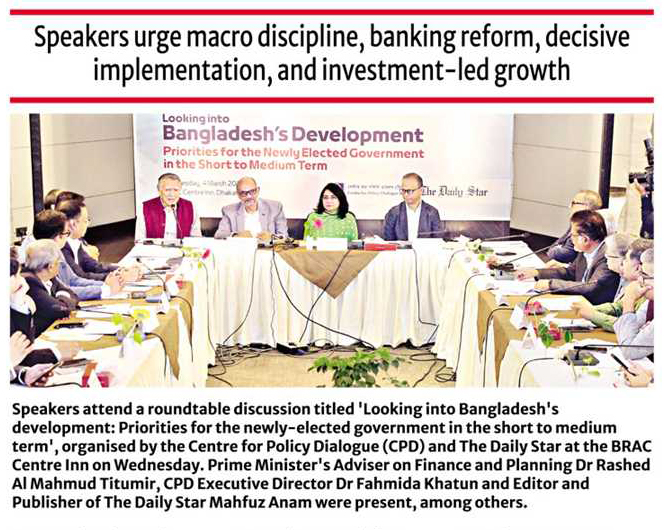
Speaking as chief guest, Dr Rashed Al Mahmud Titumir, Prime Minister's Adviser on Finance and Planning, said the government intends to overhaul what he described as a debt-driven, consumption-led model and transition towards an investment-led framework supported by both domestic and foreign direct investment.
A central plank of this reform agenda is raising the tax-to-GDP ratio to 15 per cent by 2035 from the current 6.78 per cent.
He outlined a phased strategy to strengthen domestic resource mobilisation and reduce reliance on Statutory Regulatory Orders (SROs), which he said distort market competition.
He said the government plans to move from identity-based incentives to performance-based, ex-post subsidies, drawing lessons from the garments sector, while reducing overdependence on the Large Taxpayers Unit.
Rather than adopting conventional austerity, he argued, the priority should be eliminating waste and improving public expenditure efficiency, including addressing the Tk 60,000 crore annual energy subsidy burden.
Dr Fahmida Khatun, Executive Director of the Centre for Policy Dialogue, described the economy as being at a "critical juncture" ahead of LDC graduation.
GDP growth slowed to 3.49 per cent in FY2025 before edging up to 4.50 per cent in the first quarter of FY2026. Inflation eased to 8.66 per cent in January 2026, but wage growth remained subdued.
Private sector credit growth fell to 6.10 per cent in December 2025, while government borrowing from banks rose sharply. The non-performing loan (NPL) ratio climbed to 35.73 per cent in September 2025 before declining to 30.60 per cent in December after rescheduling.
She called for coordinated fiscal and monetary discipline, expansion of the tax base, digitalisation of revenue administration, banking sector reform and export diversification beyond readymade garments.
Dr Sadiq Ahmed, Vice Chairman of the Policy Research Institute of Bangladesh, said growth hovering around 3.5 per cent, rising poverty and open unemployment among educated youth exceeding 10 per cent underscore the urgency of reform.
Inflation at around 8.5 per cent remains well above the global average, eroding purchasing power. He identified fiscal management, balance-of-payments stability and restoration of banking health as three priority areas.
Financial sector fragility drew particular attention.
Dr Md Main Uddin, former chairman of the Department of Banking and Insurance at the University of Dhaka, described NPLs as a "malignancy" in the system.
He urged firm action against wilful defaulters, including blacklisting and restrictions on travel and business activity, and recommended capping single-borrower exposure at 10 per cent of a bank's capital. Political resolve, he said, is essential.
AK Azad, President of the International Chamber of Commerce Bangladesh, noted that default rates stand at around 36 per cent, approaching 50 per cent in some state-owned banks.
With private sector credit growth at roughly 6 per cent and government borrowing from banks reaching 32.19 per cent, sustainable expansion remains elusive. Without strict action against defaulters and improved access to gas and electricity, new investment will be constrained.
Dr Mohammed Helal Uddin, Executive Vice Chairman of the Microcredit Regulatory Authority, said credit and deposit growth remain weak.
Around 20 banks recorded credit growth between 0 and 5 per cent, while 14 saw negative growth. On the deposit side, 26 banks registered negative growth. Credit expansion below 6 per cent, he warned, cannot support recovery or contain inflation.
Mahfuz Anam, Editor and Publisher of The Daily Star, argued that implementation is more critical than policy design.
He criticised bureaucratic delays and cost overruns in development projects and called for comprehensive digitalisation across ministries, supported by sector-based advisory mechanisms.
Mahmud Hasan Khan (Babu), President of the Bangladesh Garment Manufacturers and Exporters Association, welcomed the government's openness to dialogue but stressed the need for policy stability and consultation.
He proposed district-based tax targets to broaden revenue collection.
Shams Mahmud, former president of the Dhaka Chamber of Commerce and Industry, cautioned that LDC graduation could erode trade preferences.
He urged renegotiation of Generalised System of Preferences arrangements and pursuit of free trade agreements to preserve export competitiveness.
Showkat Aziz Russell, President of the Bangladesh Textile Mills Association, said around 350 garment factories and more than 50 textile mills have closed. Some viable firms face financing gaps of about Tk 2.0 billion.
He called for refinancing mechanisms rather than repeated short-term loan rescheduling.
Asif Ibrahim, former director of Bangladesh Garment Manufacturers and Exporters Association and vice-chairman of NewAge Group, stressed that reviving private investment is essential for job creation.
He urged streamlining the Bangladesh Investment Development Authority, reducing bureaucratic overlap and updating tax incentives for labour-intensive, high-tech and green industries, alongside industry-led vocational training.
Energy analyst Shafiqul Alam noted that Bangladesh imports around 62 per cent of its primary energy, exposing it to global price volatility.
He called for stronger conservation measures, repair of gas pipeline leakages and regional cooperation, including hydropower imports from Nepal.
Syed Almas Kabir, former BASIS President, urged a shift from low-cost labour dependence to a knowledge-based digital economy.
With artificial intelligence and robotics reshaping manufacturing, he advocated a national reskilling strategy, research and development incentives, promotion of local intellectual property and a unified digital architecture.
Nurul Gani Shovon, President of NASCIB, called for stronger district-level SME support and revival of specialised rural credit programmes, alongside single-digit lending rates to stimulate small-scale investment.
Across the discussion, speakers converged on one message: policy consistency, institutional reform and effective execution will determine whether Bangladesh can navigate the challenges ahead and emerge from LDC status with a stronger, more inclusive economic foundation.
bdsmile@gmail.com, jahid.rn@gmail.com
© 2026 - All Rights with The Financial Express