Cottage, Micro, Small and Medium Enterprises (CMSMEs) are likely to be designated as a priority sector in the upcoming national budget for FY'27, Adviser to the Prime Minister on Finance and Planning Dr. Rashed Al Mahmud Titumir said on Wednesday.
Referring to the election manifesto of the ruling BNP, he said the government is placing strong emphasis on economic democratisation and employment generation, describing CMSMEs as the root of the employment.
To revive economic activity from the prolonged sluggishness, the government may introduce key fiscal measures to accelerate the CMSME sector, he said at a focus group discussion as the chief guest.
These measures could include incentives, tax structure reforms, and the formation of a joint fund, he said, adding: "As we're committed, we want to see the sector flourishing significantly in the coming days."
 The discussion, titled 'Synergizing the Banking Sector: Lenders' and Borrowers' Perspective', was organised by the Dhaka Chamber of Commerce and Industry (DCCI) at its auditorium.
Highlighting the need for a coordinated economic framework, Dr. Titumir said reforms to the Bank Company Act and other financial laws are inevitable.
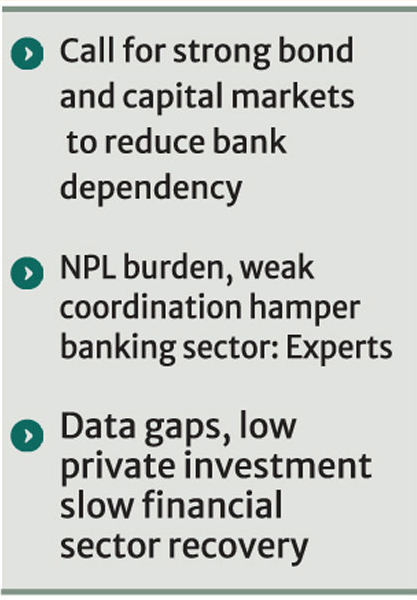
He also stressed the importance of developing a strong bond market and capital market as a sustainable alternative financing system.
The government is committed to supporting labour-intensive industries, reopening closed state-run factories and boosting industrial production, while extending support to women entrepreneurs, he added.
Acknowledging the current fragility of the financial sector, the adviser assured stakeholders that necessary steps for policy formulations and structural reforms are being undertaken to ensure systemic recovery and stability.
Chairman of Bangladesh Association of Banks (BAB) Abdul Hai Sarkar said that there is no alternative to simplifying SME financing, noting that private banks have now come forward to support this sector.
However, he pointed to a lack of coordination between policymakers and stakeholders, which needs to be addressed.
Moderating the session, DCCI President Taskeen Ahmed warned that the deterioration of asset quality and the rising burden of non-performing loans (NPLs) directly erode banks' deployable funds and raise credit risk exposure for banks.
Naushad Mostafa, Director (SME and Special Programs Department) of Bangladesh Bank (BB), said the lack of authentic and accurate data remains a major obstacle to effective decision-making.
He stressed the need for improved AI-based connectivity among service providers, financial institutions, and government agencies to ensure seamless data flow and more informed policymaking.
BB Director (Research) Selim Al Mamun cautioned that negative trends in the financial sector cannot be reversed overnight.
Despite excess liquidity in the system, private sector activity remains subdued due to macroeconomic instability, he said, underscoring the need to improve the ease of doing business to restore investor confidence.
Another BB Director (Research), Md. Abdul Wahab, emphasised the importance of alternative financing models.
"We have to create a strong bond market and a strong capital market as well," he said, urging the private sector to look beyond traditional bank loans and embrace alternative financing sources.
Managing Director of NCC Bank M. Shamsul Arefin said banks are increasingly prioritising financing for eco-friendly green projects and encouraged entrepreneurs to focus more on such ventures.
He noted that poor documentation among CMSME entrepreneurs is a major obstacle hindering their access to credit.
Deputy Managing Director of City Bank Ashanur Rahman said the implementation of IFRS 9 from next year will limit banks' ability to maintain excess loan provisions.
Noting that the potential of the CMSME sector is not being fully utilized, he called for expanding the central bank's Credit Guarantee Scheme and simplifying loan application documentation.
Rahman further stressed the necessity of establishing a dedicated marketplace for CMSME products. Without it, entrepreneurs will struggle to sell their goods, which would ultimately hinder banks' loan recovery and lending processes, he warned.
jubairfe1980@gmail.com
© 2026 - All Rights with The Financial Express