Industrial term loan disbursement declined sharply in the January-March quarter of the fiscal year 2025-26 as businesses remained cautious about making fresh investments amid tight liquidity, elevated borrowing costs, and persistent macroeconomic uncertainties.
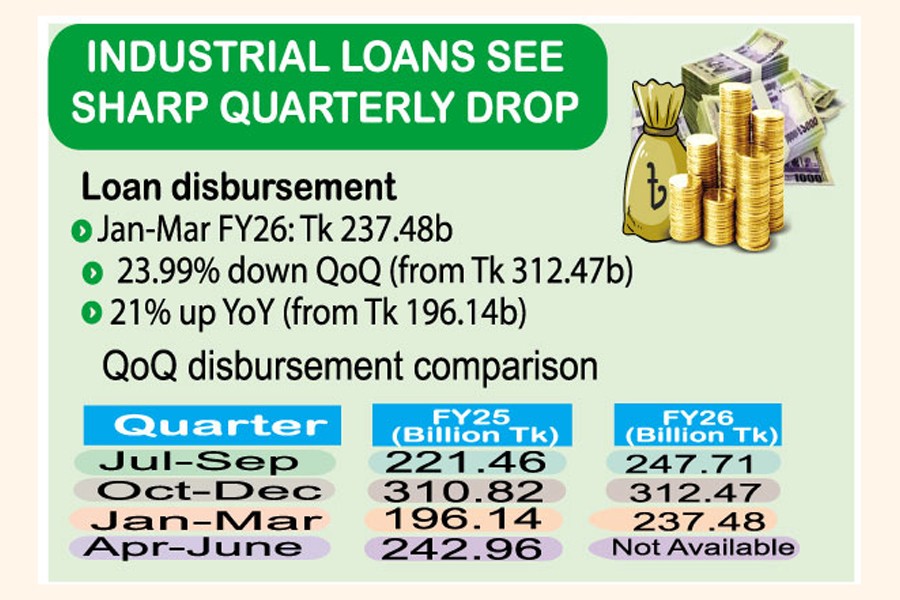
According to the latest Bangladesh Bank (BB) data, banks disbursed industrial term loans amounting to Tk 237.48 billion in the said period, marking a 23.99 per cent decline from Tk 312.47 billion in the previous quarter.
Despite the quarterly fall, industrial term loan disbursement increased by around 21 per cent year-on-year from Tk 196.14 billion recorded in the corresponding quarter of FY25.
The data showed industrial term loan disbursement stood at Tk 247.71 billion in the July-September quarter of FY26 before rising by more than 26 per cent to Tk 312.47 billion in the October-December quarter.
The subsequent decline in the January-March period underscores the continued volatility in long-term industrial financing.
A similar pattern was observed in the previous fiscal year.
Industrial term loan disbursement increased from Tk 221.46 billion in the July-September quarter of FY25 to Tk 310.82 billion in the October-December quarter, before falling to Tk 196.14 billion in the January-March period, reflecting uneven investment demand across quarters.
Overall, industrial term loan disbursement reached Tk 971.38 billion in FY25, up from Tk 887.38 billion in FY24, despite persistent macroeconomic headwinds.
Bankers attributed the fluctuating lending trend to persistent liquidity constraints, higher lending rates, and subdued private sector investment appetite.
Meanwhile, industrial term loan recovery lost momentum in the January-March quarter of FY26 after reaching a recent peak in the previous quarter.
According to the data, banks recovered Tk 266.16 billion in industrial term loans during the January-March quarter of FY26, down by around 25.5 per cent from Tk 357.19 billion in the October-December period.
However, the amount remained slightly higher than the Tk 264.36 billion recovered in the corresponding quarter of FY25.
The recovery trend had seen a hike over the past several quarters.
Industrial loan recovery rose to Tk 289.22 billion in the July-September quarter of FY26, registering a slight increase from Tk 271.81 billion in April-June of FY26.
During FY25, recoveries improved from Tk 264.36 billion in the January-March quarter to Tk 271.81 billion in the April-June quarter before climbing to Tk 331.75 billion in the October-December quarter.
Recoveries reached a recent high of Tk 357.19 billion in the October-December quarter of FY26 before easing in the following quarter.
Despite slower disbursement and weaker recovery in the latest quarter, the outstanding stock of industrial term loans continued to expand.
Outstanding industrial term loans rose to Tk 4.49 trillion at the end of the January-March quarter of FY26 from Tk 4.23 trillion in the preceding quarter and Tk 3.89 trillion in the corresponding quarter of FY25.
Bankers say many businesses are delaying expansion plans due to high financing costs, exchange rate uncertainty, and weak demand, resulting in lower appetite for long-term industrial borrowing despite easing inflationary pressures.
They observe that the quarter-on-quarter decline in industrial term loan disbursement signals that private investment has yet to regain momentum.
They also say stronger policy predictability, improved business confidence and greater macroeconomic stability would be essential to stimulate fresh industrial investment.
Talking to the FE, Syed Mahbubur Rahman, managing director and CEO of Mutual Trust Bank, says, "Industrial term loan disbursement is not showing any significant growth. The overall trend suggests that investment activity has remained largely stagnant".
He says private sector credit growth has remained almost static, indicating weak demand for fresh investment.
"Both the domestic and global economic environments remain non-conducive for large-scale investment. High inflation has eroded consumers' purchasing power, while many large business groups are yet to resume expansion plans," he adds.
Rahman stresses that ensuring reliable energy supply would be critical to reviving industrial investment.
"The investment climate needs to be made more favourable through greater policy certainty, improved infrastructure, and uninterrupted energy supply. These measures will help restore investor confidence and stimulate demand for long-term industrial financing," he says.
He also says private sector credit growth has remained almost stagnant, indicating weak demand for fresh investment.
sajibur@gmail.com
© 2026 - All Rights with The Financial Express