Primary textile and garment accessories manufacturers have urged the government to ensure equal corporate tax treatment, arguing that despite being vital components of Bangladesh's apparel export value chain, they continue to shoulder a significantly higher tax burden than export-oriented garment manufacturers.
 Industry leaders raised the issue while speaking to The Financial Express on the proposed FY2026-27 budget, calling for an end to what they described as a longstanding tax disparity that favours apparel exporters while placing backward-linkage industries at a competitive disadvantage.
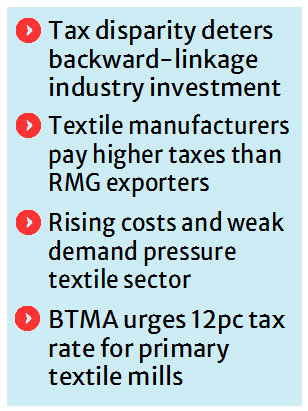
The Bangladesh Textile Mills Association (BTMA) has requested that the government reduce the corporate tax rate for primary textile mills to 12 per cent until 2030, aligning it with the concessional rate currently enjoyed by export-oriented ready-made garment (RMG) manufacturers.
Textile millers said local yarn and fabric producers supply most of the raw materials used by garment exporters and play a crucial role in ensuring shorter lead times, higher domestic value addition and stronger export competitiveness.
Despite their contribution, textile manufacturers currently pay substantially higher taxes than the garment factories they support.
"Both sectors are part of the same export supply chain, but they are not receiving the same policy treatment," said BTMA former vice-president Md Saleudh Zaman Khan Jitu.
The association noted that the existing tax structure discourages investment in backward-linkage industries at a time when the sector is struggling with rising gas and electricity costs, high interest rates, escalating raw material prices and weak global demand.
Garment accessories manufacturers echoed similar concerns, saying local producers of labels, packaging materials, zippers, buttons, hangers and other inputs face higher operating costs and tax burdens despite contributing directly to export earnings through their support to the apparel sector.
Industry representatives stressed that strengthening backward-linkage industries is essential for Bangladesh's long-term competitiveness, particularly as the country prepares for graduation from the least developed country (LDC) category and faces increasing competition from regional rivals.
According to BTMA, textile-producing competitors such as India, Vietnam and Cambodia provide extensive tax and policy support to their textile sectors, enabling them to supply yarn and fabrics at more competitive prices.
The association warned that continued tax disparities could discourage fresh investment, accelerate factory closures and increase reliance on imported raw materials, ultimately weakening domestic value addition in apparel exports.
BTMA President Showkat Aziz Russell said textile mills and accessories manufacturers are integral parts of the country's export ecosystem and deserve policy support comparable to that provided to apparel exporters.
Industry leaders maintained that tax parity across the apparel value chain would help sustain production, protect jobs, enhance local sourcing and strengthen Bangladesh's competitiveness in the global export market.
newsmanjasi@gmail.com
© 2026 - All Rights with The Financial Express