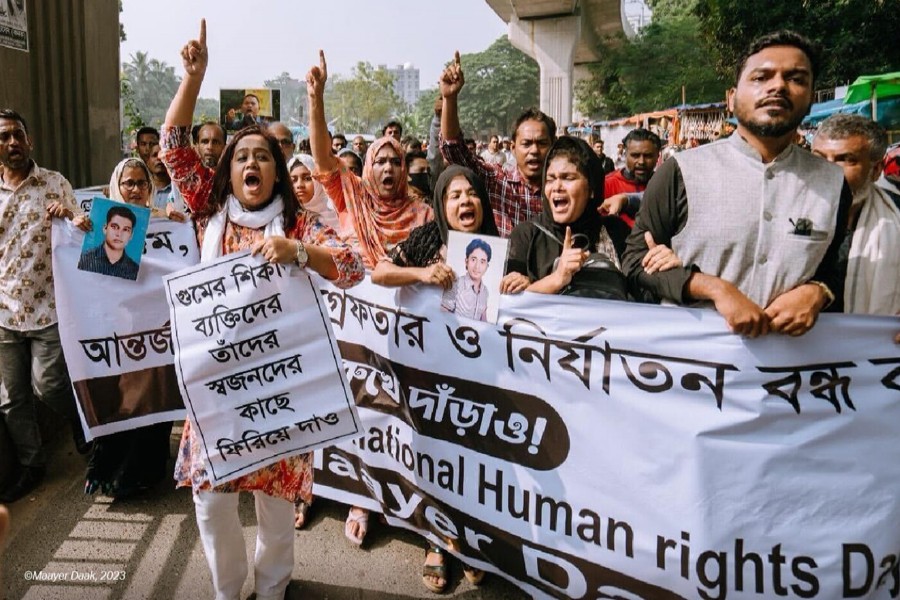
 Family members and friends of forced disappearance victims at a protest rally in Dhaka in 2023 —Maayer Daak Photo
 A democracy will not often fail with the loud cracking of Glass. In fact, failure will often occur in the silent hours of fear rebranded as order, of oppression justified as stability, of institutions of democracy subverted to safeguard power rather than safeguard democracy’s citizenry. In times such as these, it is not tyranny that will jeopardise democracy but rather the deliberate delay of truth. In such instances, democracy will not fail all it will be denied is foundation.
The significance of this is very well understood by both authoritarian regimes and fascist regimes. It is not merely the fear of accountability that such regimes experience; their design inherently enables them to avoid it. The recent past is not foreign to such a truth. However, it is the first time this past has come face to face with institutional courage. The formation of the Commission of Inquiry on Enforced Disappearances by the Interim Government presents a radical departure from such a culture. The Interim Government’s decision to permit such an inquiry raises a fundamental democratic value: truth precedes legitimacy.
Why Fascist Systems Fear Accountability: The political theory at hand explains very effectively why authoritarian governments are so fervently opposed to accountability. Fascist or authoritarian rule entails control over three interrelated spheres: law, memory, and fear. To start, the rule of law does not disappear; it is instead instrumentalised. The use of forced disappearance, secret killings, and the like becomes justified in the context of governance. The question of accountability undermines this by revealing how legality had been used as a weapon.
Secondly, authoritarianism requires the use of collective memory as a tool. The purpose of forced disappearance is merely to make people vanish; instead, it ruptures collective memory, leading to the privatization of pain and transforming fear into a social habit. The important role of the truth commission is to turn silence into record and denial into documentation.
Third, accountability destroys fear. Once victims get to express themselves, and the truth about wrongdoing is acknowledged, coercion’s psychological stranglehold on society ceases to exist. That’s why dictatorial regimes always call upon society to “move on.” Justice sets precedents, and precedents dissolve impunity.
State Capture as a Strategy of Survival: The defining characteristic of modern authoritarian regimes is that, rather than destroying the state, they seize control of it. Under Sheikh Hasina’s leadership, courts, elections, law-enforcement agencies, and regulatory bodies did not simply cease to function. Instead, they were all undermined to ensure the regime’s survival.
According to political scientists, this can be explained as a form of “authoritarian resilience through state capture,” based on Guillermo O’Donnell’s “delegative democracy” and other work on “competitive authoritarianism.” This type of politics eliminates “the distinction between the party and state.” There is a loss of autonomy for institutions, a “selectivity of legality,” and “asymmetrical accountability.”
This logic paradoxically came into its own in its security apparatuses. The Commission clearly establishes that enforced disappearance existed not merely in isolated pockets but rather in a bureaucratized form of coordination among state bodies, including the RAB, police, DB, and intelligence agencies, in particular events of electoral risk, opposition mobilisation, and legitimacy crises.
What is crucial, however, is that the practice changed over time. The earlier periods were marked by a greater incidence of “permanent disappearances” and “deaths.” The later periods are more dependent upon “secret detention” and then “strategic appearance” via “false or prolonged” legal proceedings. Such learning and guidance by the executive implies order rather than chaos within the institution. The courts were used as a tool for procrastination rather than seeking justice. In addition to the use of force and the courts, the administrative state had a far more insidious role. Victims were simply designated as criminals, militants, or “crossfire” victims according to their location in space, not fact. Witnesses were coerced into speaking. Political affiliations were removed from documents.
Findings from the Evidence: There is nothing to suggest any plausible denial on the part of the Commission, as it has been found that, out of 1,913 complaints, 1,569 were established as cases of enforced disappearance. A total of at least 287 victims are either dead or missing, while the Commission has estimated the total to be at 4,000 to 6,000 in fifteen years.
The politics of disappearance were overwhelming. Virtually 97 per cent of the disappeared with known political affiliation were from opposition parties and affiliated youth wings. Disappearances escalated during elections in 2014 and 2018 and fell only when external reputational pressures increased. These trends indicate that disappearance was not a security failure but a political policy.
The most important finding of this report, however, is structural in nature: a system of this size, duration, and level of integration could simply not have existed without sanction at high levels of politics. Accountability was deferred, not because truth was difficult to establish, but because power was contingent on its suppression.
Latin American Model of Social Policies: There is a historical precedent for the current situation in Bangladesh. “The experiences of several Latin American countries illustrate with striking clarity the consequences for societies that transition from an authoritarian period to democracy through delay, denial, or selective memory rather than via full accountability.”
Argentina’s experience indicates that the moment of the fall of the dictatorship was not the point at which the country’s democracy was stabilised, but rather the moment when the state formally recognised cases of enforced disappearance and brought the perpetrators to trial. While truth missions marked the moral rehabilitation, it was accountability processes that restored public trust in the state’s institutions.
The Chilean experience provides a sobering alternative. There, a political consensus to “look forward” resulted in several decades of silence, facilitated by amnesty and negotiated restraint.
Historical state recognition of past wrongdoing in Brazil did not extend to systematic prosecution. This imperfect justice undermined democratic consensus by introducing authoritarian discourses, leading to the reintroduction of coercive rhetoric behind the screens of democracy in Brazil’s elections.
The meaning for Bangladesh is clear. Democratic transition is not assured by neither a paper trail nor by lip service to past transgressions. Where accountability is deferred, impunity becomes a reality; when justice is one-sided, the tendencies of authoritarianism remain. A lesson from the history of Latin America is simple, but one that must be remembered well: when accountability is deferred, it is not a sign of moderation—it is a sign of surrender. If Bangladesh defers rather than demonstrates decisiveness, it faces a future that these societies had attempted to overcome.
Democratic Repair—Not Retribution: “Accountability is vengeance,” say authoritarian stories. But this is not how it works in a democracy. Accountability rebuilds institutional legitimacy, re-establishes civilian primacy over the uses of force, increases citizen trust, and grounds a nation’s memory in truth, not terror.
As Muhammad Yunus remarked on receipt of the report from the Commission, “The crimes recorded were ‘paishachik’ – demonic not only in their ferocity but in their implementation in the name of democracy.” He did not ask for revenge but for a moral severance, so that such a form of governance would never return.
From Truth to Reform: Truth, as potent as it is, cannot by itself survive. For accountability to serve as democratisation’s guarantor against tokenism, Bangladesh’s immediate task is to turn moral light into institutional change. This would necessitate one thing: independent criminal probes and prosecution proceedings conducted in accordance with proper due process procedures, with proper chains of command in place and sufficient witness protection mechanisms for law enforcement investigators and victims. Secondly, there is a necessary role for security sector reforms, which would include RAB (a security force), civilian control of all intelligence agencies, regulated secret detentions, properly maintained custody records, and parliamentarianism for joint security force operations. Thirdly, there is the imperative to render all judges independent of government control through processes that ensure freedom from government intervention in judicial appointments and in adjudicative decisions in all politically charged cases. Fourthly, there is a complete redesign of the National Human Rights Commission along lines that are independent enough to exercise all investigative powers and to report to parliament without government oversight. Lastly, there is the urgent requirement to establish ‘The National Archive of Enforced Disappearance & Political Violence in Bangladesh.’
Democracy cannot be restored on the basis of silence. Democracy cannot be maintained based on fear. History shows that there is no example of forgetting about freedom. Ultimately, accountability is not a threat to democracy; it is democracy’s last hope.
Dr Serajul I Bhuiyan is a Professor of Journalism and Mass Communications at Savannah State University, Georgia, USA. sibhuiyan@yahoo.com
© 2026 - All Rights with The Financial Express