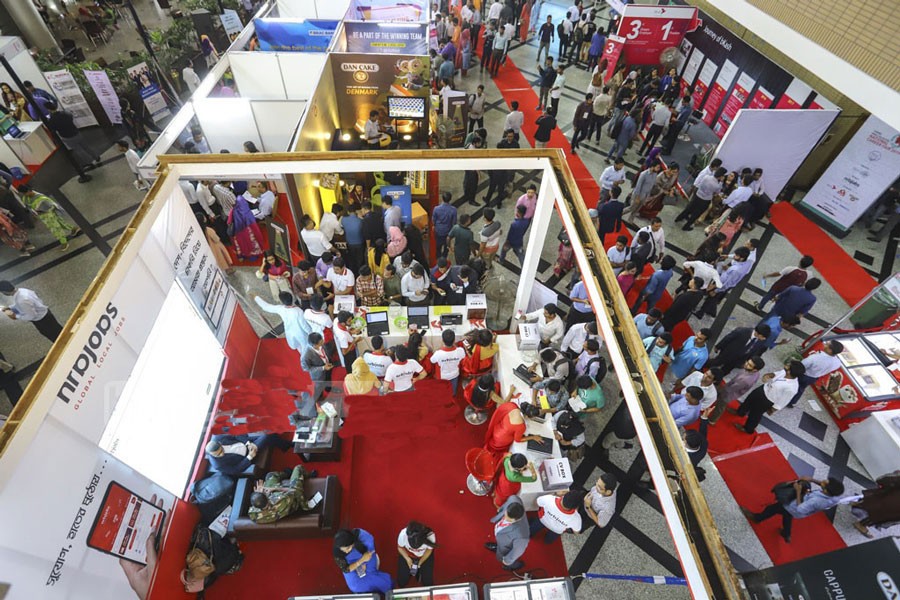
 Job-seekers crowd at a job fair in Dhaka —bdnews24.com photo
 Bangladesh has long been praised for its sustained growth trajectory, supported by strong export industries, remittance inflows, and a youthful population. However, behind the overall figures lies a troubling reality: the educated youth of the country are increasingly unable to find decent jobs, while the economy that once appeared to offer the promise of a demographic dividend now risks becoming a demographic burden. The combination of an economic slowdown and rising unemployment among youth and graduates has caused social ripples that could transform the nation's socio-economic landscape.
Recent labour market data paint a sobering picture. According to the Bangladesh Bureau of Statistics (BBS), the unemployment rate among tertiary-educated individuals rose to 13.5 per cent in 2024, with approximately 885,000 unemployed graduates reported by the survey. At the same time, the overall unemployment rate increased to around 4.63 per cent in the October-December quarter of FY 2024-25, with nearly 2.7 million people unemployed. These figures highlight not only individual hardship but also a structural mismatch: widespread enrolment in higher education has not been matched by proportional job growth.
To understand the current predicament, one must consider recent economic developments. Bangladesh's economy experienced a notable slowdown from 2023 to 2025. Growth, which had consistently ranged between 6 and 8 per cent for years, decelerated due to global challenges (inflation, supply-chain disruptions, rising interest rates) and domestic instability. Although policy measures in fiscal and monetary areas have started to restore macroeconomic stability-with inflation easing and the exchange rate stabilising-the impact on job creation has been slow.
Investment growth has been anaemic, and the formal sector has struggled to expand at a rate sufficient to absorb new entrants. The informal economy remains dominant, estimated at roughly 85 per cent of total employment (ILO/World Bank), even in recent labour market profiles. When the formal sector grows sluggishly, while the supply of graduates rises rapidly, pressure is bound to emerge.
Therefore, macro-stability alone is not sufficient. Achieving low inflation or a stable currency is crucial, but if the result is jobless growth, social risks increase. Investment, innovation, and structural change remain essential-not only for higher growth but for inclusive growth.
The increasing unemployment rate among graduates is only puzzling if one assumes that higher education automatically guarantees employment. The situation in Bangladesh indicates otherwise. Several interconnected mechanisms play a role, such as:
Skills mismatch: Universities continue to produce large numbers of graduates in generalist disciplines-arts, humanities, social sciences-while employers demand digital, technical, STEM, and service-oriented skills. A recent study indicated that graduates of non-science disciplines face much higher unemployment rates than those in engineering or ICT fields. Moreover, the rapid expansion of tertiary enrolment (for example, from about 1.5 million in 2000 to over 5.6 million by 2021) has not been matched by proportionate job-creating capacity in the formal economy.
Formal sector bottlenecks: High-quality jobs-secure, permanent, well-remunerated-are concentrated in large firms, state institutions, and export-oriented industries. However, these roles are often gatekept by networks of social capital, patronage, and credentialism. Entry is not always based on merit, and many graduates from modest backgrounds find themselves excluded. The logic of social reproduction suggests that children of privileged backgrounds often benefit not only from credentials but also from networks and cultural capital that facilitate job placement.
Precarious informal employment: For many graduates, the informal economy becomes the default fallback - but informal jobs rarely provide upward mobility. Low wages, lack of benefits, insecure contracts, and limited opportunities for skill development characterise the informal sector. When graduates accept such jobs, they may be officially "employed," but are deprived of the stability and career progression their investment in education implied.
Mismatch in expectations: A generation of young people grew up expecting not just employment, but decent employment. Globalisation, digital media, and exposure to foreign labour markets (through migration) heightened those expectations.
The fallout from rising graduate unemployment is broader than just a number in a survey. Significant consequences are as follows.
Brain-drain: An educated youth cohort that cannot find suitable employment domestically increasingly looks abroad. Migration, historically a driver of remittances and household resilience, now takes on a more urgent significance: escape from exclusion. While remittance flows support the economy, the long-term loss of human capital-creative, entrepreneurial, managerial talent-is substantial. It diminishes Bangladesh's ability to move up the value chain and innovate.
Social unrest risk: History and comparative experience indicate that educated but unemployed youth pose a dual threat: disillusionment with the existing system and a desire for change. In Bangladesh, recent years have seen mobilisations-students, graduates, young professionals-protesting irregularities in recruitment, quota systems, and the lack of meritocracy. When youth perceive that their investment in education has not yielded benefits, the legitimacy of institutions diminishes. As labour force participation rates fall (for instance, from about 50.92 per cent in 2023 to around 49.49 per cent in 2024) and unemployment increases, warning signs continue to rise.
Security and crime implications: When decent opportunities decrease, vulnerable youth may turn to informal or illegal activities. Whether it is petty crime, cybre fraud, or exploiting digital loopholes, the risk of social instability rises. The business environment and community safety both decline when large groups of educated young people are marginalised.
Middle-class fragility: In Bangladesh, the middle class has long served as the engine of growth, aspiring families investing in education, small entrepreneurs leveraging stability. When job precocity spreads among the middle class, the aspirations that underlie consumption, civic engagement, and social mobility are undermined. This can lead to social stagnation, lower investment in human capital, and lower faith in institutional pathways.
Addressing this challenge requires a comprehensive strategy that spans education, labour-market reform, social protection, and governance.
Revamp education and skills systems: Higher education must adapt quickly. Universities should align curricula with market demands: digital literacy, data analytics, green technologies, service-sector skills, and entrepreneurship. Strengthening industry-academia connections-through internships, co-designing courses, recognising micro-credentials, and work-based learning-can reduce skills mismatch. Funding incentives can encourage universities to grow professional and vocational programmes, while scholarships or support can enable less-privileged students to access technical education.
Promote labour-intensive, productivity-enhancing sectors: Job creation must be purposeful. Bangladesh should focus on industries with strong employment elasticities-light manufacturing tied to export chains, agro-processing, green infrastructure construction, renewable energy services, and digital services with local delivery. Policies can encourage SMEs and start-ups through incentives for hiring youth, formalising informal enterprises, and improving access to financing. Infrastructure investments and green transition projects should incorporate local hire and apprenticeship clauses to boost youth employment.
Expand vocational training and entrepreneurship ecosystems: The traditional academic path is no longer the only route to gainful employment. High-quality vocational programmes with clear certification and clear pathways to employment can create opportunities for many young people. Similarly, support for youth entrepreneurship must go beyond microfinance: simple business registration, seed funding, incubation, mentorship, and market-linkage support are vital.
Strengthen social protection and active labour-market policies: To cushion the social fallout of unemployment, active measures are necessary. Public works programmes targeted at youth, wage subsidies for youth employment, unemployment assistance linked to retraining and counselling, and mental health services must be expanded. Social protection should not be residual but should serve as a bridge to re-engage with the labour market.
Enhance governance and institutional trust: All these policy measures depend on credible, transparent institutions. Recruitment in the public and private sectors must be based on merit; procurement and business licensing must be free from corruption; regulatory policies should support rather than hinder start-ups and youth employment. Without improved governance, even the best skill interventions may not succeed. The recent IMF-supported reforms have restored some macroeconomic credibility, but reforming institutions remains essential.
Bangladesh stands at a typical demographic crossroads. The young generation can either lead inclusive growth or contribute to social and economic unrest. The outcome depends on policy and societal decisions.
Digital upskilling programmes and micro-credential recognition could quickly boost employability for many youth, overcoming local limitations. Public-private partnerships in apprenticeship pathways, remote-work facilitation, and diaspora-linkage platforms can broaden opportunities beyond domestic job markets. The recent declines in inflation and stabilisation of the exchange rate present a window of opportunity - but only if youth inclusion remains central to the growth agenda.
From a societal perspective, the narrative must shift. Families and educators must value vocational paths and entrepreneurship as legitimate and respectable. Employers must invest in on-the-job training and open recruitment beyond informal networks. Media and civil society must shift away from blaming youth to recognising systemic issues and championing structural reform. Equity must remain a central consideration: young women, first-generation graduates, rural youth, and historically marginalised groups face compounded disadvantages-targeted support to these groups is essential for a genuinely inclusive transition.
The story of Bangladesh's growth has been compelling. Millions were lifted out of poverty, rapid industrialisation, rising exports, global recognition-and yet, to translate that story into sustainable development, the youth must not be left behind. The current economic slowdown and rising youth and graduate unemployment should not be seen as temporary setbacks but as alarms signalling structural bottlenecks.
Dr Matiur Rahman is a researcher and development professional.
matiurrahman588@gmail.com
© 2026 - All Rights with The Financial Express