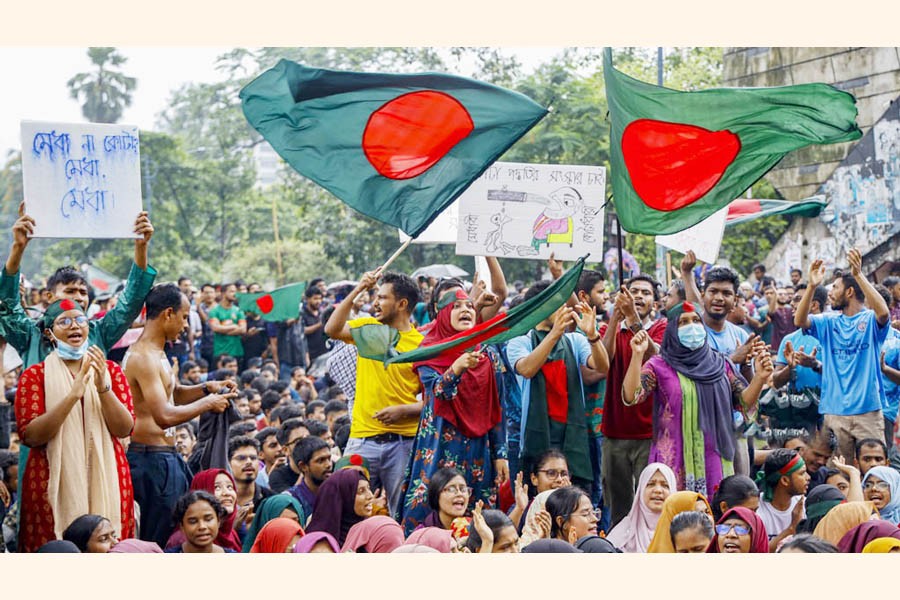
 Though youths led the July mass uprising in Bangladesh, they have yet to get enough room in leadership of politics and bureaucracy due to dominance of the elderly ones —Agency Photo
 Bangladesh is a young country trapped in old politics. The median age is just over 27, yet the people making national decisions are often three times older. The caretaker government led by Nobel Laureate Muhammad Yunus brings global respect, but its makeup tells a different story: aside from a couple of student advisers, the cabinet is dominated by senior figures whose average age reflects the continuity of an older generation at a time when the country's future is increasingly shaped by the young. It is one of the most age-heavy governing teams in the country's history-and among the oldest in the world.
This mismatch is not a quirk of political timing. It reflects a deeper structural problem: Bangladesh's leadership is aging rapidly, even as the country's citizens are growing younger, more digitally connected, and more globally aware. For a country racing to secure middle-income status and navigate a turbulent world, this generational gap is becoming a strategic liability. The result is a widening gap between who Bangladesh is and who governs it-a divergence that raises a troubling question: is Bangladesh drifting toward gerontocracy?
South Asia reveres age. Seniority is often equated with wisdom, patience, and good judgment. But cultural respect does not give older leaders a lifetime lease on national leadership. Healthy political systems celebrate senior figures while opening genuine pathways for the next generation. Bangladesh struggles on that front. The mixed record of the caretaker government's student advisers-thrust into national crisis without preparation or mentoring-says more about the nature of ad hoc appointments than about youth capacity. Their experience should not be misread as a verdict on an entire generation.
And the problem extends far beyond the interim government. The major political parties-BNP and Jamaat-e-Islami-are recycling familiar faces. Their lists of parliamentary hopefuls lean heavily toward long-standing senior figures. BNP's standing committee remains dominated by leaders in their '70s and '80s, and Jamaat's leadership is anchored in its '60s and '70s. Little suggests willingness to hand the reins to a new cohort.
The bureaucracy tells a similar story. For decades, mandatory retirement helped maintain generational balance. That balance has been shaken willy-nilly. The interim regime has reinstated a large group of long-retired civil servants - often without much transparency or clear criteria - replacing officials deemed too close to the previous government. These returns-some years after formal retirement-disrupt natural succession, clog opportunities for younger officers, and weaken the meritocratic spine a modern civil service needs.
Put together, these trends point to an unmistakable direction: Bangladesh is drifting toward gerontocracy. Power is consolidating among leaders whose long tenures risk detaching them from the aspirations, anxieties, and global outlook of the country's young majority.
The scale of this generational mismatch is evident from international comparisons.
ASIA: Japan, one of the world's oldest societies, has an average parliamentary age of about 55. South Korea's National Assembly averages around 53. India's Lok Sabha is younger still. Emerging democracies like Indonesia and Malaysia have median parliamentary ages in the late 40s. None of these countries-despite their older populations-has a political class as senior-heavy as Bangladesh's.
EUROPE: The median age of European Parliament members is 49. Several European prime ministers, including those of Finland and Denmark, took office in their 30s or early 40s, reflecting a recognition that fast-moving technological and climate challenges require younger leadership.
NORTH AMERICA: Canada's cabinet ministers are generally between 40 and 55. Even the United States-often criticized for gerontocratic politics-has begun trending younger, with generational turnover becoming a central political debate.
By contrast, Bangladesh is a demographic outlier: one of the youngest populations being led by one of the oldest political cohorts in the world.
Age itself is not the issue. Many older leaders have served the country with distinction. But when the entire leadership structure is skewed toward the elderly, fundamental problems arise. First, it leads to policy myopia. Older leadership often favors continuity. Bangladesh needs agility-on digital governance, climate adaptation, labor mobility, and skills for a changing global economy. Without generational renewal, policy risks being anchored in an earlier era. Second, it causes a representation deficit. Bangladesh's young people fill the workforce, shape the digital economy, and drive civic movements. Yet they barely appear in decision-making spaces. This lack of representation widens the distance between government agendas and public expectations. Third, it breeds institutional rigidity. Political parties without generational turnover become stale and overly dependent on patronage networks. Bureaucracies become hierarchical and risk-averse-innovation stalls. Fourth, it leads to democratic fragility. Gerontocracies delay succession planning and discourage internal competition. That increases uncertainty and weakens institutions-conditions Bangladesh can ill afford.
Bangladesh can still course correct. The demographic mismatch is real but not irreversible. A few measures suggest themselves. First, adopt age and term limits. Many democracies expect leaders to step aside by their early 60s. Bangladesh's political parties and institutions need similar norms to ensure turnover and prevent leadership bottlenecks. Second, introduce youth quotas in party leadership. Gender quotas expanded women's representation in South Asia; youth quotas could do the same for the next generation. Setting aside 20-30 percent of leadership positions for those under 40 would create real openings. Countries such as Kyrgyzstan, Sri Lanka, and Tunisia already use youth quotas, and Sweden's political parties maintain youth targets with considerable success. But quotas must come with standards-education, experience, and training-to ensure that youth inclusion strengthens governance rather than diluting it. Third, modernise the bureaucracy. Bangladesh should end the routine reappointment of retired civil servants. When expertise is needed, retired officers can serve as advisers, not line managers-mirroring practices in Japan. At the same time, the statutory retirement age should be updated to reflect longer life expectancy and international standards. And the civil service should expand lateral entry, technical specialisation, and competitive mid-career recruitment. These reforms would build a more dynamic administrative corps and prevent the system from becoming a revolving door for former officials. Fourth, make Parliament younger. Lowering campaign costs, expanding public financing, and tightening political funding rules would allow younger, less affluent candidates to compete on a level field. Finally, institutionalise succession planning. Political parties need real leadership pipelines and mentoring structures. Youth wings must be more than decorative units reserved for rallies.
Bangladesh's greatest asset is its youth. Yet its leadership structure increasingly reflects the demographic profile of a much older nation. At a time when the country faces economic headwinds, institutional transition, and shifting geopolitical realities, it needs leaders who can think toward 2050, not toward the back 1990.
Gerontocracy is not destiny. But it is a warning. Bangladesh now faces a choice: continue on a path where age outweighs energy or build a political culture that matches the ambition and imagination of its young citizens.
The future belongs to them. Bangladesh's politics should, sooner or later, follow.
Dr M G Quibria is an economist and former senior adviser at the Asian Development Bank Institute (ADBI). mgquibria.morgan@gmail.com
The opinion expressed in the article is strictly personal.
© 2026 - All Rights with The Financial Express