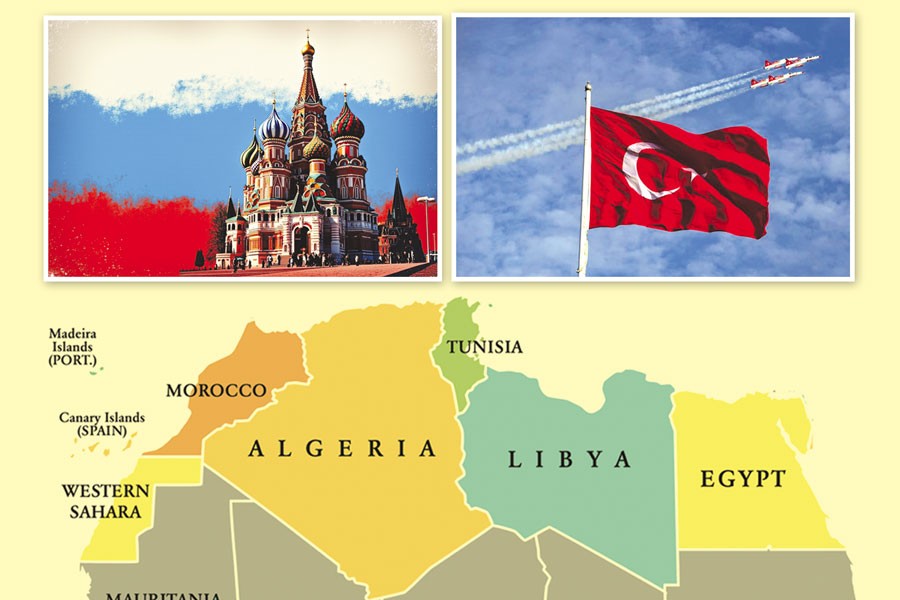
North Africa has become a key arena of competition among regional middle powers. While Europe and China remain central economic partners, actors such as Russia, the United Arab Emirates, Saudi Arabia, and Turkey are increasingly shaping political and security outcomes through military cooperation, investment, and strategic alliances. Analysts Stefan Lukas and Yusuf Can have observed that their growing influence offers North African governments not only new sources of support but also intensifies regional rivalries and weakens traditional Western leverage.
Other geo-strategists have also consequently pointed out that in recent years, North Africa has increasingly become an arena of geopolitical competition in which global and regional middle powers are expanding their influence not through open confrontation, but through a dense network of economic investments, security cooperation, and political alliances. While European states and China continue to serve as central economic anchors in both trade and infrastructure projects, the security policy dynamic is increasingly moving in favour of other external actors who operate more flexibly and are often less bound by norms. In this context, however one must not forget that the European Union remains the most important trading partner for many States in the region, accounting for over 30 per cent of foreign trade of countries such as Morocco or Tunisia. China also continues to expand its presence through infrastructure investments under the Belt and Road Initiative.
In recent years, Russia has reestablished itself as a key security actor in North Africa, deliberately exploiting existing instabilities to gain political influence with relatively few resources while positioning itself as an alternative to Western partners. This is particularly evident in Libya, where pro-Russian forces - especially the Wagner Group and its successor the Africa Corps - have played a significant role since 2019 by providing military support to eastern actors while securing strategically important infrastructure such as oil facilities and military bases. A concrete example of this cooperation is the support supplied to the Libyan National Army (LNA) under Khalifa Haftar, in which Russian actors not only provided military expertise but also secured logistical support and access to air bases such as al-Jufra, thereby enabling Russia to gain direct influence over military operations and control of key territories.
In addition, Russia has expanded its presence in Sudan, where it has been seeking access to a naval base on the Red Sea for years, a move that would significantly extend its operational reach between the Mediterranean and the Indian Ocean. These efforts are part of a broader strategy to secure strategic hubs along key trade and military routes. At the same time, Algeria remains a key partner for Russia in the region, particularly in the military sphere: According to data from the Stockholm International Peace Research Institute, approximately 70-80 per cent of Algeria's military equipment comes from Russia, underscoring the close security ties between the two countries.
In addition to Russia, the Gulf states, particularly the UAE and Saudi Arabia, have emerged as influential actors in North Africa, strategically linking their economic strength with political and, in some cases, military engagement. The UAE has played an active role in Libya in particular by providing financial, logistical, and military support to forces based in eastern Libya, which has had a significant impact on the balance of power on the ground. This included the delivery of drones and the construction of military infrastructure to support Haftar, through which the UAE has directly intervened in the military dynamics of the conflict. At the same time, the UAE is systematically expanding its economic presence, for example, through investments in ports, logistics, and energy infrastructure, thereby enabling economic influence to be directly translated into political influence. Emirati companies are increasingly involved in port projects in Egypt and Morocco to secure long-term logistical hubs.
By comparison, Saudi Arabia takes a more cautious approach to military matters in North Africa, but has gained considerable influence, particularly through financial support, especially in Egypt, whose economic stability has depended heavily on aid from the Gulf states since 2013. According to the International Monetary Fund, the Gulf states have supported Egypt in recent years with tens of billions of dollars in the form of loans, deposits, and investments. A concrete example is Saudi Arabia's repeated provision of central bank deposits and investment commitments, for instance as part of agreements to stabilise the Egyptian currency and finance major infrastructure projects. These support measures have enabled Riyadh to exert considerable influence over Cairo's economic policy direction.
Turkey has emerged as one of the most consequential middle powers in North Africa, leveraging a distinct combination of military engagement, arms exports, economic investment, and energy deals. Unlike Russia or the Gulf states, Turkey operates under a nominally institutional framework and a NATO membership that theoretically constrains its behaviour. Yet in practice, Ankara has demonstrated a willingness to act unilaterally and transactionally.
One of Turkey's most direct and consequential engagements in North Africa has been in Libya. Beginning in late 2019, Ankara has intervened militarily on behalf of the Tripoli-based Government of National Accord (GNA), deploying proxy fighters, naval assets, air defense systems, and Bayraktar TB2 drones that proved decisive in halting the Haftar offensive and reshaping the battlefield balance of power. This intervention was formalised through a bilateral security and military cooperation memorandum, which also included a controversial maritime delimitation agreement establishing overlapping exclusive economic zones in the Eastern Mediterranean, a move with significant implications for energy rights that directly antagonised Greece, Cyprus, and Egypt. Turkey's military footprint in Libya has since become entrenched, with Ankara maintaining a presence at the Watiya air base and the Misrata naval base, providing ongoing training, equipment transfers, and logistical support to aligned forces. The drone component of this engagement is particularly notable.
In the arms and defence sector more broadly, Turkey has actively cultivated bilateral relationships across North Africa. Armored vehicles, drones, and light weapons manufactured by Turkish defence firms including Baykar, FNSS, and BMC have found buyers in the region. Ankara has pursued defence cooperation frameworks with several governments as part of a broader effort to position itself as an alternative arms supplier to countries seeking to reduce their dependence on Western or Russian systems. These arrangements are rarely purely commercial, as they typically come bundled with military training agreements, joint exercises, and the embedding of Turkish advisers, creating ongoing institutional relationships that translate into sustained political influence.
On the energy front, Turkey's interests in North Africa are substantial and strategic. The maritime delimitation agreement with Libya's GNA was designed, in part, to secure Turkish access to potential hydrocarbon exploration zones in the Eastern Mediterranean, a region of intense competition among Greece, Egypt, Israel, and Cyprus. Turkish energy companies have also shown interest in infrastructure projects tied to Libya's oil sector, and Ankara has sought to position itself as a transit and processing hub for energy flows from North Africa and the Mediterranean toward European markets. This energy dimension intersects directly with Turkey's broader ambition to become an energy corridor state, a role that gives it leverage both regionally and in its negotiations with the European Union, especially in the context of the Russian invasion of Ukraine and the Iran war.
Soft power constitutes a further dimension of Turkish strategy. The Turkish Cooperation and Coordination Agency (TIKA) operates across the region, funding development projects, cultural centers, and humanitarian assistance that cultivate goodwill and visibility.
The transformation of North Africa into a contested arena of middle power competition reflects a broader restructuring of the international order in which the capacity to project influence no longer belongs exclusively to a handful of global powers. Russia, the Gulf states, and Turkey, as well as others, each approach the region with distinct instruments and motivations, yet share a common strategic logic: the willingness to engage transactionally, to combine economic, security, and political tools without the normative constraints that define Western and especially European partnership models, and to treat North African governments and factions as leverage points in broader regional and global contests. Russia prioritises military access and anti-Western positioning; the Gulf states deploy financial power to shape governance outcomes and protect dynastic interests; Turkey pursues a more expansive agenda that includes energy rights, defence exports, commercial contracts, and ideological influence, all underwritten by hard military power in the Libyan case.
What these actors collectively produce is a more fragmented, competitive, and in some respects, more permissive environment for North African governments. Local elites have acquired new sources of arms, finance, and diplomatic cover, reducing their dependence on any single external partner, including Europe and the United States. This structural shift has real consequences for Western interests. European governments, which retain deep economic ties with the region and bear the most direct exposure to the security and migration dynamics that instability generates, increasingly find that their leverage is diluted by the availability of alternative partners who ask fewer questions and move faster. The result is not the displacement of Western influence, but its dilution.
For North Africa itself, the proliferation of external actors carries ambiguous consequences. Greater external competition can generate resources and infrastructure that would not otherwise materialise, and it can give governments bargaining room to resist the most intrusive forms of external conditionality. But it also fuels conflict, as Libya most clearly illustrates, where competing external patrons have prolonged and deepened a civil war that might otherwise have reached a resolution. The game of middle powers in North Africa is ultimately not played for the benefit of North Africans - it is played for influence, access, and advantage in contests whose stakes extend far beyond the region's borders.
Muhammad Zamir, a former Ambassador is an analyst specialised in foreign affairs, right to information and good governance.
muhammadzamir0@gmail.com
© 2026 - All Rights with The Financial Express