510 years ago, in 1516, Utopia by Thomas More was published in Europe. Written in Latin, the English meaning of the full Latin title is: ‘A truly golden little book, not less beneficial than enjoyable, about how things should be in a state and about the new island Utopia.’ In 1518, a revised edition appeared, and the English translation was printed in 1551, 16 years after More’s death. The book is a work of fiction and socio-political satire depicting a fictional island society and its religious, social, and political customs. For the last five decades, the term Utopia has described ‘an ideal commonwealth whose inhabitants exist under seemingly perfect conditions.’ (www.britannica.com) The terms utopian and utopianism are also used to indicate a visionary reform that tends to be ‘impossibly idealistic.’
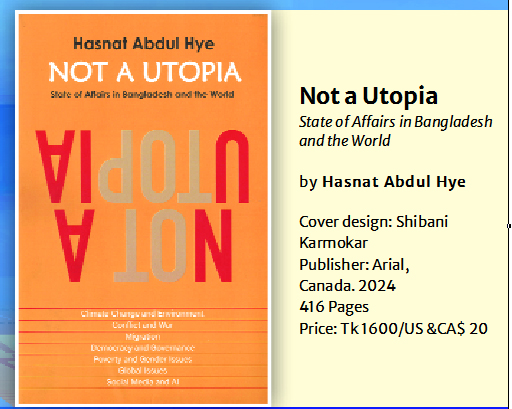
Not A Utopia, by Hasnat Abdul Hye, published around one and a half years ago, is an anthology that addresses a number of critical issues in the current world. The approach to the deal is not unrealistic but is ambitious to some extent, although apprehensive about its possible realisation. The author argues that addressing the problematic issues discussed in the book is possible, so it is not a utopia. Nevertheless, if addressed properly, it will become a matter of a dream coming true. According to the author: “On the one hand, the present state of affairs in the areas of human endeavour that matter for the commonweal of mankind is far from that of what can be called a utopia. On the other hand, it is being implied that if the malaise that afflicts them now could be consciously and sustainably alleviated, mankind’s life within national boundaries and bound by international relations could be improved by a degree that would appear near about that in a utopia.” (P-V)
The book is a thoughtful compilation of articles by Hasnat Abdul Hye, most of which were published in The Financial Express during 2022, 2023, and 2024. The subtitle State of Affairs in Bangladesh and the World reflects the author’s focus on areas needing attention. The book discusses climate change and environment, conflict and war, migration, democracy and governance, poverty and gender issues, global issues, and social media and artificial intelligence (AI).
Drawing on his long experience in policy-making and his study of global geo-eco-political development, Hye offers remedial measures to address various problems. However, he avoids being assertive always and often presents these as second-best options. In his own word: “Of course, recommendations have sometimes been made by way of solutions and signals given about the pernicious effects of poorly crafted decisions or lack of appropriate policies. In Short, the approach taken is a mix of ‘do’s’ and ‘don’ts’ with regard to the issues impinging on the life and welfare of people in general and special groups in certain cases.” (P-vi)
The anthology reflects the senior writer’s devotion to analysing local and international affairs through a critical lens. Besides his vast works in literature, Hye has written on topics affecting people in various ways. He prioritises climate change and its impact on the lives and livelihoods of millions in Bangladesh and beyond. His analytical pieces on paradox and the political economy of climate change are thought-provoking and informative. He presents the outcomes of COP27 and COP28, two consecutive global summits on climate change, in separate articles. In total, ten essays on climate change and the environment show his effort to examine the issue.
As the world has been witnessing two of the most devastating wars of the 21st century, Hye rightly focuses on the Ukraine War and the Gaza War with a historical perspective. He also argues that the continuation of wars and conflicts worldwide is mainly driven by the West.
The writer analyses Israel’s brutal invasion of Gaza, carried out in the name of fighting terrorists and self-defence, in several articles that expose the hypocrisy of the West. Together, these pieces provide a broad view of the historical Palestine-Israel conflict. They also document the Israeli genocide in Gaza, which is not recognised by the US and its allies, who seek to protect the Zionist state, even though some Jewish scholars openly call it genocide. For instance, British-Israeli historian Avi Shlaim named his latest book Genocide in Gaza: Israel, Hamas, and the Long War on Palestine. Published in May last year, the book argued that what Israel has done in Gaza since October 7, 2023, by killing thousands of Palestinians and destroying homes, schools, hospitals, food systems and more, is nothing but genocide.
More than a dozen articles on democracy and governance, one of Hye’s favourite areas, are included in Not A Utopia. The discussion is entirely Bangladesh-centric for obvious reasons. Except for the last article under this theme, all were written before the July mass uprising in 2024 that forced the repressive regime of Hasina to fall and led her to flee to India. Since newspapers could not easily publish sharp criticism of the regime before August 5, 2024, the pieces were written in a balanced manner, without compromising facts or objectives. Beneath the surface, criticism of the regime’s efforts to undermine democratic institutions and the effects of poor governance is clear. The author also focuses on Bangladesh’s economy, damaged by years of misrule and poor governance.
In the article titled ‘Re-building the State of Bangladesh’, the author succinctly outlines an overview of the political journey of Bangladesh since the independence of the country in 1971. He infers: “The overview of the political history of Bangladesh shows that ‘state building’ was hampered and thwarted from the very beginning because of the design of political leaders and their parties to perpetuate their power. It did not make any difference whether the head of the government was a politician or a former militarily general. All parties that ruled the country under so called democracy saw to it that the opposition parties did not have much of a chance to challenge their authority and power, To this end, all kinds of obstacles were put in place to make it difficult for opposition parties to carry on their normal activities.” (P-209) There is little to differ with Hye’s observation which is based on reality.
By focusing on poverty and gender issues, the author revisits inequality, welfare, and the cost of living in the current context. In the article ‘The Enigma of Poverty Reduction’ the author argues that reducing poverty is serious work, not a matter of wish fulfilment. He adds: “Having a realistic appraisal of the poverty situation is desirable not only from an academic perspective. For correct policy planning, it is absolutely necessary to have a correct assessment of the poverty situation. The adequacy of policy decisions on this will largely depend on whether accurate estimates of the present poverty profile have been made.” (P-231) His article ‘Revisiting Feminism’ provides a brief history of feminism and will be helpful for anyone who wants to learn the basics of the topic.
The author also addresses international issues like Covid, global debt, and the world economy. Most pieces discuss contemporary developments, with some analysis of factors and future projections.
Finally, Hye reviews the world of social media and the rapid rise of artificial intelligence (AI), making the book an essential read for many. He believes AI is gradually becoming Frankenstein’s monster for mankind. According to Hye: “Though fictional, the experiment of eccentric Frankenstein has a moral lesson for mankind: you play God at your peril. Developments in robotics in recent years seem to indicate that the warning has been lost on scientists and researchers in the tech world. Motivated by both the excitement and profit, research works on imparting ever powerful robots with artificial intelligence (AI) have gone apace, pushing the boundaries of scientific discovery in the digital world.” (P-381) A similar argument is also made by Yuval Noah Harari, the renowned historian and science writer. In his books and articles, he has repeatedly cautioned that mankind should never summon a power they cannot control.
As the reckless use of social media grows daily and AI fuels this trend, the future is becoming more complex and turbulent. Hye concludes his book by saying: “The popularity of social media has come with a price tag. It is taking up more and more time of its users, making some of them addicts. With the addition of AI, the attraction of social media is likely to balloon, claiming more time from users. Unless judicious use is inculcated at a young age, it may be difficult to rein in the mind when one is grown up.” (P.405) The question is whether readers will take this note of caution seriously.
asjadulk@gmail.com
© 2026 - All Rights with The Financial Express