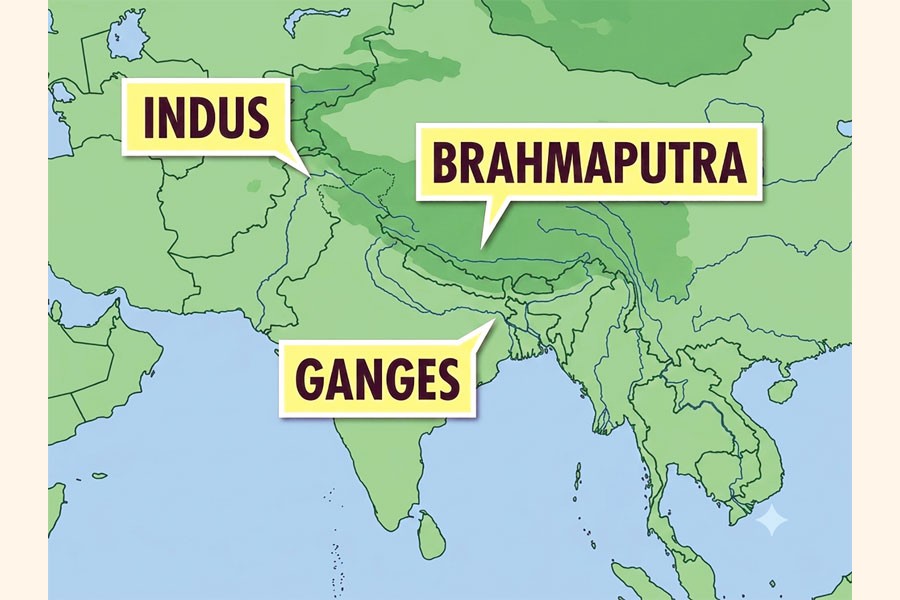
For over sixty years, the Indus Waters Treaty (IWT) has symbolised international cooperation. Signed in 1960 with the World Bank’s mediation, it endured wars, military crises, and diplomatic breakdowns between India and Pakistan. In a world often marked by conflict, the IWT demonstrated that rivals could maintain a rules-based system for sharing vital resources. For scholars of international relations, it signifies how international law and dialogue can prevent water disputes from escalating into geopolitical conflict.
The long-standing perception of the India-Pakistan water-sharing treaty has been challenged following the 2025 Pahalgam attack. New Delhi kept the treaty in abeyance, citing Pakistan’s support for cross-border terrorism. Pakistan claims the treaty remains binding and describes India’s decision as the “weaponisation of water.” The situation has escalated into a broader debate about the resilience of international treaties during geopolitical conflicts and the future of rules-based river governance.
The ongoing dispute over the Indus Waters Treaty has implications beyond the region, particularly for lower-riparian states in South Asia, such as Bangladesh. With 54 trans-boundary rivers shared with India, Bangladesh’s agriculture, food security, and livelihoods are deeply reliant on cooperative river management. Concerns about the Ganges Water Treaty and the delayed Teesta agreement have taken on new urgency in Dhaka.
While the situation invites comparisons with other river agreements in South Asia, it’s crucial to recognise the distinct historical and geopolitical contexts of India-Pakistan and India-Bangladesh relations. The Indus case highlights how rivalry can strain treaties, while the Ganges Water Treaty demonstrates that shared rivers can foster confidence-building and regional stability. As the renewal of the Ganges Treaty approaches next year, this distinction may be more significant than current similarities suggest.
The key distinction between India and Pakistan lies in their adversarial relationship marked by wars, military crises, terrorism, and a lack of political trust. Security concerns dominate their interactions, including those related to water cooperation. India has stalled the Indus Waters Treaty, asserting that cooperation is impossible amid ongoing terrorism, while Pakistan insists that treaty obligations are legally binding regardless of political issues.
Bangladesh’s relationship with India is marked by significant cooperation despite political disagreements. Recently, bilateral relations faced challenges, yet the two countries maintain a partnership through trade, cross-border electricity cooperation, and connectivity projects. Active border management and ongoing institutional dialogue underscore the need for cooperation, as both governments recognise the importance of collaboration.
The political atmosphere is currently strained, but the relationship is not broken. Unlike India-Pakistan relations, which oscillate between crisis management and confrontation, India-Bangladesh relations continue to feature functioning institutions capable of managing disagreements without allowing them to spiral into strategic hostility. It is this institutional resilience that makes direct comparisons between the Indus and Ganges situations incomplete.
The second distinction concerns the Ganges Water Treaty itself. Since its signing in 1996, the agreement has not been free from criticism, nor has it resolved every issue surrounding trans-boundary rivers. Yet its broader contribution to bilateral relations has been undeniably positive. For Bangladesh, the treaty institutionalised predictable dry-season water allocations, formally acknowledged the country’s downstream rights, and perhaps most importantly, established a permanent mechanism for consultation rather than confrontation. Instead of repeatedly allowing disputes over Farakka to dominate bilateral diplomacy, the treaty established an agreed framework for both countries to manage their differences through dialogue and technical cooperation.
India likewise derived significant benefits. The agreement substantially reduced one of the most persistent irritants in bilateral relations, provided greater stability surrounding the Farakka barrage, underlined India’s diplomatic image as a responsible upper-riparian state, and reinforced its broader regional commitment to resolving disputes through negotiated arrangements rather than unilateral measures.
In that sense, the Ganges Water Treaty should not merely be viewed as a mechanism for sharing river flows. Both countries have benefited from its existence, and both stand to benefit from its successful renewal. As preparations for negotiations continue, neither side appears interested in allowing the agreement to lapse.
A third consideration is the current political climate between Dhaka and New Delhi. It would be inaccurate to suggest that relations are presently operating at their highest point. They are not. Bangladesh’s evolving domestic political landscape has inevitably altered bilateral dynamics, while several unresolved issues continue to generate public concern. Yet difficult periods between neighbours are neither unusual nor necessarily permanent.
A consistent message from Bangladesh’s political, academic, and civil society circles has been that India should engage with Bangladesh as a whole rather than favour any single political party. Sustainable partnerships should not rely on electoral outcomes but rather on institutional engagement and respect for democratic processes. Recent diplomatic efforts indicate that New Delhi is beginning to recognise the strategic importance of this approach. If maintained, this shift could strengthen bilateral relations and enhance India’s acceptance across Bangladesh’s political landscape.
Equally important, Bangladesh’s expectations today are neither unreasonable nor incompatible with stronger relations. Dhaka seeks mutual respect, sovereign equality, non-interference in domestic political affairs, and an equitable partnership that recognises the legitimate interests of both countries. These aspirations are not obstacles to closer cooperation; they are prerequisites for rebuilding public trust.
To its credit, India has also demonstrated interest in restoring momentum in bilateral relations. Diplomatic engagement has continued despite political changes in Dhaka. Technical discussions on renewing the Ganges Water Treaty have already commenced, while both governments continue to cooperate across numerous institutional platforms. Recent exchanges indicate that neither capital wishes the current phase of strained relations to become permanent.
That does not mean all concerns have disappeared. Public remarks by certain political figures in West Bengal have periodically generated anxiety within Bangladesh, while the continued absence of a comprehensive Teesta Water Sharing Agreement remains perhaps the single most visible source of frustration in the bilateral relationship. For many Bangladeshis, Teesta has become a symbol of unrealised expectations. Its prolonged delay has gradually eroded confidence in India’s willingness to translate political goodwill into tangible outcomes.
Yet precisely because these concerns remain unresolved, the forthcoming renewal of the Ganges Water Treaty assumes significance that extends well beyond water allocation. It represents an opportunity to rebuild confidence.
The treaty’s scheduled renewal presents New Delhi with an opportunity far greater than negotiating cubic feet of water. It offers an opportunity to reassure ordinary Bangladeshis that India remains committed to equitable partnership, responsible upper-riparian behaviour, and genuine regional cooperation. Successfully concluding a renewed treaty that reflects contemporary realities and addresses Bangladesh’s legitimate concerns would send a powerful political message that India’s commitment to its eastern neighbour remains anchored in fairness rather than expediency.
For Bangladesh, too, the renewal presents an opportunity to consolidate a more mature and balanced relationship with India—one founded upon reciprocity, transparency, and confidence rather than recurring suspicion. If accompanied by meaningful progress on the long-pending Teesta issue, the renewal could become the most significant confidence-building measure in India-Bangladesh relations in many years.
The Indus Waters Treaty raises questions about the resilience of international river agreements amid geopolitical tensions, especially in Dhaka. However, equating the Indus scenario with the Ganges overlooks crucial historical and strategic differences. While India and Pakistan are in a security rivalry marked by distrust, India and Bangladesh maintain strong economic ties and cooperative institutions.
As negotiations for renewing the 1996 Ganges Water Treaty approach its expiry, both nations have a chance to shift regional anxiety into confidence. A modernised and equitable agreement would secure water for millions and reinforce cooperation as the cornerstone of India-Bangladesh relations. In an uncertain South Asian landscape, renewing the Ganges Treaty could symbolise the enduring foundation of regional partnership built on trust.
Simon Mohsin, political and international affairs analyst.
simonbksp@gmail.com
© 2026 - All Rights with The Financial Express