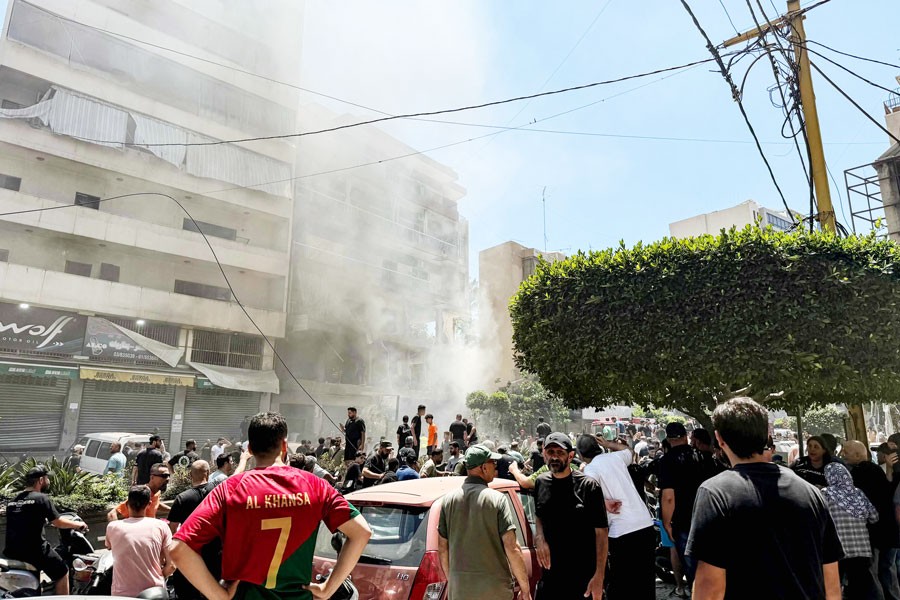
 People gather at the site of an Israeli airstrike that targeted a building in Beirut’s southern suburbs on Sunday. — AFP
  WASHINGTON/TEHRAN, (Agencies): The US says it was close to signing a peace deal that would end the three-month-old war with Iran, though terms have not yet been made public.
It is not clear at this point how any agreement would stack up against the 2015 deal with Iran, which lifted sanctions in exchange for restrictions on its nuclear activities.
The agreement, signed by Iran, the US, Russia, China, France, Britain and Germany, aimed to extend the time Iran would need to produce a nuclear bomb from two to three months to a year. Tehran says it has never had a nuclear weapons programme.
Trump pulled the US out of the deal in 2018 during his first term in office and re-imposed sanctions. Iran began breaching its terms in 2019, and United Nations sanctions were reimposed in 2025. The deal is now effectively dead.
Below are the main elements of the 2015 deal, known as the Joint Comprehensive Plan of Action (JCPOA).
The US, European Union and United Nations lifted sanctions that targeted Iran's oil, gas, petrochemical, banking, shipping and auto sectors, as well as its trade in gold and minerals. The EU and US also removed the Central Bank of Iran and other entities and people from sanctions lists. The US allowed sales of commercial aircraft and imports of Iranian carpets and food.
Meanwhile, Iran said on Sunday there was "no point" in peace talks with the United States, accusing it of failing to uphold its commitments and casting doubt on a deal that Donald Trump had insisted would be signed imminently.
The latest hurdle came hours after Israel -- which launched the war alongside the US in February -- said its military had carried out strikes targeting Iran-backed Hezbollah in Beirut's southern suburbs.
The US president had previously said a deal to end the war in the Middle East would be signed as early as Sunday and that the blockaded Strait of Hormuz would reopen immediately, though Iran had offered a less concrete timeline.
"The Zionists' aggression against Dahieh once again showed that the United States either lacks the will to implement its commitments or lacks the ability to do so," Iran's chief negotiator Mohammad Bagher Ghalibaf said on X, referring to the suburbs.
"If you do not have the will or the ability to fulfil your commitments, then there is no point in talking about continuing down this path."
Trump -- who over weeks of negotiations repeatedly declared a deal with Iran was all but concluded -- had said on Saturday that the accord was "scheduled to get signed tomorrow, and immediately after it is signed, the Hormuz Strait is OPEN TO ALL".
Barack Obama said it was unrealistic to expect that any deal between US President Donald Trump and Tehran would mark a "significant improvement" over his own nuclear pact 11 years ago.
In interview excerpts released Sunday on ABC News talk show "This Week," the former president also suggested it was better to negotiate a deal that falls short of all of Washington's requirements in order to avoid an outright war.
"It is doubtful that any agreement that arises is going to be significantly different or a significant improvement from the deal that we had in the first place," Obama said, referring to 2015's landmark pact that Trump abandoned.
Obama said his own deal "had worked for a long stretch of time before... the United States pulled out of it."
Earlier, Somaliland's President Abdirahman Mohamed Abdullahi met his Israeli counterpart on Sunday in Jerusalem in his first-ever state visit, which comes months after Israel officially recognised the breakaway African state.
In December, Israel became the first country to recognise the independence of Somaliland since it declared its autonomy from Somalia in 1991 following a civil war.
© 2026 - All Rights with The Financial Express