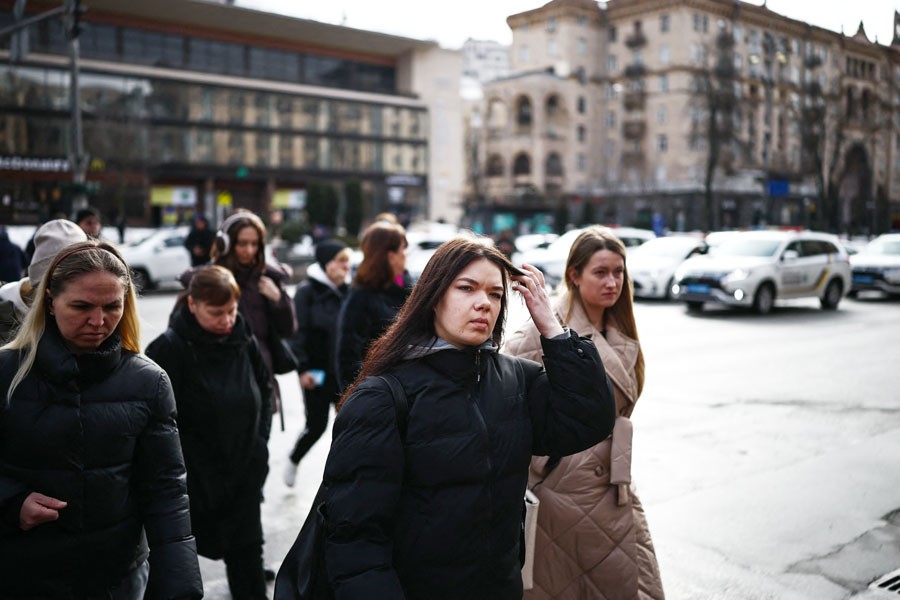
 Local residents cross the road near Independence Square in Kyiv on Tuesday on the fourth anniversary of Russia's invasion of Ukraine. — AFP
 GENEVA, Feb 24 (AFP/Reuters): Moscow voiced alarm Tuesday at Washington's assertion it will resume nuclear testing to match alleged secret explosions by China and Russia, warning such a move would spark a dangerous "domino effect".
Speaking before the Conference on Disarmament in Geneva, Russian ambassador Gennady Gatilov decried US President Donald Trump's announcement last year that his country was prepared to stage its first nuclear test since 1992.
"We warn that the US withdrawal from its national moratorium would trigger a domino effect," he said, speaking through a translator, stressing that "the responsibility for the consequences would rest entirely with Washington".
Christopher Yeaw, the US assistant secretary of state for arms control and nonproliferation, indicated last week that Trump was serious when he said in October that the United States would resume nuclear testing.
"As the president has said, the United States will return to testing on a-quote-'equal basis,'" Yeaw said at the Hudson Institute think tank.
He stressed that "equal basis doesn't mean we're going back to Ivy Mike-style atmospheric testing in the multi-megaton range", referring to a massive 1952 thermonuclear detonation in the South Pacific.
"Equal basis, however, presumes a response to a prior standard. Look no further than China or Russia for that standard," he said.
He did not announce a timing for a new test, saying Trump would make a decision, but that any test would be at a "level playing field."
Before the Conference on Disarmament on Monday, Yeaw doubled down on US accusations of Chinese secret nuclear tests.
The Kremlin said on Tuesday that Western countries' decision to intervene in the conflict in Ukraine meant it had become a much wider confrontation with nations that Russia believed want to crush it.
Speaking exactly four years after tens of thousands of Russian troops entered Ukraine on President Vladimir Putin's orders, Kremlin spokesman Dmitry Peskov said the fighting continued, but that Moscow remained open to achieving its aims through political and diplomatic means.
"Following the direct intervention in this conflict by Western European countries and the United States, the special military operation de facto turned into a much larger confrontation between Russia and Western countries, which had and continue to harbour the goal of destroying our country," said Peskov.
Asked whether Moscow believed the conflict could be resolved through talks, Peskov said: "We are continuing our efforts to achieve peace, our position is very clear and consistent. Now everything depends on the actions of the Kyiv regime."
© 2026 - All Rights with The Financial Express